Dhaka shifts focus to monorail as metro plans stall

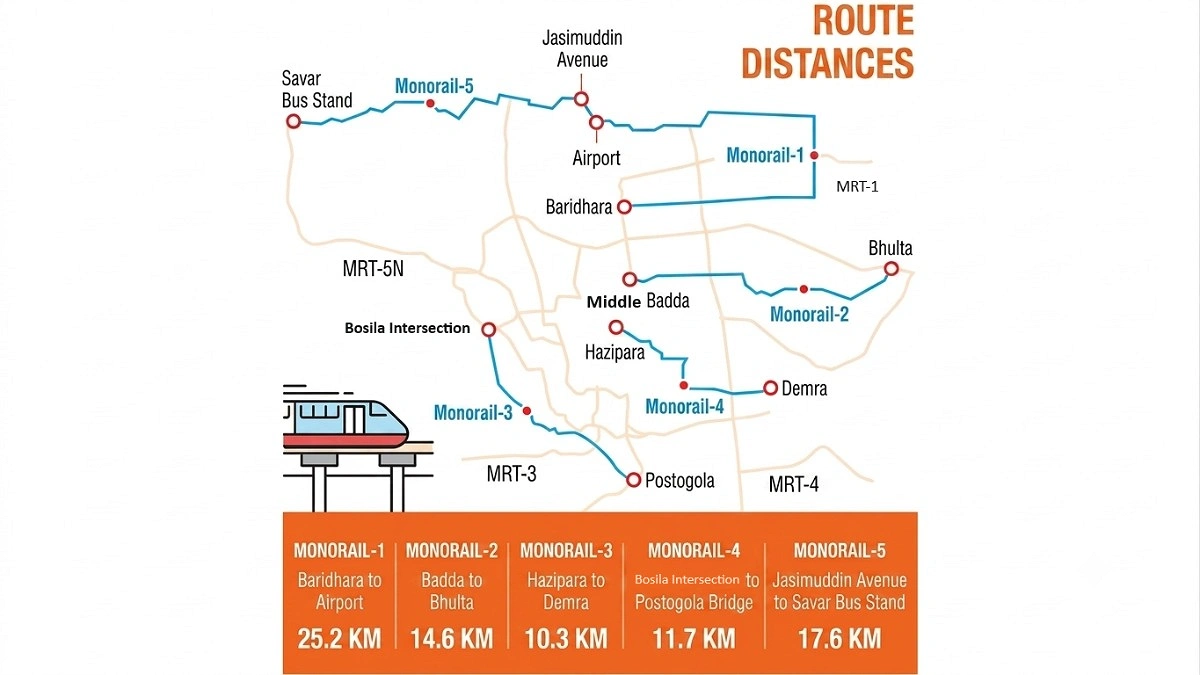
Graphics: Agamir Somoy
The government’s attention shifts to the monorail, even as the Motijheel-Kamalapur route - the only one of six planned metro lines to see any real progress - remains unfinished and other lines have largely stalled.
Strategic Transport Plan (STP) was finalized as the Revised Strategic Transport Plan (RSTP) in 2015 to remain effective until 2035. Dhaka Transport Co-ordination Authority (DTCA) is amending it once again to incorporate the monorail under a project titled “Updating the Revised Strategic Transport Plan for Dhaka”.
The updated plan proposes the construction of five monorail routes to ease communication between Dhaka and its surrounding regions and is expected to be presented for Cabinet approval soon, sources confirmed to Agamir Somoy.
Initial work for the monorail has already begun, with plans to bring surrounding areas like Savar and Bhulta under its network.
Construction will initially start with two routes, and the Bangladesh University of Engineering and Technology (BUET) has been tasked with the preliminary feasibility study. Station locations and estimated construction costs will be determined after the initial survey.
On the other hand, work on two ongoing underground metro lines appears to have stopped. Kajima Corporation, a Japanese firm involved in the construction of Metro Rail Line-1, has already departed, saying they will no longer work on the project.
Agreements with other construction firms have also not been finalized within the stipulated timeframe. Similar stagnation affects Metro Rail Line-5 (North), intended to run from Hemayetpur to Vatara via Gabtoli and Mirpur-10.
Meanwhile, Metro Rail Line-5 (South), planned from Gabtoli to Dasherkandi via Rasel Square and Aftabnagar, is nearly on the verge of cancellation. This stagnation, which began during the interim government’s tenure, has caused dissatisfaction among investors and contractors.
The government argues that implementation cannot proceed without reducing the high construction costs.
Transport and communication experts believe that losing momentum on large-scale projects due to political considerations ultimately results in a loss of public funds. They argue that if all governments maintained a consistent policy for major planning, the public would reap the true benefits, and shifting from metro to monorail may not yield fundamental results.
However, State Minister of Road Transport and Bridges Habibur Rashid explicitly said metro and monorail are not in conflict.
Responding to questions from Agamir Somoy, he said, “It is true the government is moving forward with monorail work. But the metro work will also continue. Metro and monorail are not conflicting; rather, they are complementary.
We want to ensure a passenger can get off the metro and board a monorail. A strong public transport network will be built by blending metro and monorail.”
In contrast, architect and urban planner Iqbal Habib views the monorail as “ambitious” for Dhaka’s existing transport system. He added, “The failure to implement the design prioritizing public transport in the RSTP and the inability to launch projects like Bus Route Rationalization is a major failure.
“Implementing a monorail to serve a few people through over-investment is a farce that needs no proof. In a city burdened by the miserable state of public transport, the idea of suddenly adding a new vehicle while ignoring buses is merely a tendency to show off development.”
What is a monorail?
A monorail is a rail-based mass transit system that runs on a single concrete or steel beam rather than two parallel tracks. The name comes from “mono” (one) and “rail”.
There are generally two types of technology: the “straddle-beam” method, where the train straddles the beam, and the “suspended” method, where the train hangs below the beam. Most global monorail projects currently use straddle-beam technology.
Key features include being entirely elevated, which minimizes road occupancy, avoids traffic congestion, and requires less land acquisition in densely populated cities. Being electric, it also causes less noise and air pollution.
However, it has limitations: lower passenger capacity compared to the metro, complex route expansion, and high maintenance and construction costs due to specialized technology. Consequently, it is considered most suitable for congested or highly populated urban routes.
Monorails are used effectively in countries like Japan, China, Thailand, Malaysia, the UAE, and Brazil. According to DTCA documents, the planned routes in Dhaka are:
- Route 1: From Jamuna Future Park (Baridhara) to Hazrat Shahjalal International Airport (25.2 km). Though the direct distance is only 7 km, the route will cover 25 km as it winds through Bashundhara, 25 ECB Army Camp, Jalshiri (Sector-11), Purbachal CBD, Namapara Road, Ashiyan City, Dakshinkhan, and Haji Camp.
- Route 2: From Middle Badda Bazar to Bhulta (14.6 km) via Satarkul, Sun Valley Housing, Kayetpara, Murapara, and Majipara.
- Route 3: From Hajipara to Demra (10.3 km) via South Banasree, Nandipara, and Dakshingaon.
- Route 4: From Bosila Intersection to Postogola Bridge (11.7 km) via Rayerbazar, Hazaribagh, Kamrangirchar Bridge, and Babubazar Bridge.
- Route 5: From Jashimuddin Avenue to Savar Bus Stand (17.6 km) via Uttara Center, Birulia Bridge, Akrain Bazar, and Rajashon.
Uncertain future for metro lines
State Minister Habibur Rashid informed Agamir Somoy that the Roads and Highways Department (RHD) and BUET are conducting feasibility studies on selected routes, though nothing is finalized.
Meanwhile, plans for Metro Rail Line-2 and Line-4 have seen no significant progress and have seemingly been forgotten, making the original goal of launching six metro lines by 2030 unrealistic.
Amidst this, the Japanese Ambassador to Bangladesh recently wrote to the government urging the acceleration of JICA-funded metro projects. Japan is concerned that delays are increasing implementation time and project costs.
Communication expert and BUET professor Hadiuzzaman told Agamir Somoy, “Metro rail and monorail are not alternatives to each other but systems with different capacities. Metro rail acts as the backbone of urban transport by carrying many more passengers per hour.
“On the other hand, monorail is more effective for medium-pressure routes, airport connections, or feeder corridors. If funding, manpower, or administrative focus on metro projects decreases in favor of monorail projects, the capital’s integrated public transport plan may suffer in the long run.
“The test for the government now is to bring the slow metro projects back to speed while planning the monorail to serve as a complement, not a competitor.”