


Song of the Empty City...

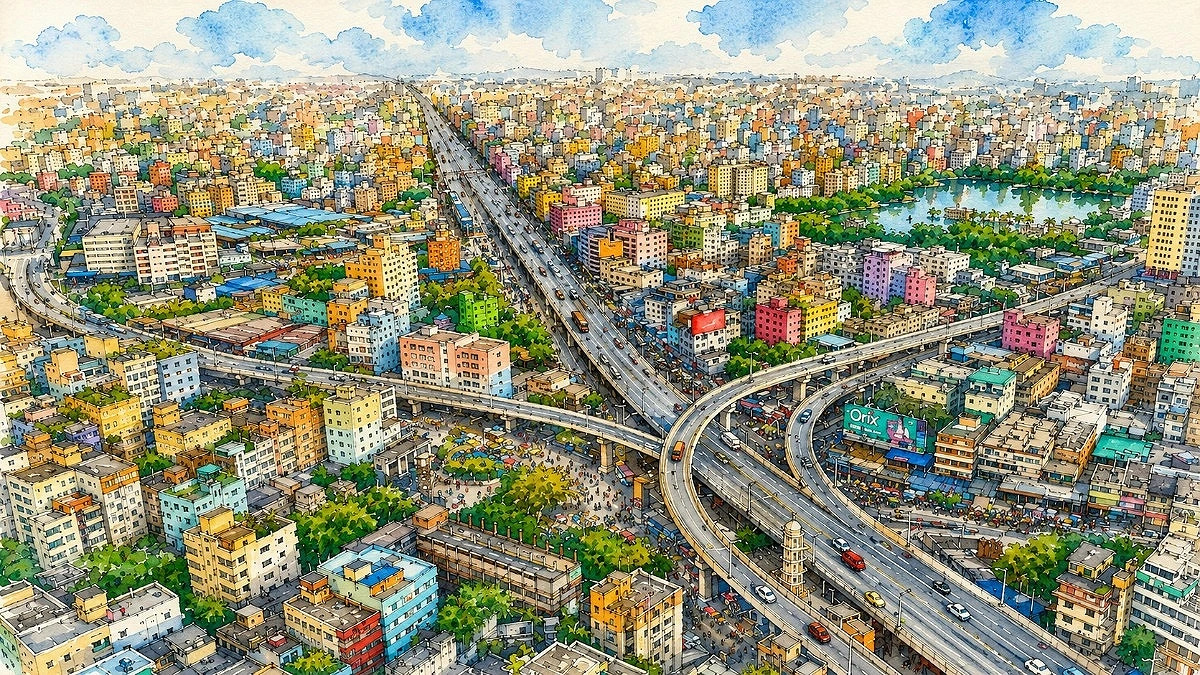
Graphics: Agamir Somoy
This city now celebrates its emptiness. During the long holiday break, its citizens have abandoned their daily dwellings and left for their own destinations. The streets lie empty. The shuttered shops resemble a sleeping kingdom from a fairy tale. Vast skyscrapers and office buildings yawn in idleness. During the daytime, the sun or rain crashes wildly and alone upon the roads of this empty city. Krishnachura (flame tree) flowers illuminate the deserted avenues, while lone evening jasmines bloom awake on some balcony.
The nights of this Dhaka city are also strangely desolate. The restless darting of headlights from a few fast-moving cars, the occasional harsh mechanical whine of a battery-powered rickshaw running continuously, the spread of streetlights cutting through the darkness – that is all. Then the city becomes quiet and silent. Only the whistle of a watchman, the solitary chatter of police on walkie-talkies, the lonely ramblings of a drunkard, a beggar with an empty bowl in front of a food shop – the kingdom of hunger, tearing aside the veil of urban solitude, wandering like a madman on the path.
The poet Federico García Lorca once called New York City a "Sleepless City" in his poetry. He saw that vast, sleepless city awake. Our city also does not sleep. Neither do its citizens. Some say, the more a city stays awake at night in the flow of life, the more modern it is. Is the life of this city modern? In its dumps accumulate remnants of jackfruit, food thrown away as garbage from wedding parties, the entrails of slaughtered animals. A cattle market effortlessly sets up in a metro station!
Our diverse, sleepless city has fallen asleep during the holiday break. One day, when an invisible magician touches it with his magic wand, counting the dates on the calendar, the stone statues will come to life and wake up.
People come to this city out of some need. Someone comes looking for work, someone seeking a job, someone chasing business, and perhaps someone searching for love. And as soon as they arrive, they become entangled, trapped in the city's life. The residents complain against the city all day long. There is a long list of dislikes in their minds. Yet, despite everything, we love this city. Inside the emptiness, inside the solitude, inside the profound silence, when the city sits with its face hidden, we feel a strange tenderness. It feels as if the complaints are like love letters never dropped into a mailbox – they are but the citizens' marks of love for this city.
The city is not neutral toward people. Its very trade is with people. Someone's cup fills with pain, someone else's with joy. Sometimes a melancholy raga (Behag) plays, other times a triumphant one (Joyjoyanti). The city remains static – its roads, alleys, skyscrapers, its garbage, its beauty, its problems and solutions accumulate in everyday stories. Amidst all this, the city's residents live and die.
That sleepless city, that city crushed by its own bustle – when it suddenly catches the holiday breeze and falls asleep, it feels like an unknown land beside a new river. No noise, no sky-piercing horns of vehicles, no quarrels, no red-hot angry glances, no crowds of people on the streets. Only solitude has come to occupy urban life.
How many people leave the city during such long holidays? The media reports that citizens are rushing toward their roots. Do no roots ever become entrenched in this city? Perhaps not. The city is used only out of necessity. Returning to their relatives at rural addresses, these citizens want to forget the city and its ruthless life. Does the city only spread cruelty and ruthlessness? Is the city only a story of a gray, monotonous life? Who has ever tried to understand the city's tears, its sulks, its joys, where and when? Yet, everyone returns to this indifferent expanse of the city; necessity brings them back. Perhaps that is why, when we see this city, worn out by mere use, left alone from time to time, a wave of unfamiliar sorrow rises in our minds. None of us hear the song of that lonely city.

