

Water crisis in Mirpur triggers desperation

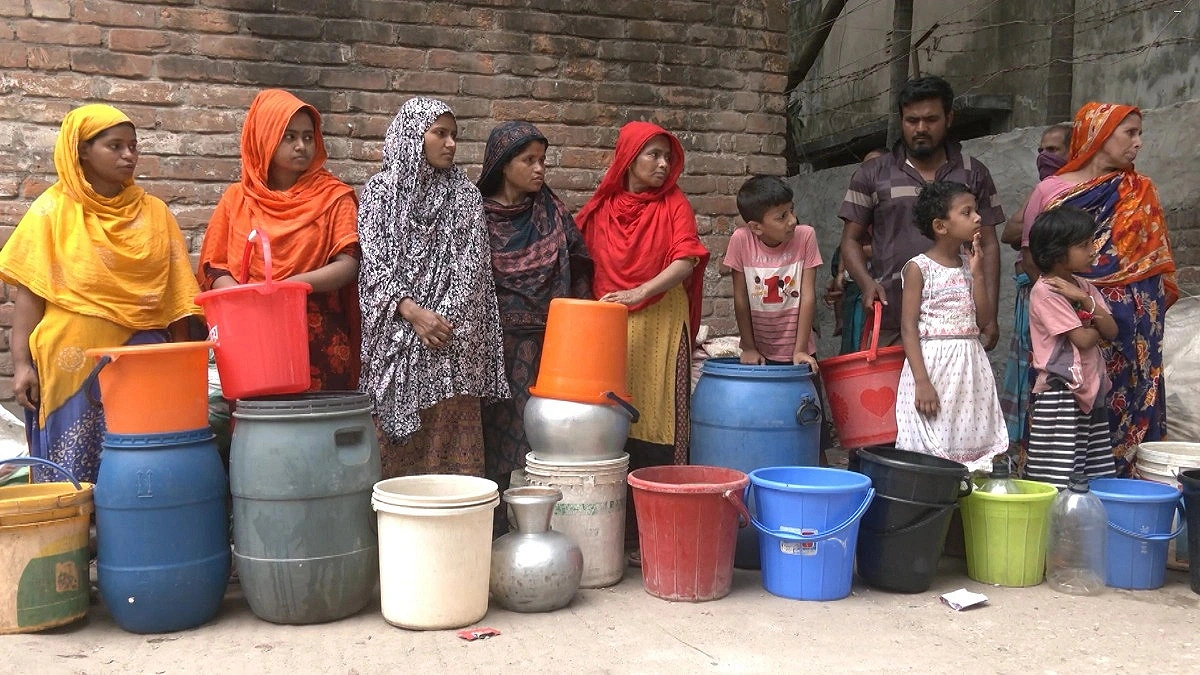
People form long queue to get water at a undisclosed Mirpur location. Photo: Collected.
"We can manage for a few days without gas by buying food from shops. But without water, we can't do anything. Right now, we can't get water even if we pay for it." – These words were spoken with intense anger by Nazrul Mia, a resident of the Shewrapara vicinity in the capital.
Masud Rana residing in the same area also spoke about the water shortage. He said since June 20, a water crisis has been affecting Shewrapara, Kazipara, Mirpur-2, Mirpur-11, and surrounding neighbourhoods. As a result, residents have been scrambling for water for the past week.
Locals say that after the Metro Rail started operating, the number of multi-storey buildings and population of Mirpur area has increased significantly. However, Dhaka WASA has not increased water supply proportionally. Consequently, many areas are not getting water for long periods. To meet daily needs, residents have to collect water from distant sources, leading to a huge waste of time and money, along with unbearable suffering.
"I have a spinal problem, and my doctor has strictly forbidden me from carrying anything heavier than 5 kg. My wife is also unwell, so we are in great distress. Earlier, when such a crisis hit, we would store water in drums. But this time, due to illness, I couldn't store water. Hauling water up to the fifth floor every day has become a living nightmare for us," said Nazrul.
Dulal Mia, who sells football jerseys near Sheorapara Metro Station, shared a litany of complaints with the correspondent. He said, "If we can't even drink proper water, what's the point of living in this country? I've been staying at my sister's house for about a week now. But how long can I keep doing that? Even when trying to buy water, they are charging exorbitant prices. Something has to be done about this."
According to Dhaka WASA, under normal conditions, about 12 crore (120 million) litres of water are supplied daily to the Mirpur area from the Bhakurta treatment plant in Savar. However, on June 20, a fault developed in the plant's transformer and generator. Only 7 crore litres were supplied that day. For the next two days, 10 crore litres were supplied each day. As a result, over these three days, a total of 9 crore litres less water was supplied compared to the normal supply.
WASA officials said that the water from Bhakurta primarily goes to the greater Mirpur area. Therefore, even a slight shortfall in supply puts immense pressure on Sheorapara, Kazipara, Monipur, and surrounding areas. Areas that already had lower supply relative to demand have faced an even worse situation.
Mirpur neighbourhoods that are facing water crisis, falls under the jurisdiction of WASA's Mods Zone-4. The Executive Engineer there, Md. Imdadul Haque, said, "As soon as the crisis began, some families started storing extra water, which further intensified the shortage. We are currently installing a deep tube well in Shewrapara area. We hope that once this work is completed, the water crisis will be resolved."

