


The Services You Get in Dhaka for 100 Taka...

Drawing: Arabinda
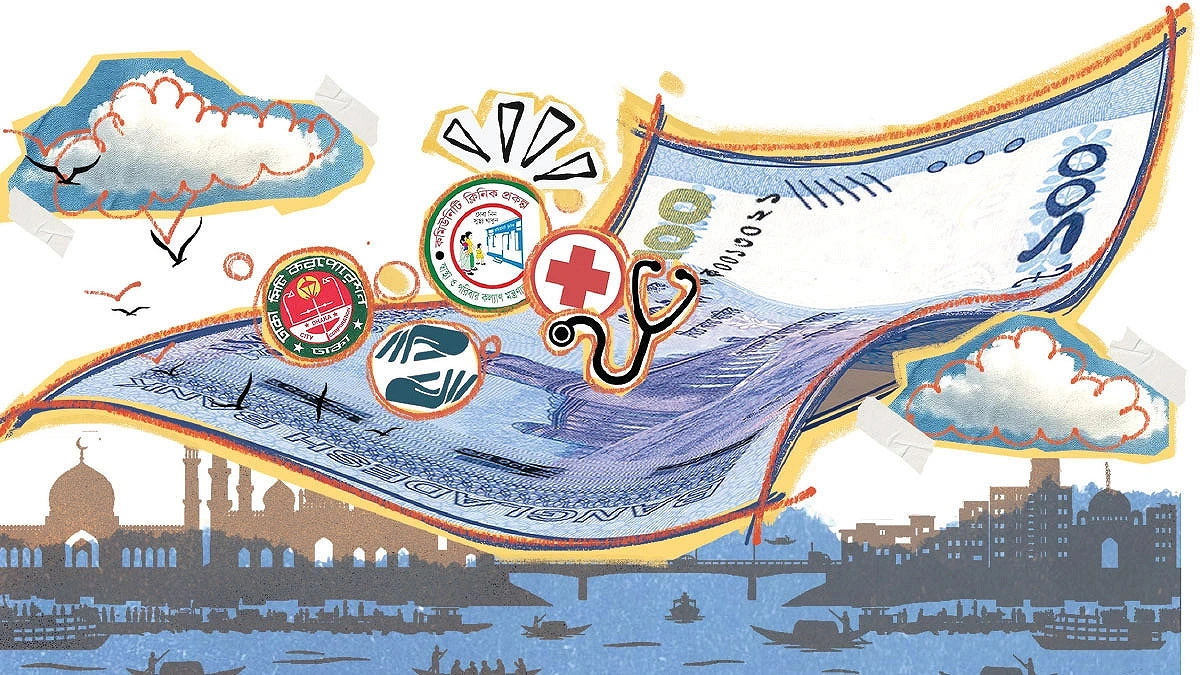
Many people believe that 100 taka is not enough to get anything in Dhaka. But the reality is quite different. The city’s two corporations provide nearly 100 services to residents for 100 taka or less. More than 90 of these are health-related services, while the rest are general civic services.
During last Eid-ul-Fitr, a young worker named Borna hoped to receive 500 taka as Eid salami from her employer. Despite repeated requests, she was given only 100 taka. Disappointed, she remarked that nothing can be bought in Dhaka for 100 taka anymore. Her frustration reflects a common perception, but the range of public services available challenges that idea.
Civic services at minimal or no cost
Birth registration certificates cost 50 taka, but are issued free of charge if registered within 45 days of birth. Character certificates and death certificates are provided completely free. These services are available at all ward and regional offices of the two city corporations.
A wide network of health facilities
Dhaka North City Corporation operates 36 health service centers, including 30 primary healthcare centers and six maternity centers. Dhaka South City Corporation runs 40 facilities, comprising 31 primary healthcare centers, six maternity centers, and three hospitals.
Maternity centers remain open 24 hours a day. Primary healthcare centers operate from 8:00 am to 2:00 pm and remain closed on Fridays and public holidays. These facilities are heavily used by low-income and lower-middle-income residents. For the extreme poor, up to 30 percent of patients receive services at the lowest possible cost through special red card facilities.
Medical care for just 100 taka
At these centers, patients can consult an experienced MBBS doctor for only 100 taka. A variety of essential tests are also available at the same or lower cost, including routine blood tests, basic eye examinations, and cervical cancer screening. Blood sugar and routine urine tests, which help detect diabetes and kidney complications at an early stage, cost just 60 taka.
In addition, children receive 10 essential vaccines under the Expanded Programme on Immunization (EPI) completely free of charge. Costly tests such as dengue diagnostics are also provided at no cost.
Quality services, limited awareness
According to the chief health officer of Dhaka North City Corporation, the goal is to bring quality primary healthcare to residents’ doorsteps. The focus is on ensuring that low- and middle-income families can access specialist consultations and necessary diagnostic tests within a 100 taka budget—services that are far more expensive in the private sector.
Despite the affordability and range of services, the number of people using these facilities has not increased.
According to Dhaka South City Corporation (DSCC) health officer Dr. Nishat Parvin, access to various health services for city residents has now been made much easier and more affordable. She said they are strictly monitoring the system to ensure that service recipients receive these services without any harassment, adding that there are plans to further expand the scope of services in the future.
City residents, however, rarely seek out low-cost services. Sayra Banu, who lives beside a ward commissioner’s office in Shukrabad, does not even know where the health center is located. The woman in her sixties said, “If I had known, would I have spent so much money seeing private doctors?”
This lack of awareness among city residents has also been highlighted by public health experts. Dr. Benazir Ahmed said, “Many people still do not know that such excellent services are available at such low cost or even free. For these initiatives to succeed, extensive publicity and outreach are necessary.”
After a brief pause, the public health expert added, “These low-cost health services run by Dhaka’s two city corporations are truly commendable.”

