

Flash floods inundate 212 villages in Banshkhali

Agamir Somoy image regenerated by AI.
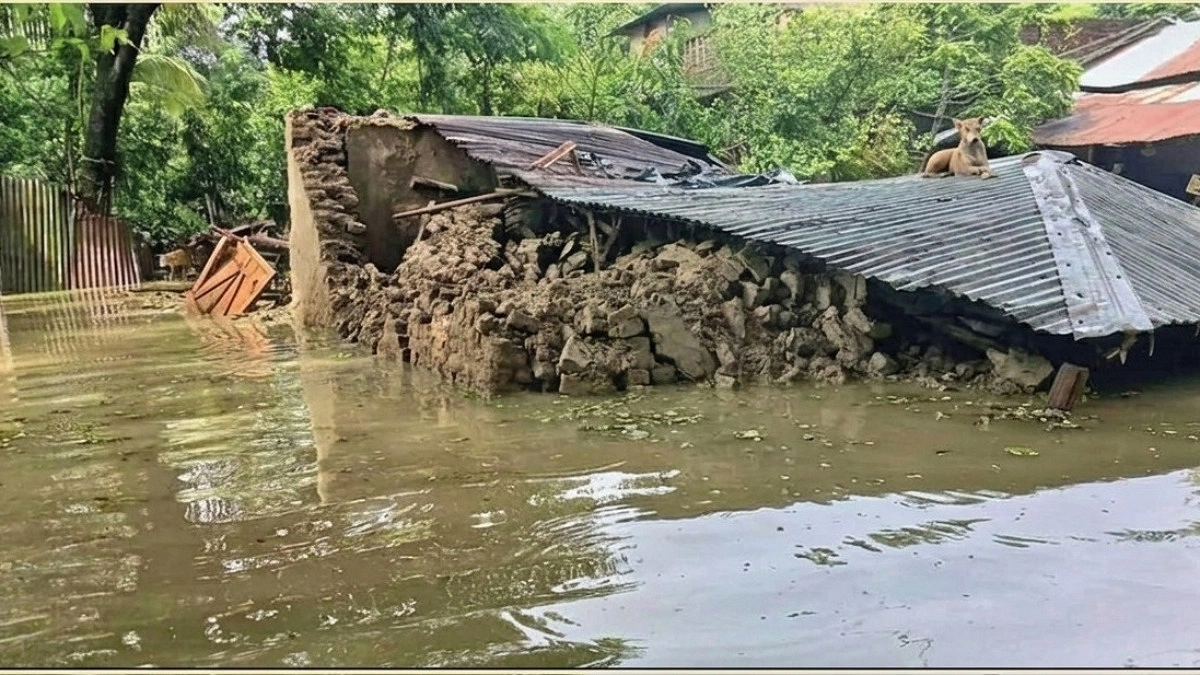
A night of fear turned into a morning of devastation for residents of Banshkhali as flash floods triggered by hill runoff left vast areas of the upazila submerged.
Mohammad Riyad, a resident of Banshkhali village, sent the women and children of his family to relatives' homes before the flooding intensified. The men stayed behind, spending the entire night awake as the sound of collapsing mud houses echoed through the darkness.
"I couldn't sleep all night. All we heard was the sound of mud houses collapsing," Riyad said. According to him, around 90 to 95 percent of the homes in Banshkhali village, except for concrete buildings, are now underwater, with floodwaters ranging from waist-deep to neck-deep.
The devastation extends far beyond a single village. Most of the 212 villages across all 15 unions of Banshkhali upazila are now inundated. According to the latest census, the upazila has a population of 490,777, including around 245,000 women and 206,091 children and adolescents. It has a total of 101,543 households, a large number of which remain stranded by floodwaters.
The sudden surge of water from the surrounding hills caught residents off guard, leaving them with no time to prepare. Tube wells have been submerged, creating an acute shortage of safe drinking water, while many families are running out of dry food supplies. Mud houses have collapsed one after another, and stored rice, paddy, and household belongings have been washed away.
Electricity has remained unavailable for several days, while many residents have lost communication with the outside world after their mobile phone batteries ran out. Part of the Banshkhali–Chattogram main road has been damaged, ponds and fish farms have been washed away, and many families have lost their poultry. Families with sick members and pregnant women are facing the greatest hardship. Anxiety has intensified further after sections of the coastal embankment along the Bay of Bengal reportedly collapsed.
Parvez Chowdhury, a resident of Ratnapur village, said the scale of flooding was unprecedented.
"We live in a coastal area where floodwater usually drains away quickly. I've never seen this much water enter our homes in my lifetime. Everyone is stranded, and houses are flooded," he said.
Abdullah Al Momen, a resident of Dighirpar in Baharchhara village, briefly thought conditions would improve when the rain stopped in the morning.
"I hoped the water would begin to recede after the rain stopped, but it started raining again. My pond is underwater and the fish have escaped. There is knee-deep water on the road," he said.
Former union parishad member Kamrul Alam Chowdhury of Ilsha village said most homes in Baharchhara Union are now submerged.
"Residents of concrete buildings are relatively safe, but tin-roofed, bamboo and mud houses are completely surrounded by water. The floodwater is not receding—it's continuing to rise," he said.
Not everyone has been affected equally. Zulekha Akter, a resident of Sadhanpur village, said her homestead is on slightly higher ground, so floodwater has not yet entered her house. Even so, she remains anxious as nearly all surrounding homes have been flooded, and fresh rainfall has raised fears that her home could soon be inundated as well.
Mohammad Ilias, a teacher at Anwarul Ulum Madrasa in Chhanua village, said the Jalakadar Canal is the main drainage channel for western Banshkhali. According to him, the canal has been encroached upon and filled in over the years, while sluice gates have become inoperative. In addition, embankments built for fish enclosures at various locations have blocked the natural flow of water, leaving the entire area submerged.
"Road transport has come to a standstill. Amid this crisis, a woman in labor had to be taken to hospital on a van this morning," he said.
Eight-Month-Old Baby Rescued in a Cooking Pot
Amid the widespread suffering, a remarkable rescue operation has captured public attention.
At around 8:30 pm on Wednesday, an eight-member team from the Banshkhali Fire Service rushed to the Chechuria Bridge area after receiving reports of residents trapped by floodwaters. Wading through neck-deep water, the rescuers evacuated five children and eight women before moving them to a nearby emergency shelter.
A 21-second video of the rescue has since gone viral on Facebook. The footage shows a firefighter carefully making his way through neck-deep water while holding a rope in one hand and carrying a large cooking pot in the other. Inside the pot was an eight-month-old baby. Another firefighter walked beside him, holding an umbrella over the pot to shield the infant from the rain.
Mizanur Rahman, an officer at the Banshkhali Fire Service Station, said firefighters launched the rescue operation immediately after receiving reports that residents were stranded. The infant was safely transported to higher ground inside the large cooking pot as part of the emergency evacuation.

