

Metro Rail, Monorail Plans at Odds Amid Policy Dispute

Collected Photo
Government agencies are at odds over plans to implement a Mass Rapid Transit (MRT) system to improve public transportation in the port city of Chattogram. While the Dhaka Transport Coordination Authority (DTCA) has spent the past three years assessing the feasibility of a metro rail system in the city, the Chattogram City Corporation (CCC) has independently moved forward with a Tk 30,000 crore monorail project. The city corporation has already signed a memorandum of understanding (MoU) with a foreign company in this regard.
Amid the dispute, one side argues that Chattogram is unsuitable for metro rail due to infrastructure constraints, while the other maintains that a monorail will do little to ease the city’s mounting traffic congestion.
According to the competing claims, a monorail would carry 18,000 passengers a day, whereas a metro rail system would transport between 650,000 and 1.1 million passengers daily.
Transportation experts, however, have described the competing proposals as an example of ‘mega-project obsession’. They argue that neither a metro rail nor a monorail project, costing between Tk 30,000 crore and Tk 50,000 crore, is necessary for Chattogram. Instead, they say the city could achieve a lasting solution to traffic congestion by overhauling its traffic management system and existing bus routes at a cost of only around Tk 1,000 crore.
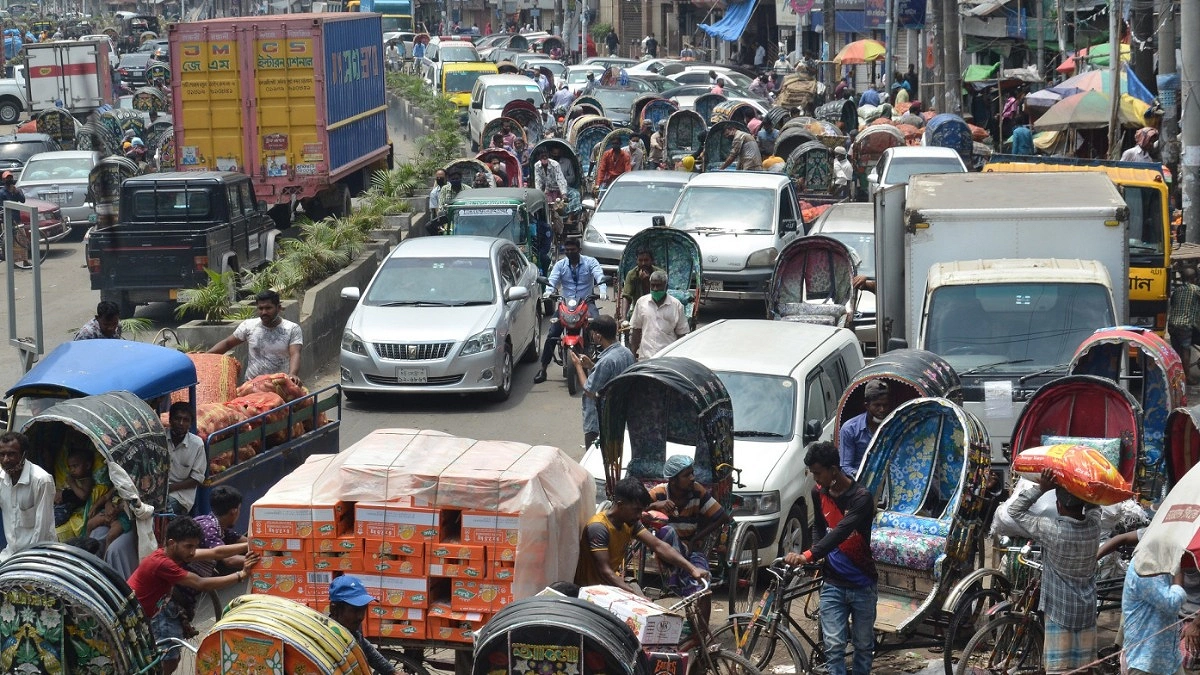
A master plan prepared by the World Bank in 2018 warned that if no immediate action is taken, the average speed of traffic in Chattogram would fall from 11 kilometers per hour to just 7 kilometers per hour by 2030, almost equivalent to walking speed. Rather than pursuing mega projects, the plan recommended introducing Bus Rapid Transit (BRT) or dedicated bus-priority lanes, developing pedestrian-friendly sidewalks, modernizing 49 major intersections and junctions, bringing fragmented bus operators under larger companies, and establishing an independent Public Transport Authority (PTA).
Referring to findings from previous studies, Professor Dr. Muhammad Rashidul Hasan, Dean of the Faculty of Architecture and Planning at Chittagong University of Engineering and Technology (CUET), said, “Metro rail or monorail systems become necessary when passenger movement reaches 50,000 people per hour. Currently, Chattogram handles around 17,000 passengers per hour. Under these circumstances, the need for expensive projects such as metro rail or monorail is very limited. We need to move away from the culture of implementing costly projects.”
The government planned to build a metro rail system in the commercial capital of Chattogram. To conduct a preliminary study before launching the service, it approved a Tk 70 crore project. Funded by the Korea International Cooperation Agency (KOICA), the project received approval in November 2022, and authorities have extended its duration until December this year.
The DTCA has identified six routes to connect different parts of the city, with the Kalurghat-Airport corridor emerging as one of the most important. In 2024, an average of 140,000 vehicles used this nearly 25-kilometer corridor every day, carrying about 290,000 passengers.
According to preliminary findings from the DTCA’s pre-feasibility study, the number of vehicles on the route will rise to 247,000 by 2041, while daily passenger traffic will reach 512,000. This figure would exceed the corridor’s capacity for vehicles, passengers, and freight movement by 66 percent. As a result, the entire corridor could become dysfunctional by 2041 without a major transport project, with the volume-to-capacity ratio reaching 1.66. The report states that MRT, or metro rail, could play the most effective role in addressing the severe traffic congestion.
The study also shows that a metro rail system would reduce traffic pressure on the main corridor by 58 percent. Consequently, the congestion index would drop from 1.66 to just 0.70. The system would remove approximately 142,000 vehicles from the road each day and allow 209,000 passengers, representing 42 percent of total passengers, to travel rapidly above or below ground.
By contrast, the proposed monorail would fail to resolve the crisis, according to the study. Its projections indicate that even after spending Tk 30,000 crore to build the monorail, the congestion index would remain above 1.0, the threshold for traffic breakdown. Under traffic engineering standards, a congestion index of 1.0 or higher means a road has effectively become inoperable.
Mir Mohammad Kamrul Hasan, project director and traffic engineer at the Dhaka Transport Coordination Authority (DTCA), said, “We recently presented data at a meeting showing that a monorail would not be effective in Chattogram. Moreover, the construction of flyovers along the city’s main roads leaves no room for a monorail. That is why we are examining through our study whether an underground metro rail system would be feasible.”
On the other hand, the Chattogram City Corporation signed an MoU on June 1 last year with the Arab Contractors and Orascom Peninsula Consortium to implement a monorail system in the city. It subsequently sought cooperation from the Bangladesh Investment Development Authority (BIDA), as well as the ministries of Road Transport and Bridges, Power, Energy and Mineral Resources, and Local Government, for feasibility assessment and project implementation. While BIDA and the Local Government Ministry approved further action, the city corporation received no response from the other two ministries. On May 5, Mayor Dr. Shahadat Hossain again wrote to the two ministries seeking their support. Most recently, on June 7, DTCA Executive Director Dr. Md. Mashiur Rahman visited Chattogram and held meetings with officials from the city corporation and the Chattogram Development Authority (CDA).
The city corporation argues that Chattogram is an old and densely populated city with limited available space. The city contains hills, canals, port facilities, and extensive utility networks, including gas, water, and electricity lines, both above and below ground. A metro rail system would require large-scale land acquisition, which would be difficult and socially sensitive. For that reason, the city corporation believes Chattogram needs a lighter, more flexible, and faster-to-implement rail system.
Abu Sadat Mohammad Taiyab, supervising engineer of the Chattogram City Corporation and spokesperson for the project, said, “Metro rail requires wide corridors, heavy construction work, and deep foundations, none of which are feasible in Chattogram. Flyover foundations already exist beneath the city’s main roads. If authorities attempt to build a metro system underneath them, the entire flyover could collapse. That is unimaginable. Monorails use narrow pillars and require very little road space. They can be built easily over narrow roads, canals, and hills. This is the practical solution.”
Meanwhile, the World Bank’s Strategic Urban Transport Master Plan for Chattogram, prepared in 2018, clearly states that the city’s traffic congestion does not stem from a shortage of roads. Rather, it identifies improper road use, indiscriminate parking, unsignalized intersections, and the lack of sidewalks as the primary causes of congestion.

