
2007 Disaster Record Surpassed as Rainfall Hits New High

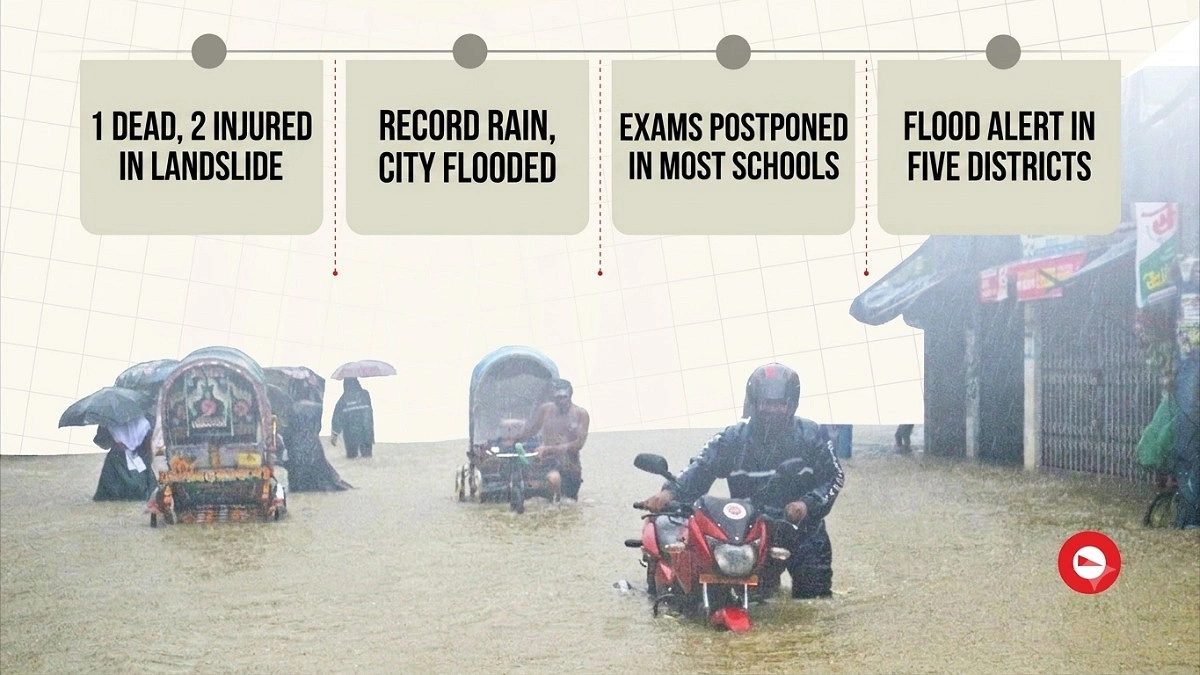
Photo: Agamir Somoy
After a largely dry June, heavy rainfall has dominated the first week of July. A low-pressure system over the sea later intensified into a monsoon depression, triggering continuous rain over the past three days. The downpour has matched warnings issued by the Bangladesh Meteorological Department and shattered several rainfall records on Tuesday.
Chattogram recorded 412.3 millimeters of rainfall in the 24 hours ending at 3 pm Tuesday. The city has not seen such rainfall in recent history. Many residents have compared the downpour to a cloudburst.
A cloudburst is generally defined as more than 100 millimeters of rain falling within an hour over a small area of about 30 square kilometers. However, Tuesday's rainfall in Chattogram was marked by uninterrupted rain that began before dawn and intensified throughout the day. Rainfall reached 330.8 millimeters by 9 am and 386.8 millimeters by noon before crossing the 400-millimeter mark later in the day.
The rainfall surpassed the record associated with the June 11, 2007 disaster in Chattogram. Heavy rain, flash floods from the hills, and landslides killed 127 people that day. The city recorded 408 millimeters of rainfall in 24 hours, a figure long associated with one of the area's worst natural disasters. Tuesday's rainfall exceeded that mark by recording more than 412 millimeters within 24 hours.
In recent years, heavy rain and hill runoff triggered flooding in Chandanaish and Satkania on August 7, 2023. The Chattogram-Cox's Bazar railway line had recently been completed and was awaiting inauguration at the time. Flooding caused by rain and runoff bent nearly three kilometers of the newly built railway track.
Rainfall on that day reached 322 millimeters in 24 hours, nearly 90 millimeters less than Tuesday's total. Rain also fell in neighboring Bandarban district, east of Satkania, and runoff from the hills there contributed to the flooding.
In 2012, another major landslide disaster struck Chattogram on June 26, in the Akbar Shah Mazar area of the city, killing 28 people. The city recorded 463 millimeters of rainfall in 24 hours that day, nearly 50 millimeters more than Tuesday's total.
On June 13, 2017, landslides killed nearly 150 people in Rangamati, Bandarban, Khagrachhari, and Chattogram. Chattogram recorded 177 millimeters of rainfall in 24 hours that day. Rangamati reported the highest death toll.
Despite Tuesday's record-breaking rainfall in recent history, the all-time highest 24-hour rainfall recorded by the Chattogram Weather Observatory remains 511 millimeters. In 1983 the observatory recorded that figure on August 4. Tuesday's rainfall was therefore nearly 100 millimeters lower than the all-time record.
The current monsoon season began with a severe rainfall deficit in June. The month received 44 percent less rainfall than normal. Chattogram recorded 351 millimeters of rain against the normal June average of 613 millimeters.
The normal rainfall for July is 694 millimeters. Tuesday's rainfall alone exceeded half of that monthly average.
The downpour inundated roads, shops, and residential areas across the city. Waterlogging affected Kapasgola, Katalganj, Bahaddarhat, Moulovipukur Par, Panchlaish Residential Area, Chandgaon, Agrabad Bank Colony, and CDA Residential Area, among other neighborhoods. Water also accumulated on the Chattogram-Hathazari Road.
One person died and two others were injured in a landslide in the Rahman Nagar area of the city. Residents have been enduring severe hardship due to widespread waterlogging.
Lt. Col. Mohammad Mohsinul Haque Chowdhury, director of Chattogram's waterlogging mitigation project, attributed the situation to the large volume of rainfall within a short period.
He said Chattogram received 546 millimeters of rainfall between July 5 and July 7. The drainage project was designed to handle up to 500 millimeters of rainfall. He added that although excessive rainfall may cause temporary water accumulation, the water should drain away within one to two hours.
