

Adamdighi of Bogura
Rice husking mills decline, unemployment rises
- Only 90 of Adamdighi husking mills out of 232 are operational
- 5,000 workers now jobless due to the closure of 142 mills
- Unable to compete with automatic mills
- Unemployed workers living subhuman life, forced to switch professions

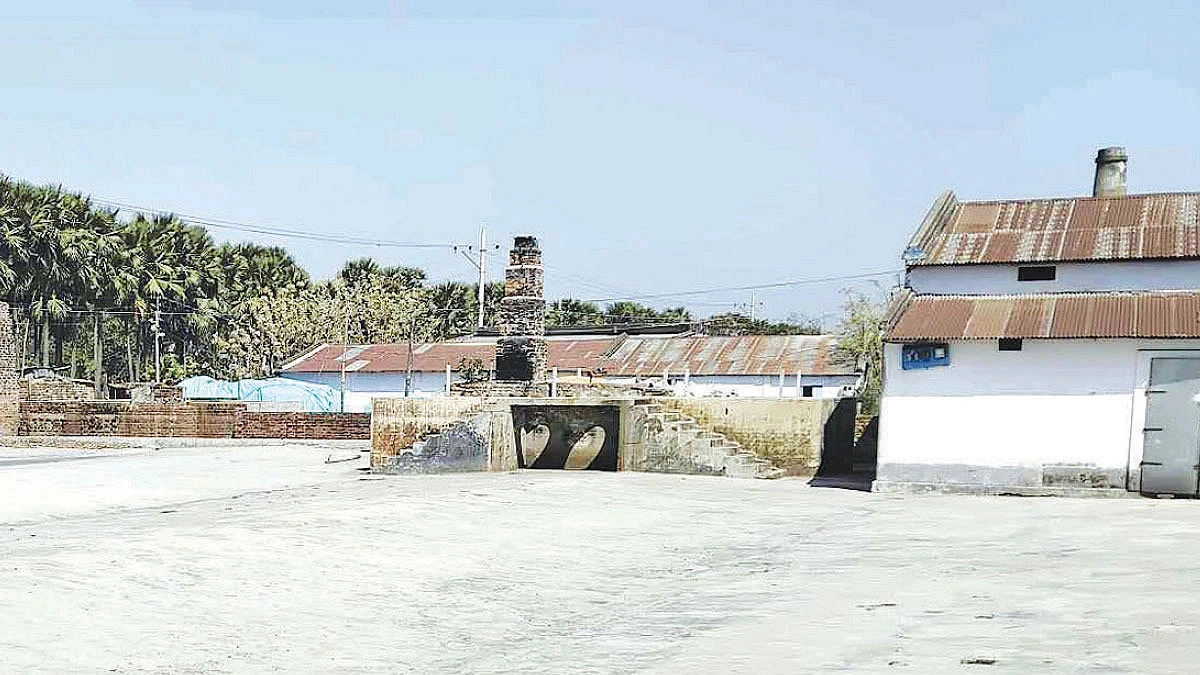
Currently, 90 conventional and 13 automatic rice mills are operational in the upazila. Photo: Agamir Somoy
Years of continuous losses have forced the closure of 142 rice mills (husking mills) in Adamdighi Upazila of Bogura. The upazila once had 232 conventional rice mills in total. This year, only 90 husking mills are supplying rice to the government under contract. At present, the upazila has 90 operating conventional mills and 13 automatic rice mills.
With most mills shut down, nearly 5,000 workers linked to the sector have lost their jobs and are now unemployed, struggling to survive with their families.
According to inquiries, Adamdighi—being a paddy-rich area and home to the country’s largest food storage facilities, the Santahar CSD and Silo—saw a boom in rice milling businesses since 1990s onward. Many entrepreneurs even set up mills on cropland. Attractive profits sustained expansion of husking mills for years, but the momentum eventually stalled. After 2000, automatic rice mills began to proliferate in the area. These mills can produce rice directly from raw paddy quickly, without parboiling and drying. As a result, conventional mills started shutting down one after another.
Explaining the reasons, Santahar-based rice mill owner Matiur Rahman said his conventional mill can process 154 tonnes of paddy in 15 days, requiring 140 sacks per day (each sack weighing 75 kg). In contrast, the automatic Baishakhi Rice Mill can process 48,000 tonnes of paddy in 15 days across three units, needing over 3,000 tonnes of paddy per day. Unable to compete with this vast production gap, conventional mills have steadily closed.
Describing their precarious situation, he said: “For various reasons, we can’t compete with automatic mill owners. One key factor is the rice recovery ratio. Conventional mills yield 25 kg of rice per maund of paddy, while automatic mills yield about 28 kg per maund. The bran and husk from conventional mills fetch very low prices. But automatic mills produce about 40 sacks of rice bran from 600 maunds of paddy, each 50-kg sack worth around Tk 2,000. Since rice bran is used to make edible oil and feed for fish and livestock, demand is high. Moreover, automatic mill owners get large bank loans at low interest, allowing them to buy and stockpile paddy right after harvest—something we cannot do.”
Another mill owner, Mostafizur Rahman, highlighted the losses: “Paddy prices are high right now, so producing rice is not profitable. We incur losses every year—about Tk 150 to Tk 200 per maund.”
He added: “More than 150 rice mills have shut down. Thousands of workers have lost their jobs and are now unemployed, living in dire conditions.”
Rehana Begum, a female worker affected by the closures, shared her hardship: “With the mill closed, I’m completely unemployed. Some days we eat once, other days not at all. Some people are leaving to find other work.”
Acknowledging the trend, Abul Basar, Adamdighi Upazila Food Officer, said: “Conventional rice mills are closing due to the rise in automatic mills, higher paddy prices, and loss of capital, among other reasons.”
According to the upazila food department, during the current IRRI-Boro season, the target is to procure 1,197 tonnes of paddy and nearly 15,500 tonnes of rice. The department expects to meet 100% of the procurement target this season. Most of the collected rice has been supplied by automatic mills, with the remainder coming from conventional mill owners.

