

Nearly 500 Factories Shut as Bangladesh Misses Export Goal

Graphics: Agamir Somoy
Global wars in the Middle East and Russia’s invasion of Ukraine have dragged the world into a prolonged economic recession, slashing demand for Bangladeshi ready-made garments (RMG) in key markets.
Factory owners struggle with crippling gas and power outages that disrupt production, while high-interest bank loans choke their finances. As a result, nearly 500 factories have already shut down.
Against the grim backdrop, experts said Bangladesh now stands little chance of hitting its $100 billion garment export target by 2030.
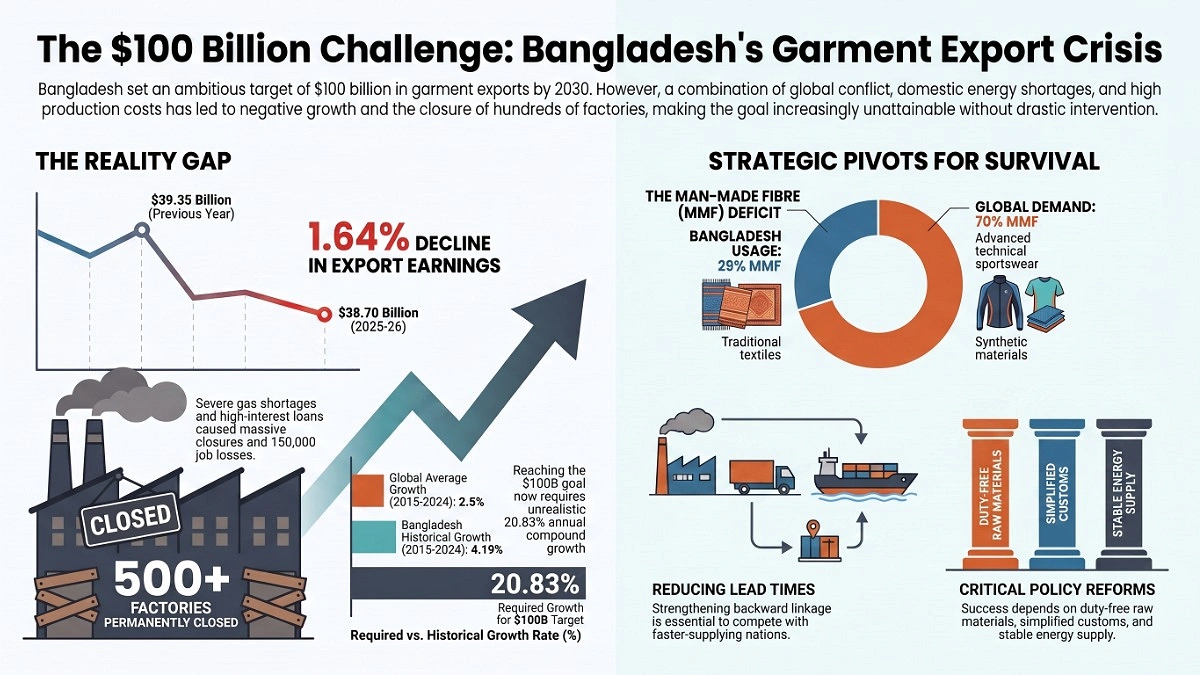
According to World Trade Organization (WTO) data, global garment exports grew by an average of only 2.5 percent annually from 2015 to 2024. During the same period, Bangladesh’s garment export growth was 4.19 percent.
On the other hand, in 2025, the country’s garment export earnings stood at $38.82 billion. Industrialists expressed fears that to reach the $100 billion garment export target by 2030, an average annual compound growth rate of 20.83 percent must be achieved, which is not possible in the current context.
According to Export Promotion Bureau (EPB) data, Bangladesh’s earnings from garment exports in the recently concluded 2025-26 fiscal year (July-June) were $38.70 billion. In the 2024-25 fiscal year, earnings from this sector were $39.35 billion. Export earnings decreased by 1.64 percent or $645.82 million in one year.
Meanwhile, according to Industrial Police and garment sector organizations, nearly 500 industrial factories have permanently closed in the last two years. Many more factories are at risk of closing.
During this time, about 1,50,000 workers have lost their jobs in the garment sector alone. The main reasons for factory closures are a decrease in purchase orders and a reduction in production capacity due to a lack of gas and electricity.
In some factories, management weaknesses and the inability to make shipments on time are also factors.
International reasons include instability in the world market, including fuel, centered around the US and Israeli attack on Iran last 28 February, the impact of the Russia-Ukraine war, and downward demand in the world market due to the imposition of counter-tariffs by the US.
According to Industrial Police, 457 industrial factories closed in the two years from June 2024 to June 2026. Among them, there are 170 textile and ready-made garment factories. The remaining 287 are non-garment.
The list of closures includes 108 member factories of the Bangladesh Garment Manufacturers and Exporters Association (BGMEA), 35 factories of the Bangladesh Knitwear Manufacturers and Exporters Association (BKMEA), and 8 factories of the Bangladesh Textile Mills Association (BTMA).
The remaining 19 are factories affiliated with the Bangladesh Export Processing Zones Authority (BEPZA).
However, there is a discrepancy between the Industrial Police data and the information from the three organizations in the garment and textile sectors. BGMEA data shows that 221 of the organization’s factories have closed in two years. Among them, the maximum number of 141 factories closed in 2025. In 2024, 77 factories closed.
Currently, the number of BGMEA member factories in the Dhaka and Chattogram zones combined is 2,127.
Shasha Denims Managing Director Shams Mahmud said, “When this target was set, the growth in garment exports was not sustainable. Even during Covid, when many things stopped around the world, several reputable brands came to Bangladesh and garment export growth began to increase. But although promises were made by the then government to take several initiatives, they were not implemented.
“On the other hand, such a collapse occurred because the country’s financial sectors fell into the hands of a few people. As a result, far from growth in garment exports, owners had to start fighting for survival. The government has taken several initiatives. These will take at least two years to implement. Consequently, achieving that goal will be difficult.”
Demand for high-value and specialized clothing is increasing in the global market. The price of clothing produced from Man-Made Fiber (MMF) is several times higher than that of ordinary clothing made from cotton yarn.
MMF clothing accounts for about 70 percent of the global market. The remaining 30 percent comes from yarn obtained from natural fibers like cotton. Yet, Bangladesh is still lagging far behind in exporting such clothing.
MMF products account for only 29 percent of the country’s export-oriented ready-made garments. The remaining 71 percent is clothing produced from cotton yarn.
BKMEA President Mohammad Hatem blamed high duties and taxes on raw material imports for this lagging behind.
He told Agamir Somoy, “For some raw materials, it is about 35 percent. Demands have been made for a long time to withdraw this duty. In response to this demand, the 10 percent duty on synthetic fabrics, one of the main raw materials for MMF garment production, has been withdrawn in the proposed budget for the 2026-27 fiscal year. Duty concessions have also been given on some other raw materials. This will increase Bangladesh’s capacity in producing and exporting high-value clothing.”
The country’s garment sector is dependent on large-scale purchase orders and is limited to the production of low-cost basic products. This is because the infrastructure of this industry is basically built for the implementation of large-scale orders.
On the other hand, the backward linkage industry required for the production of small-scale fashion-dependent or high-value products has not yet sufficiently developed. As a result, Bangladesh’s progress in the high-value-added market is limited. At the same time, long lead times have become a major challenge for Bangladesh.
According to industry stakeholders, those countries that can ensure rapid production and supply are able to maintain a good position in the export market. Therefore, initiatives must be taken to reduce lead times by strengthening backward linkages.
Sparrow Group Managing Director said, “The country’s garment sector is suffering from a bit of a crisis of confidence. For this reason, some world-renowned brands are reducing sourcing from Bangladesh. To restore their confidence and achieve the $100 billion export target, policy reforms and increased investment in the garment sector are essential.
“Besides, to ensure sustainable growth, adequate gas and electricity supply must be ensured. Simplification of the customs process is extremely necessary. Administrative delays and complexities must be reduced. If production is not interrupted, export capacity will increase significantly.”
Moreover, rapid changes are occurring in the global garment trade. The trend of online sales and delivering products directly to the consumer is increasing. Entrepreneurs also believe that to increase e-commerce-based sales, it is necessary to build own brands and strengthen marketing activities at the international level.
The government has taken initiatives to restart the closed factories by investing about Tk 20,000 crore. Shovon Islam expressed hope that this will increase production capacity. Demand in the global market is still growth-oriented.
BGMEA former director Mohiuddin Rubel said, “If the right policy support is provided and production capacity is increased, even if Bangladesh does not achieve the $100 billion export target within the specified time, it is possible over time.”

