

Construction Projects to Incur Major Expenditure
- Allocation set by code-based budgeting in development projects

Picture: Agamir Somoy image regenerated by AI
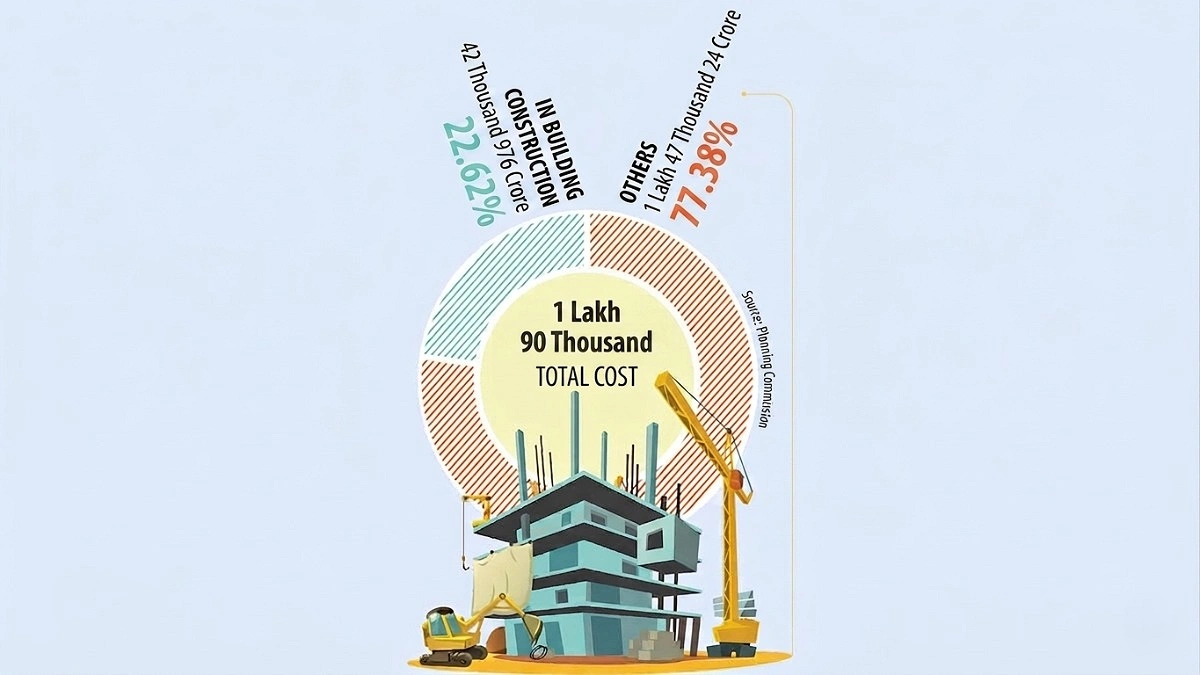
The Planning Commission has introduced a code-based allocation system for project implementation under its economic classification. The data shows that construction of various buildings will account for the highest expenditure.
The highest allocation is for non-residential building construction, with Tk 29,524.67 crore under the Annual Development Programme (ADP). Including other building categories, the total spending on buildings will reach Tk 42,976 crore.
On the other hand, the lowest allocation has been proposed for judicial allowances, amounting to only Tk 2,000.
Under the 2026–27 fiscal year ADP, a total of Tk 190,000 crore has been allocated across 315 codes. Of this, Tk 98,785 crore will come from the government fund, Tk 82,926 crore from foreign loans, and Tk 8,924 crore from the self-financing of organizations.
When asked about the matter, Musrat Mehjabeen, Chief of the Implementation Division of the Planning Commission, told Agamir Somoy that this system was not in place before but has now been introduced.
She explained that the code-based allocation shows how much will be spent across different categories under ADP projects, such as salaries and allowances. For example, if one wants to know how much is allocated for training, the code-based breakdown helps provide a consolidated picture across all projects. She described it as a highly effective system.
Musrat Mehjabeen said that higher spending on building construction does not mean that all project funds are being spent in that sector. However, it remains the largest expenditure category. The government is aiming to gradually move away from such building-related spending in the future.
Sources from the Planning Commission said that a total of 1,121 projects are included in the ADP for the 2026–27 fiscal year. Among these, 949 are investment projects, 22 feasibility studies, 107 technical assistance projects, and 43 projects under autonomous organisations’ own financing. The code-based framework details how much allocation is assigned to each sector across all projects.
Under these projects, the second highest expenditure in the next fiscal year will be in the road and highways code, amounting to Tk 13,987 crore. Electrical equipment ranks third with Tk 12,901 crore. Other major allocations include land acquisition Tk 10,580 crore, sanitation Tk 8,298 crore, residential buildings Tk 7,034 crore, and consultancy services tk 6,415 crore.
Spending will also include Tk 2,160 crore for food-related codes, Tk 1,074 crore for training and wages, Tk 3,105 crore for drainage, Tk 6,414 crore for other buildings and structures, Tk 5,769 crore for embankment construction, Tk 3,261 crore for engineering equipment, and Tk 4,163 crore for other machinery.
The ADP review shows that in the 2026–27 fiscal year, Tk 230 crore will be spent on officers’ basic salaries, Tk 52 lakh on personal pay, and Tk 2 lakh on special pay. Tk 65.56 crore will be allocated for employees’ basic salaries. Mobile phone expenses will amount to Tk 2.95 crore.
In addition, Tk 29.68 crore will be spent on audio-visual and film production, Tk 21.80 crore on books and periodicals, Tk 83.57 crore on office building rent, Tk 25.23 crore on transportation, Tk 30 lakh on foreign training, and Tk 1.97 crore on domestic training. Furthermore, Tk 955 crore will be spent on purchasing contraceptive supplies.
Officials said that project implementation requires spending funds according to specific codes. The National Economic Council (NEC) has given final approval to the ADP worth Tk 3,08,924 crore for the upcoming fiscal year. Although it was recently approved by the NEC, the finance minister will present details of the ADP in parliament during the budget session this month.

