
10,000 MW Solar Power Plan: Optimism Amidst Implementation Challenges

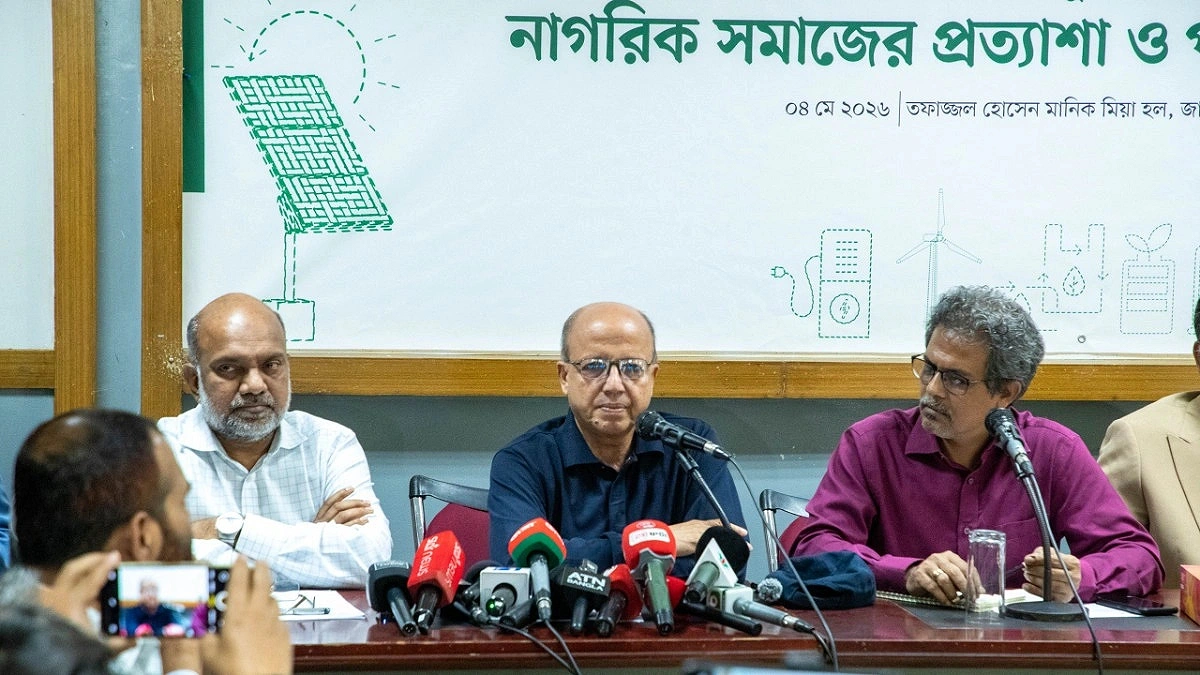
Photo: Agamir Somoy
Energy experts have welcomed the government's plan to produce 10,000 megawatts (MW) of solar power by 2030, describing it as a timely and strategic move. However, to accomplish this goal sustainably, they emphasized the need for a simplified investment environment, low-interest financing, and tax-duty exemptions.
At a press conference held today, (Monday), at the National Press Club, experts noted that global geopolitical tensions—particularly the crisis in the Middle East—have increased volatility in the energy market. As prices for oil, diesel, and coal spiral out of reach, the determination of this solar energy target has arrived at a critical juncture.
The keynote papers were presented by Shafiqul Alam, Lead Energy Analyst at the Institute for Energy Economics and Financial Analysis (IEEFA), and Zakir Hossain Khan, Managing Director of Change Initiative.
Current Energy Vulnerabilities
Shafiqul Alam highlighted the following concerns:
In the 2024–25 fiscal year, import dependency in the power and energy sectors stood at 65% and 62.5%, respectively. The closure of the Strait of Hormuz has led to a temporary shutdown of Eastern Refinery operations. Load shedding has exceeded 2,700 MW across the country.
The government is currently providing subsidies of over Tk 65 per cubic meter for LNG and up to Tk 70 per liter for diesel, putting immense pressure on the economy.
Transitioning rapidly to renewable energy is now the only viable alternative, experts said.
Financial Proposals and Strategies
Zakir Hossain called for a complete rethink of the financing structure for renewable energy in Bangladesh:
Subsidies: Transferring at least 30% of fossil fuel subsidies to the renewable sector in the upcoming budget could create investment opportunities worth nearly $360 million.
Carbon Pricing: Implementing a limited carbon pricing mechanism could generate an estimated $10 billion in financial opportunities.
Expatriate Bonds: The speakers proposed launching a $4.5 billion "Expatriate Bond" to attract investment from the diaspora.
The experts identified the lack of a dedicated green financing window at the central bank and high commercial interest rates as significant barriers. They urged the government to initiate a refinancing structure with 3-4% interest rates and to integrate Corporate Social Responsibility (CSR) funds into the financing framework.
As policy recommendations, the speakers called for full duty exemptions on solar equipment, battery storage, and electric vehicles, as well as the creation of a special revolving fund of 50 billion taka. They said that a transition to renewable energy could bring significant economic benefits. A capacity of 10,000 megawatts could reduce annual fuel import costs by 1.5 to 2 billion US dollars. They also noted that rooftop solar, solar irrigation, and electrification in the transport sector could save hundreds of millions of dollars each year.
However, concerns about implementation were raised by Mustafa Al Mahmud, President of the Bangladesh Sustainable and Renewable Energy Association. He said that although achieving 10,000 megawatts is technically possible, there is a clear gap in implementation. Due to the lack of progress on the previously announced 3,000 megawatt target, questions remain about the new goal. He criticized the imposition of up to 28 percent tax on solar equipment and called for its rapid reduction, along with the introduction of solar bonds.
Speakers also noted that the complexity of the current public-private partnership model could delay project implementation. They suggested that projects should instead be implemented directly through the Bangladesh Power Development Board.
At the discussion, Dipal Chandra Barua, Chairman of the Bright Green Energy Foundation, said that the time has come to implement a model where individuals generate their own electricity. He added that the government’s role should be to create a supportive environment, especially by reducing the cost of solar equipment and lowering taxes.
Energy expert Professor Ijaz Hossain said that failure to address the energy crisis would create major challenges for the government. In his view, solar power is the most effective solution in this regard and requires urgent policy reform.
The press conference was organized by ActionAid Bangladesh, the Just Energy Transition Network Bangladesh, and the Bangladesh Sustainable and Renewable Energy Association.
