

Charging Stations Needed Before Introducing Electric Vehicles

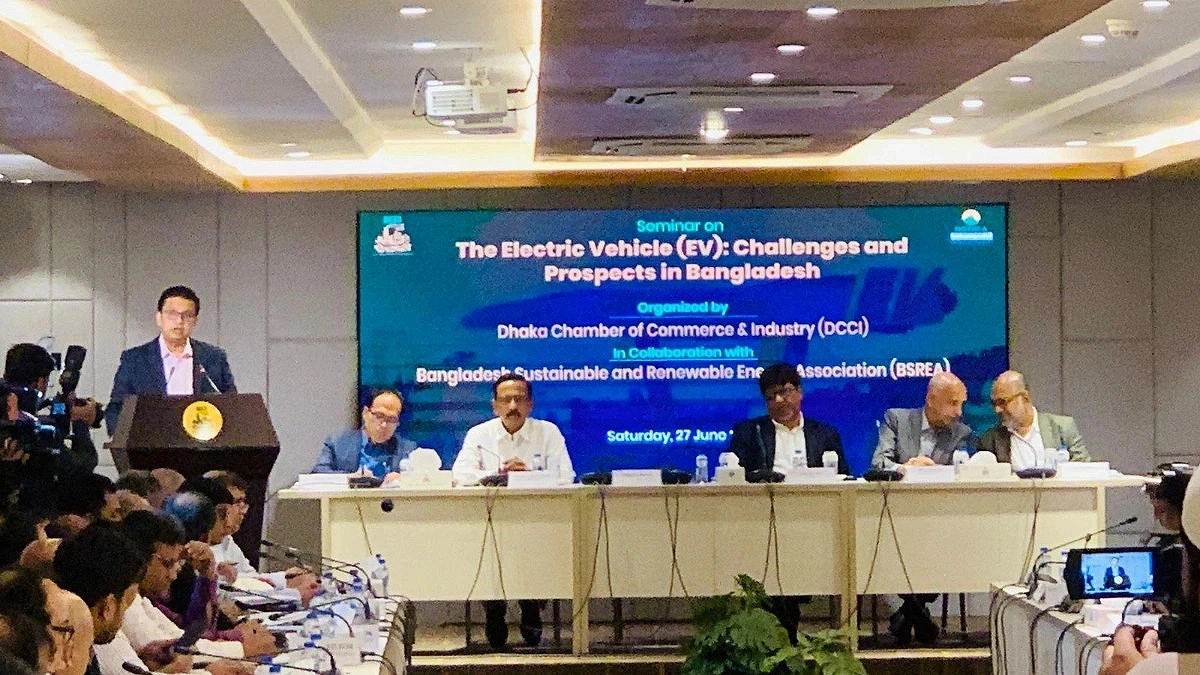
A seminar on Electric Vehicles in Bangladesh: Challenges and Prospects organised on Saturday in city.
Many see immense potential in the environment-friendly electric vehicles (EVs) in the country. However, structural barriers could slow down its expansion. Among these are shortages of electricity, charging stations, fuel, and depots. Before importiung EVs, emphasis must be placed on building charging stations.
These points were highlighted today (Saturday) at a seminar titled "Electric Vehicles in Bangladesh: Challenges and Opportunities," jointly organized by the Dhaka Chamber of Commerce and Industry (DCCI) and the Bangladesh Sustainable and Renewable Energy Association (BSREA).
The keynote paper was presented by DCCI President Taskeen Ahmed at the event.
He said, "Currently, the transport sector alone consumes 63.41% of the country's total imported petroleum. Therefore, moving towards EV technology is a demand of the time to save foreign currency and protect environment. At present, out of approximately 6.724 million registered vehicles, there are only 669 registered four-wheeled EVs.
However, around 6 million unregulated and unstructured e-rickshaws are operating on the streets across Bangladesh. Among electric vehicles, about 90% are plying the roads illegally. The government has set a target to include 30% EVs in the government and autonomous sectors by 2030., Taskeen added.
Six barriers to EV expansion have been identified by the Chamber. These include: although the country's daily electricity demand is about 17,000 megawatts, due to the severe gas-electricity crisis, many industries are currently operating at only half their production capacity. In this situation, handling the additional load of EV charging is a major challenge.
The DCCI President added that while there are about 8,000 buses in the capital and over 53,000 across the country, the number of government-owned bus depots nationwide is fewer than 30, which is a major obstacle to introducing large-scale e-buses. The necessary charging network for three-wheelers, cars, or commercial EVs on highways and in rural areas has not yet been developed.
Compared to conventional fuel-powered vehicles, buying an EV requires a significantly higher upfront investment. There is no institutional policy in the country for verifying battery safety standards, testing centers, or recycling old batteries. The current government is providing substantial tax exemptions and incentives to encourage the local EV industry. VAT and customs duties on EVs and e-bikes have been waived until 2031, and this benefit will apply to hybrid vehicles until 2030."
DCCI President Taskin Ahmed emphasised the need to develop charging facilities for electric vehicles. He said, "If someone wants to travel from Dhaka to Chattogram using this vehicle, their first thought will be: where will I charge it? So, the charging facility must be established first. Otherwise, instead of benefits, it will only increase hardships."
At the seminar, Hafizur Rahman Khan, President of the Bangladesh Automobile Assemblers and Manufacturers Association (BAAMA), said, "If the state decides dos and don'ts for the businesses, it will be better for everyone and also better for the public."
Dr. Md. Ehsan, Professor of the Mechanical Engineering Department at Bangladesh University of Engineering and Technology (BUET), said, "Just as everyone in the vicinity benefits when a mobile tower is set up in our country, people will also benefit if electric charging points are installed. However, we must also keep in mind that we cannot assume that fuel consumption will automatically decrease just because EVs are introduced."
Md. Mofizul Islam, Chief Engineer of the Bangladesh Power Development Board (BPDB), spoke at the seminar. He said, "Five years ago, electricity usage in our country would drop after 11 PM. But now, consumption is as high at night as it is during the day. As a result, electricity costs are continuously increasing."
Abdun Naser Khan, Secretary of the Ministry of Industry, said at the seminar, "We have potential in EVs. We are working on how to utilise this potential. The formulation of an EV industry development policy is underway. The main goal of this policy is to reduce the number of motor vehicles powered by imported petroleum-based fuels. This is related to our energy security. We also aim to encourage sustainable development through local production of EV battery charging infrastructure and associated technologies. Another objective is to create quality employment opportunities for engineers, technologists, researchers, and skilled workers."

