
Says Foreign Minister
To sustain export growth, Bangladesh has to face tough competition

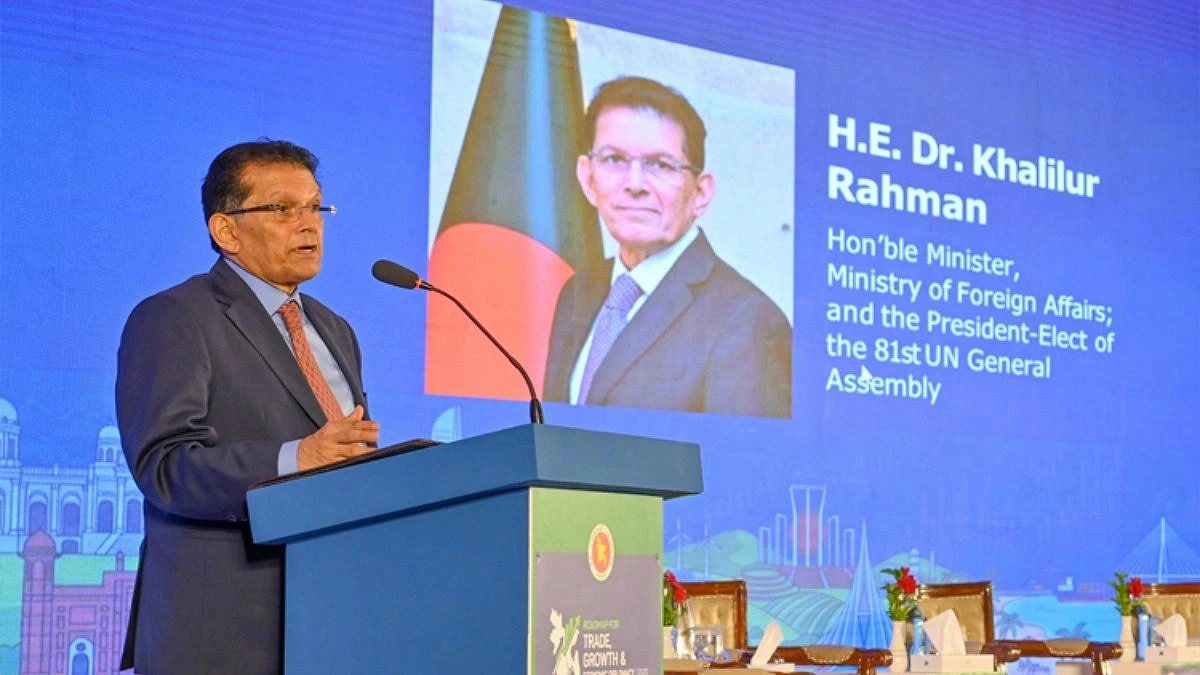
Foreign Minister Dr. Khalilur Rahman. Phopto: Foreign Ministry.
Bangladesh's export market is facing challenges due to the global economic slowdown, climate risks, and the changing dynamics of world trade. To tackle these challenges, the country must engage in tough competition. In the current situation, it is also crucial to adopt new strategies to maintain the export market and expand its reach, said Foreign Minister Dr. Khalilur Rahman.
Dr. Khalilur attended the inaugural session of the "Roadmap to Trade, Growth and Economic Diplomacy Conference" in the capital on Saturday. He highlighted the various negative impacts of the global economy on developing countries, including Bangladesh. At the same time, he called for renewed emphasis on economic diplomacy to transform these challenges into opportunities.
The conference was jointly organized by the Ministry of Foreign Affairs and the Bangladesh Investment Development Authority (BIDA). Senior government officials, heads of diplomatic missions, development partners, and representatives of the private sector participated. Addressing the event were State Minister for Foreign Affairs Shama Obaid Islam, the Prime Minister's Foreign Affairs Adviser Humayun Kabir, and Foreign Secretary Asad Alam Siam.
The newly elected President of the 81st session of the United Nations General Assembly noted that while the growth potential in Bangladesh's major export markets is positive, the pace is moderate. This could reduce consumer demand and impact exports.
The Foreign Minister reminded that the new government, led by Prime Minister Tarek Rahman, has taken office at a time when the global economy is facing multiple crises. These include a slowdown in economic and commercial growth, geopolitical tensions, trade policy uncertainty, climate risks, rising trade barriers, and major shifts in global supply chains.
According to him, the ongoing energy crisis has created a new level of complexity. Bangladesh is not isolated from these global situations, as they have a profound impact on national policymaking and economic diplomacy.
Highlighting the financial crisis in developing countries, the Foreign Minister said, "Global financial markets and institutions are now strictly controlling production, trade, and investment flows. It has become difficult for countries like Bangladesh to raise capital. They have to pay much higher interest on loans. Due to market volatility, we are at extreme risk."
He noted that developed countries can typically borrow at interest rates of 1 to 4 percent, whereas emerging and developing countries often have to pay 6 to 12 percent or even higher on loans. As a result, access to affordable and safe financing remains limited for us.
The Foreign Minister also highlighted the growing link between climate risks and the financing crisis.
He warned that due to the ongoing global energy crisis, Bangladesh's expenditure on imported fuel has already increased significantly, hurting production costs and overall competitiveness. High energy prices could divert resources away from development programs, raising concerns about long-term negative impacts on the economy.
Citing data from the International Energy Agency (IEA), he noted that the current energy crisis could surpass even the oil crisis of the 1970s. That crisis forced many developing countries to endure a "lost decade" of development in the 1980s. At that time, then-President Ziaur Rahman prioritized agricultural modernization and free market policies, laying the foundation for the country's ready-made garment industry.
"To address the current global challenges, Prime Minister Tarique Rahman's forward-thinking vision is built on three strategic goals: stability, reform, and progress," the Foreign Minister added. He emphasized translating the Prime Minister's vision for economic and commercial diplomacy into practical action plans.
