
Bangladesh seeks US support to ease debt pressures

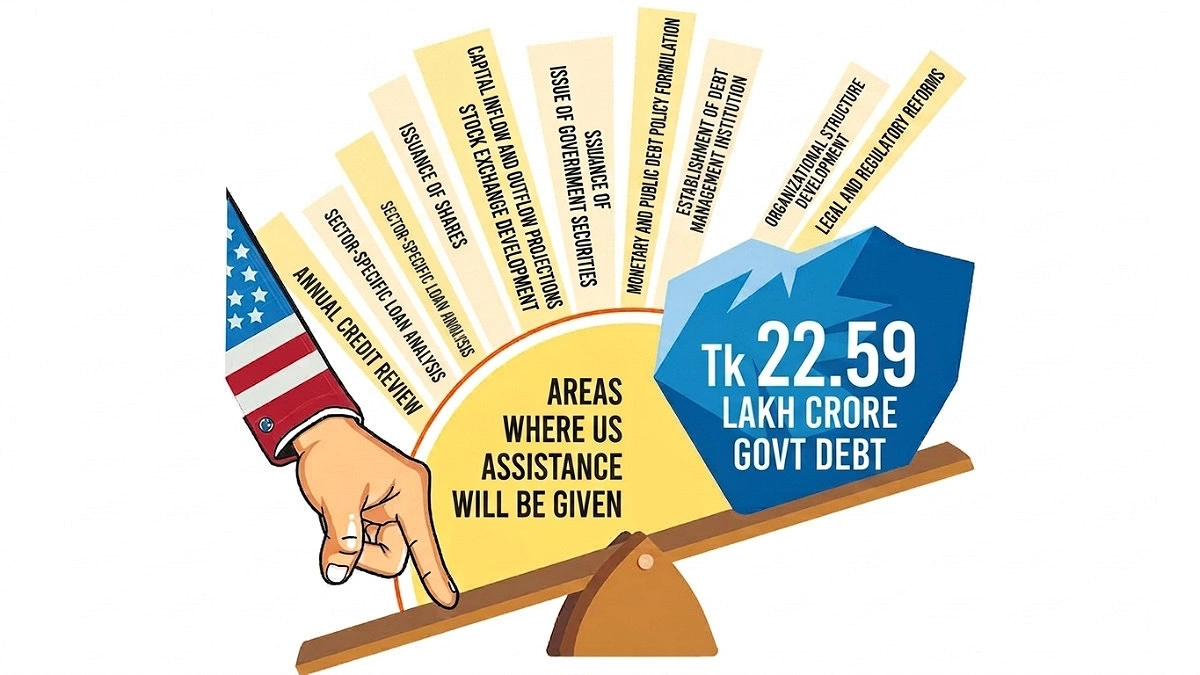
Representational image generated by AI.
How much money will be borrowed for government operations and development, when, and from where will it come—along with these questions, several other fundamental considerations are now being contemplated by the government.
These include: how much risk that debt might pose to the economy, the burden of repayment costs, cash flow (revenue) forecasting, and the modernization of government income and expenditure accounting systems. Policymakers fear that without these reforms, the country could fall into a debt trap. According to them, the government is currently saddled with a debt burden of Tk 22.59 lakh crore. In the future, this volume will increase further. To rein in this massive debt, the government has sought comprehensive assistance from the United States (Department of the Treasury).
It is learned that several letters were recently exchanged between Dhaka and Washington regarding this matter. Following Bangladesh's proposal, the U.S. Treasury's Office of Technical Assistance (OTA) issued a Project Notification Letter to the Finance Secretary on July 24. The letter stated that the U.S. technical assistance to improve Bangladesh's debt management has received preliminary approval.
Through this project, the U.S. expressed interest in offering support across several areas to upgrade Bangladesh's debt management system. These include debt risk analysis, annual borrowing plans, domestic debt market development, government bonds, issuance of shares, and issuance of and government securities. In addition, assistance will be provided in reforming legal and regulatory frameworks, developing organizational structures, establishing an independent debt management institution, engaging with investors, and forecasting the inflow and outflow of government cash funds.
A senior official from the Finance Division involved in this process said that the next crucial step in implementing the project is finalizing the Terms of Reference (ToR) and signing a Memorandum of Understanding (MoU) between the two parties. The U.S. Treasury Department indicated that it would send the draft ToR shortly. Once received, necessary feedback will be collected from relevant government officials to expedite the signing, he added.
To respond to the U.S. preliminary approval letter, the Finance Secretary recently presented a summary to Finance Minister Amir Khosru Mahmud Chowdhury for approval. In that summary, Finance Secretary Dr. Md. Khairuzzaman Mozumder said, "The U.S. Treasury Department team verbally indicated that the ToR to be signed for project implementation would be executed at the ministerial level. In the letter to be sent to the United States, Bangladesh's commitment to restoring macroeconomic stability and strengthening the debt management framework will be reiterated." The Finance Secretary recommended that the initiative undertaken by the interim government with the U.S. Treasury Department to reinforce public debt management should be continued. Following an overall review, the Finance Minister approved the summary.
It has been learned that the initiative originated on January 29, 2025. At that time, the then Finance Advisor, Dr. Salehuddin Ahmed, sent a formal letter to US Treasury Secretary Scott Bessent requesting technical assistance for modernizing public debt management. The letter sought US Treasury assistance in five areas: forecasting cash flow, improving the government's revenue-expenditure accounting system, modernizing debt management procedures, increasing revenue collection, and modernizing revenue administration. Subsequently, multiple meetings were held between high-level Bangladeshi officials and US Treasury Department officials at the assistant secretary level. The matter was also discussed during sideline meetings at the IMF and World Bank annual meetings, with officials from various levels of the US State Department in attendance.
Following the Bangladesh government's request, the US Treasury Department conducted a virtual assessment in October 2025. Based on that assessment, a project-related concept note was sent to the Finance Adviser on December 3, 2025. The note conveyed consent to begin the design phase of a technical assistance project for public debt management in collaboration with the Treasury and Debt Management Wing (TDMW) of the Finance Division. Subsequently, a field mission from the Treasury Department visited Bangladesh in June of this year. They held direct discussions on the matter with the Finance Division, the Economic Relations Division (ERD), the Department of Savings, and Bangladesh Bank. Following this field-level evaluation, the US Treasury Department proceeded towards approving the full-fledged project.
When contacted last Monday, Dr. Salehuddin Ahmed told Agamir Somoy, "Technical assistance from the US Treasury Department for public debt management could be crucial for Bangladesh. The central bank has been handling auctions of government treasury bills and bonds, market management, and transactions of government securities. Now, the responsibility for public debt management is increasingly falling under the Finance Division of the Ministry of Finance. Therefore, technical assistance is needed to make this new structure efficient and effective."
He further said that by utilizing the US Treasury's experience, it is possible to modernize debt sustainability, risk management, determining debt sources and maturities, treasury management, and government securities issuance. This will also diversify the sources of debt. It will also enhance preparedness and capacity for issuing sovereign bonds in the international market in the future. At the same time, the coordination between the responsibilities of the central bank and the Finance Division will become clearer. As a result, alongside reducing public debt risk, it will be possible to control financing costs, increase market confidence, and establish discipline in overall debt management—commented Dr. Salehuddin.
Analysis of government documents shows that by March 2026, the government's total debt had risen to Tk 22.59 lakh crore (approximately Tk 22.59 trillion). Of this, bank sector debt amounted to Tk 8.82 lakh crore, non-bank sector debt (including savings certificates) stood at Tk 4,13,808 crore, and foreign debt was Tk 9.64 lakh crore.
Analysts say the government has long been relying on domestic debt. Particularly, it is taking this debt from treasury bills and bonds, banks, and the savings certificates sector. On the other hand, foreign debt is also an important source for development projects. However, excessive reliance on a single source creates risks. With the technical assistance of the US Treasury, an opportunity will arise to create an integrated debt strategy by analyzing the cost, maturity, interest rates, foreign currency, and refinancing risks of debt from various sources.
Additionally, an important part of the US assistance is forecasting cash inflows and outflows. That is, if there are accurate forecasts of when the government will need how much money, when revenue will come in, and how much debt needs to be repaid in which fiscal year, the need to take on additional debt to cope with sudden liquidity crises decreases. With advance forecasting, arrangements for funds can be made several months ahead. This will reduce the pressure of suddenly borrowing large sums from the market and may create opportunities to raise funds at relatively lower costs. In this regard, the US Treasury Department's assistance in debt risk analysis can play a major role. It will be possible to more systematically manage issues such as refinancing old debt, restructuring maturities, and controlling interest expenses.
According to analysts, if this initiative is implemented properly, its impact will not be limited solely to public debt management. Through this, the government's financing costs can be reduced, debt risks controlled, and investor confidence boosted. At the same time, if the domestic debt market is strengthened, the government's financing alternatives will increase, thereby reducing excessive dependence on any single source.
