
Mirer Bari: One village supplies half of the upazila's vegetables

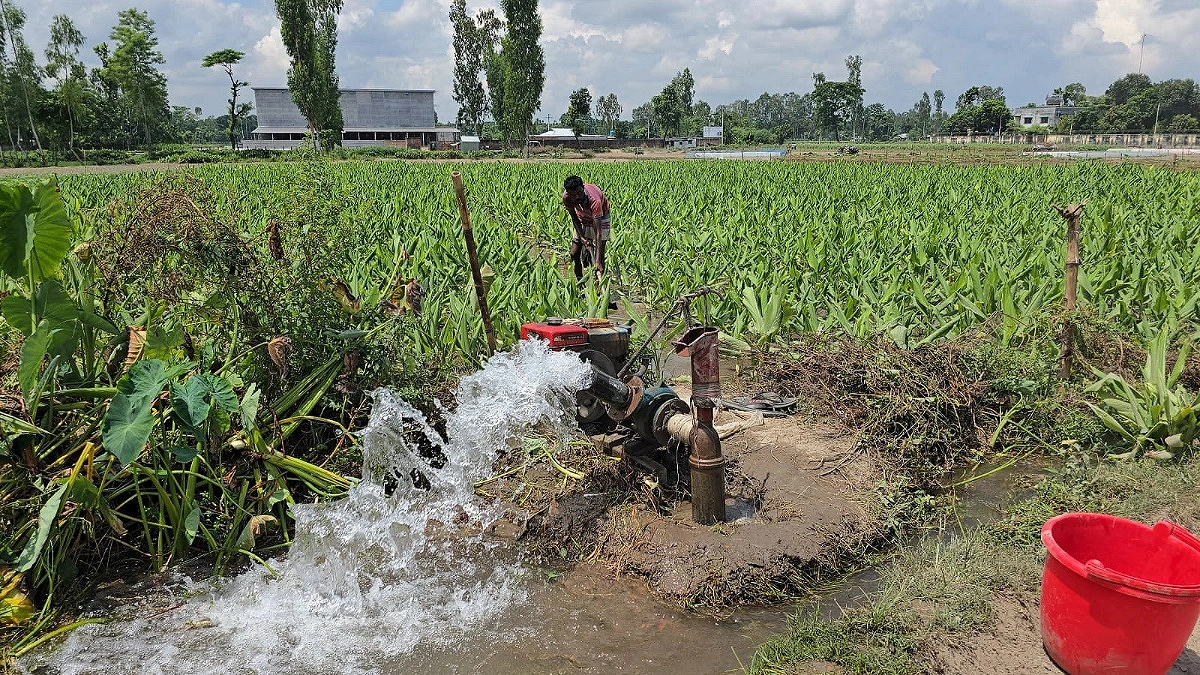
Photo: Agamir Somoy
As the first light of dawn breaks, the farmers of Mirer Bari in the Chhinai Union of Rajarhat Upazila, Kurigram, begin their bustling day in the fields. Some are busy tending to vegetable plants, others are weeding, and many are engaged in harvesting crops. One field holds brinjal (eggplant), while another has bitter gourd, bottle gourd, or hyacinth beans. Elsewhere, there are seedlings of winter cabbage and cauliflower.
Almost every season of the year, the fields and lands of this village are lush with greenery. Hence, to the locals, Mirer Bari has become known as the "Kingdom of Vegetables."
According to the Upazila Department of Agricultural Extension, in the last fiscal year, the vegetable production target for Mirer Bari's 400 hectares of land was set. The overall cultivation target for the entire upazila was 760 hectares. This means that approximately 53 percent of the total vegetable cultivation target for the upazila was achieved on the land of Mirer Bari.
The majority of the people in Mirer Bari are involved in agriculture, numbering around 800. However, instead of traditional paddy cultivation, they have chosen vegetable farming as their primary agricultural occupation. Throughout the year, they produce various seasonal vegetables, meeting local demands while also supplying vegetables to different parts of the country.
A visit to various areas of Mirer Bari village reveals a vast expanse of leafy greens and vegetables stretching across field after field. The crops are thriving thanks to the farmers' labor, care, and the quality of the soil. From homestead gardens to extensive cultivable lands, everywhere seems touched by greenery.
Conversations with local farmers reveal that almost every household in the village has some vegetable plants in their yard. Most of the arable land is being used to cultivate a variety of vegetables. The soil in Mirer Bari is primarily loamy, composed of a mix of sand, silt, and clay, which is suitable for vegetable cultivation. Additionally, as the land is relatively high, excess water does not stagnate. Attracted by the market demand for vegetables and the potential for comparatively better profits, farmers are increasingly inclined towards vegetable farming.
Due to the good soil quality, farmers mentioned that they often achieve good yields even with less fertilizer and pesticide use. This reduces production costs and also maintains the quality of the vegetables.
Local farmer Md. Zaherul Islam said, "I cultivate vegetables on my land all year round. I don't cultivate anything else. Our soil has a special quality. We get good yields with less fertilizer. The profit is good. If we don't make a profit, what would we gain from the loss?"
Zaherul also provided a breakdown of the profits from vegetable farming. This winter season, he has cultivated cabbage on 50 decimals of land and cauliflower on 60 decimals. His total expenditure has been approximately 80,000 Taka. If the crop yields well and fetches the desired market price, he expects to sell vegetables worth about 2 lakh Taka.
Additionally, this farmer has cultivated turmeric on 40 decimals of land. His expenditure for this came to 20,000 Taka. He expects to harvest 100 maunds of turmeric from that land. At the current market price of 1,000 Taka per maund, he anticipates selling turmeric worth approximately 1 lakh Taka. After deducting all expenses, he estimates a profit of around 50,000 Taka.
Female farmers Johura Begum and Rohima Begum shared that they have taken 30 decimals of land on lease (barga) from others and cultivated brinjal (eggplant) this season. Including land preparation, seeds, fertilizers, pesticides, irrigation, and care, their total expenditure has been 27,000 Taka. They are also working on the land themselves as laborers.
They hope that if the yield is good, they will get 55 to 60 maunds of brinjal. Based on the current market price of 30 Taka per kilogram, 55 maunds would be worth approximately 66,000 Taka, while 60 maunds could fetch about 72,000 Taka.
Another farmer, Ruhul Amin, cultivated bitter gourd on 45 decimals of land. He has already sold that produce. From cultivating bitter gourd on 45 decimals, he made a profit of 28,000 Taka. Now, for the winter season, he will cultivate cabbage on that same land.
Dulu Mia, a local wholesaler who collects vegetables from Mirer Bari, said, "I buy vegetables for 30 Taka, sell them at 50 Taka, and send them off. Then the shopkeeper sells them for 80 Taka."
Rayhan Badshah, a local trader involved in vegetable sales, commented, "The wholesalers take away the farmers' vegetables at low prices. The high market prices are for the wholesalers' benefit."
However, alongside the potential of vegetable farming, farmers are worried about the prices of fertilizers and pesticides. They complain that many times, when they go to the shops, they cannot get the required fertilizers. Even after standing in long lines to buy fertilizer, they often do not get the necessary amounts, causing anxiety about timely application in their fields.
Farmer Maidul Islam mentioned that he is not getting fertilizers like before. When he goes to shops to buy them, he faces various excuses. To control pests and diseases in vegetables like bottle gourd, hyacinth beans, snake gourd, and brinjal, pesticides are necessary. But the increased prices are raising production costs. While there is profit if vegetables can be sold at current market rates, they fear losses if production costs rise further.
Haimanti Rani, the Additional Agriculture Officer of Rajarhat Upazila, told Agamir Somoy that currently there is no fertilizer crisis in the upazila. Fertilizers are being supplied gradually according to farmers' demands under the supervision of Assistant Sub-Assistant Agriculture Officers.


