


"In the skin trade, it feels like they'll even take the skin off my back"

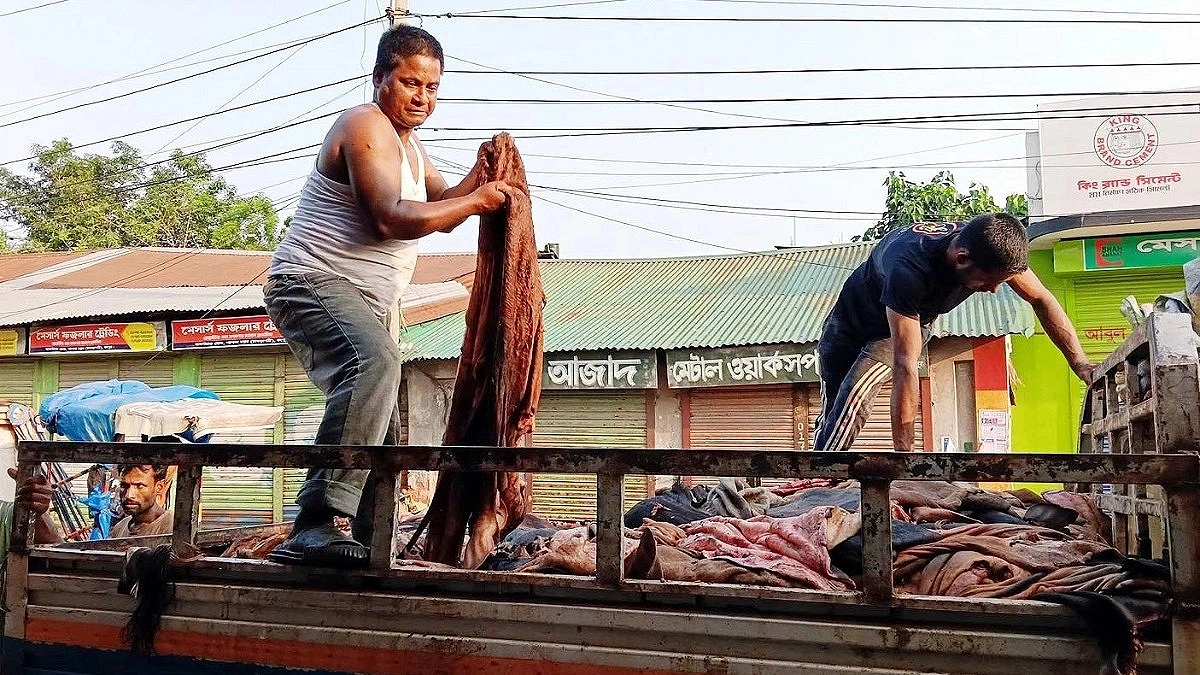
Photo: Agamir Somoy
Anwar Hossain from the Burirhat area of Rangpur city had taken a loan of 50,000 Taka from an NGO using his wife's account. He had hoped to make some profit by trading animal skins during the Eid-ul-Adha festival, which would also help him easily pay back the installments. Along with four partners, he worked tirelessly on Eid day, buying over a hundred cow skins from villages; each skin cost an average of 500 Taka. But now, trying to sell those skins at the wholesale market in Rangpur, Anwar's eyes are filled with tears. Profit is a distant dream; half of his capital has vanished.
The air at Rangpur's leather trading hub has become heavy with the cries of seasonal traders like Anwar Hossain. Some couldn't even cover their day's transportation costs and workers' wages, while others have become penniless overnight after losing their principal investment. Seasonal traders, middlemen (farrias), and retailers are facing extreme distress this year regarding sacrificial animal skins in this divisional city. Despite the government fixing prices, unprecedented anarchy reigns over skin trading at the field level.
Traders allege that a strong syndicate of wholesale buyers is dictating prices and forcing them to sell skins at arbitrary rates. According to the directive of the Ministry of Commerce, the price for salted cow skin outside Dhaka was fixed at 57 to 62 Taka per square foot. By that calculation, the price of a medium-sized skin should be at least 1200 to 1500 Taka. However, wholesalers are buying them for only 200-300 Taka. And goat or sheep skins fetch no price at all. Frustrated and despairing, many are abandoning their skins on the roads and returning home instead of selling them to wholesalers.
On Saturday, the third day of Eid, Jamal Uddin arrived at the wholesale market from the Modern More area with two goat skins and one cow skin by rickshaw. The wholesalers refused to take the goat skins, and he was forced to leave them on the road. He managed to sell the skin of his sacrificial cow, which he had bought for 85,000 Taka, for only 300 Taka. Expressing his anguish, he said, "Paying 80 Taka rickshaw fare to come sell skins ended up costing me a loss from my own pocket."
The same tragic scene was seen in the cases of Azizur Rahman from Kaunia, Mahfuz Ali from Gangachara, Lutfar Rahman from Taraganj, and Ekramul Haque from Darshana area. Nowhere are skins bought for more than 300 Taka, even though they were purchased for 500 Taka. On the other hand, orphanages and madrasas, which used to earn significant income annually by selling sacrificial skins, have found the skins to be a 'thorn in their side' this year. Baharul Islam, in charge of a local Hafizia madrasa, said that although many people donated skins, no buyers were found even after three days. Finally, they had to let go of the skins for a pittance.
While visiting Rangpur's main leather market, the area near Shaplachowk (Kamarpara), reveals a different scene. Every year, this time, the leather market buzzes with the calls of buyers and sellers, but this year there is an eerie silence. Wholesalers show no interest in buying skins; most warehouses are closed.
Local wholesaler Mokbul Hossain cites their own limitations as the reason. He explains, "Considering the costs of preservation and salt, each skin incurs an additional expense of 400 to 500 Taka. Therefore, it's not possible to buy skins at the government-fixed price."
However, veteran small trader Rafiqul Islam sees a different reason behind this crisis. He stated that big businessmen at the field level have pulled back this year due to unrecovered debts and a capital crisis. Taking advantage of this situation, a handful of traders have formed a syndicate and are controlling the market.
He expressed anger, saying that tannery owners receive large loans from the government and invest them in other sectors, whereas small-scale field-level traders do not receive any loan facilities. Due to the lack of alternative preservation systems outside of tanneries, such a devastating crisis in the leather industry has never been seen in the last decade.

