
Gulshan-Banani-Baridhara Lake Development
Three Year Project Still Unfinished After 16 Years

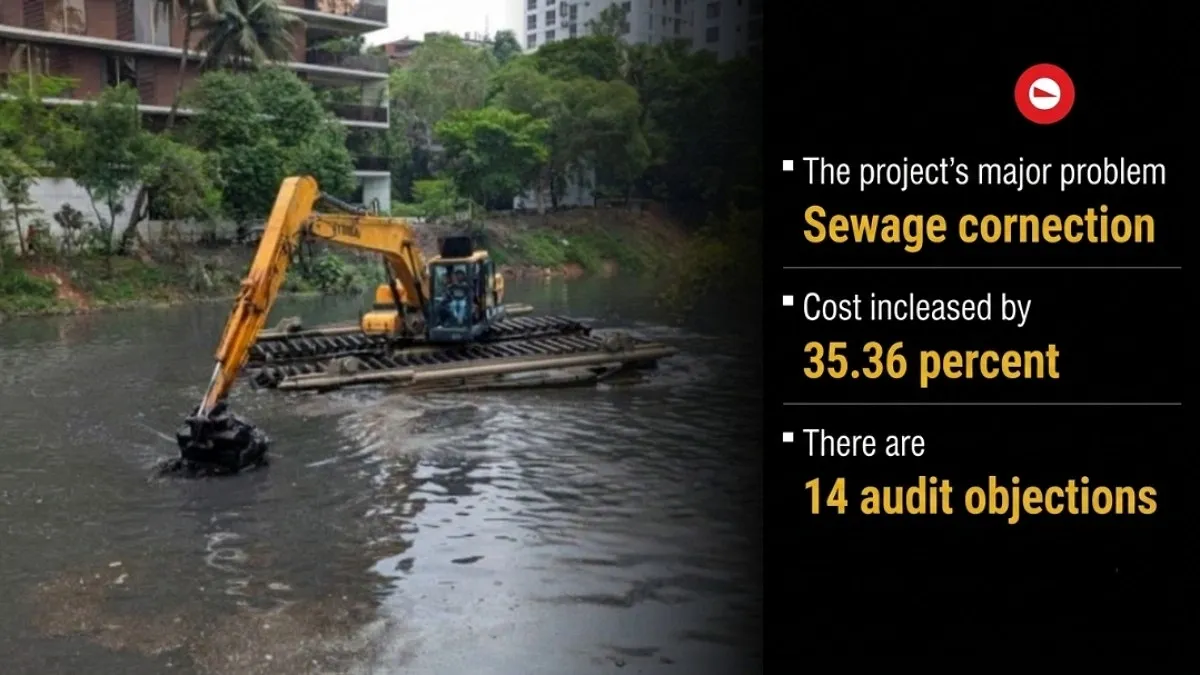
Graphics: Agamir Somoy generated by AI
The Gulshan-Banani-Baridhara Lake Development Project in the capital was supposed to be completed within three years. More than 16 and a half years later, however, the project remains unfinished with little practical progress.
About 82% of the physical work has been completed, while only 56% of the allocated funds have been spent.
Even the completed portions have failed to deliver the expected benefits. Seven locations still have direct sewerage and drainage connections flowing into the lake. Uncontrolled waste dumping continues to pollute the water and create foul odors. Meanwhile, deteriorating infrastructure, inadequate security, and illegal encroachment have reduced the lake’s usability.
Resolving land acquisition disputes alone took 15 years. The project was also delayed by poor coordination among government agencies and inadequate monitoring.
These findings were revealed in the final intensive monitoring report prepared by the Implementation Monitoring and Evaluation Division (IMED).
Project Director Shaber Ahmed told Agamir Somoy that the remaining work would be completed by December this year.
“The remaining tasks are mainly related to the Deputy Commissioner’s Office. Once the land acquisition payments are made, financial progress will reach 100%,” he said.
He added that the project had remained stalled for years because of legal disputes before he assumed responsibility.
According to project sources, the project is being implemented by the Rajdhani Unnayan Kartripakkha (RAJUK) under the Ministry of Housing and Public Works. It was launched to restore the environmental balance of Dhaka, rehabilitate natural water bodies, and improve the Gulshan, Banani, and Baridhara lake system.
Construction began in July 2010 and was originally scheduled for completion by June 2013. Due to repeated delays, the deadline has been extended several times, most recently to December 2026, increasing the project’s duration by about 450%.
The original project cost was Tk 410.25 crore, later revised to Tk 555.31 crore, an increase of 35.36%.
The project’s main objectives included reclaiming encroached lake areas, increasing water retention capacity, reducing waterlogging, and improving Dhaka’s urban environment.
Major infrastructure work, including lake dredging, shoreline protection, lake drive roads, walkways, and tree planting, has been completed, bringing some environmental and transportation improvements to the area.
However, land acquisition remained one of the biggest obstacles. Following the resolution of legal disputes lasting 15 years, acquisition of 10.75 acres has resumed.
Following a Project Steering Committee meeting in May, authorities decided to exclude an additional 3.21 acres from the project to help ensure completion within the revised deadline. Tender evaluations for repairing damaged infrastructure are also underway.
According to the IMED report, coordination between the project office, the Deputy Commissioner’s Office, Dhaka North City Corporation, and relevant housing societies was weak. Regular supervision was also lacking.
Although the project was intended to improve the lake’s environment, inspectors found that many objectives had not been fully achieved, while new environmental risks had emerged.
The report also noted that although procurement generally followed the Public Procurement Rules (PPR) 2008, irregularities occurred in approving project variations.
The project has faced 23 audit objections, of which only nine have been resolved, leaving 14 still pending.
IMED also found that no feasibility study had been conducted before launching the project. Land acquisition was delayed, project directors were replaced multiple times, preparation of the master plan progressed slowly, procurement and contracting were delayed, key staff positions remained vacant, coordination meetings were infrequent, and field-level monitoring was weak.
The report said the project missed an opportunity to develop a sustainable urban model through eco-tourism and biodiversity conservation.
Although the project still has the potential to improve the lake environment and reduce waterlogging, legal complications, inadequate long-term maintenance, declining water retention capacity, climate change, and security concerns remain significant challenges.
Overall monitoring found that engineering standards were generally maintained in major construction works, including lake dredging, walkways, and road construction.
However, of the nearly 9 kilometers of lake, only 2.4 kilometers have been cleared of harmful sludge, sediment, and waste. The removed waste was transported to designated disposal sites outside Dhaka.
While dredged sections now retain more water, large amounts of sediment and waste remain in the rest of the lake, raising concerns that water retention capacity will continue to decline and the lake’s natural recharge process will be further disrupted.
In addition, separating sewerage lines from the lake and establishing an alternative drainage system have not yet been fully completed. Because Dhaka WASA has not fully implemented its earlier plans, waste discharge into the lake continues. Officials believe the problem could be partially resolved once WASA’s ongoing water treatment project is completed.
Project officials said the Gulshan, Banani, and Baridhara lake system has long been one of Dhaka’s most important environmental assets. However, rapid population growth, unplanned urbanization, illegal encroachment, and years of poor management have gradually degraded the lakes, reducing water quality, shrinking water-holding capacity, and accelerating environmental deterioration.
They added that the shortage of open spaces, walking trails, and recreational facilities has also negatively affected the quality of urban life, making the restoration, conservation, and modernization of the lakes as important today as when the project was first launched.
