
Fishing cats endangered by human mistakes in Jashore

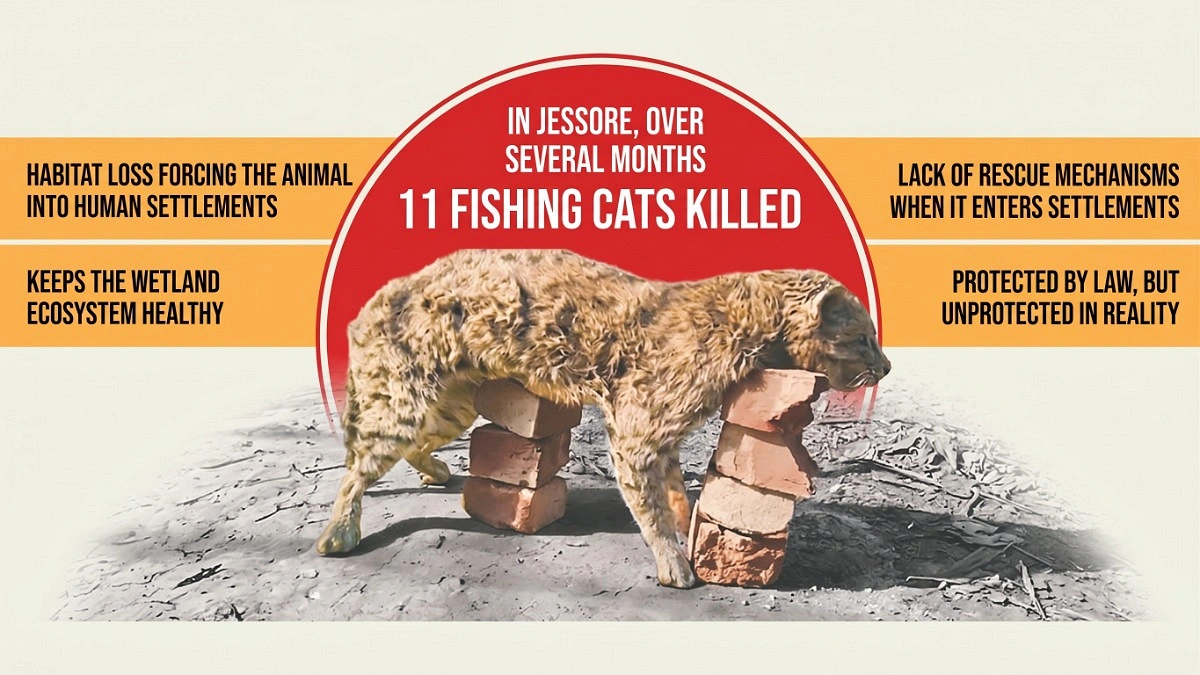
Graphics: Agamir Somoy
From a distance, it may look like a tiger cub. With striped markings on its body and a wild appearance, fishing cats that enter human settlements quickly create panic. They are then beaten to death. Such incidents involving fishing cats have been reported in different areas of Jashore. At least 11 fishing cats have been killed in Chougachha, Sharsha, Jhikargachha and Sadar upazilas in recent months. Yet this shy wetland animal poses no threat to humans. Rather, it plays an important role in maintaining the balance of aquatic ecosystems. Due to misconceptions, habitat destruction and a lack of awareness, the animal is now at risk of disappearing.
Locally, fishing cats are known as “Mechobagh,” “Bagdhora,” “Bagdasa,” “Bham” and “Go Bagha.” They once regularly roamed the vast low-lying areas, wetlands and river surrounded areas of Jashore. The basins of the Chitra, Ichamati and Kobadak rivers once provided suitable food and shelter for fishing cats. But over the past two decades, the environment has changed due to the filling of water bodies and ponds, urbanization, infrastructure development, construction of embankments for commercial fish farming and the removal of bamboo groves. This has also obstructed the natural movement routes of fishing cats. As a result, they often have to enter human settlements in search of food. Once they enter these areas, the animals face the risk of human panic and attacks.
According to wildlife experts, this animal is connected to the health of wetlands and the food chain. Besides fish, fishing cats feed on rats, various insects, frogs and young snakes. As a result, they naturally help control harmful animals in agricultural fields. By hunting sick or weak fish in water bodies, they also help maintain balance in the food chain. For this reason, fishing cats are considered an important indicator species of wetland ecosystems. Their presence also provides an indication of how sustainable the wetland environment, food and shelter in an area are. Therefore, the disappearance of fishing cats from the wetlands of Jashore is not only the loss of a wildlife species. It also carries an important message about environmental changes in the area.
Al Sami, a member of the Pran Prakriti Rokkha Committee in Chougachha, believes, “Innocent fishing cats are being beaten to death due to people’s lack of awareness. In particular, the negligence of the Forest Department is mainly responsible for this.” In his words, “When an animal is in danger in a remote village, we inform the authorities, but the rescue team does not arrive on time. Due to a lack of rescue equipment and emergency measures, the animals die before our eyes.”
However, Jashore Forest Department official Amita Mondal said, “Despite limited manpower and various constraints, we try to take quick action when we receive information. Along with legal measures to protect fishing cats, work is underway to increase awareness.”
There is no legal scope to kill fishing cats either. Under Bangladesh’s Wildlife (Conservation and Security) Act, 2012, the fishing cat is a protected animal. Catching or killing the animal is a punishable offense.
On September 6, a team from the Japan Bangladesh Fishing Cat Conservation Project visited various areas of Jashore for public awareness and research. Professor Dr. Ai Suzuki of Ritsumeikan University in Japan, wildlife researcher Aminur Rahman of the Department of Zoology at Jahangirnagar University and project research assistant Abul Kasem visited different areas of Jashore Sadar, Chougachha, Jhikargachha and Sharsha upazilas.
The researchers’ observations also highlighted the need to increase awareness among local people. According to Jahangirnagar University wildlife researcher Aminur Rahman, fishing cats are not aggressive. They are friends of our aquatic environment. If awareness cannot be increased, local agriculture and the environment will be affected.
Dr. Ai Suzuki, a researcher and assistant professor at Ritsumeikan University in Japan, believes that the wetlands of Jashore are also important from the perspective of international research. He said, “The fishing cat is an endangered species internationally. The aquatic basin of Jashore is important for their survival. If this animal cannot be protected, it will also cause losses for broader environmental research.”
