
Human trafficking, drug production rise alarmingly in Myanmar

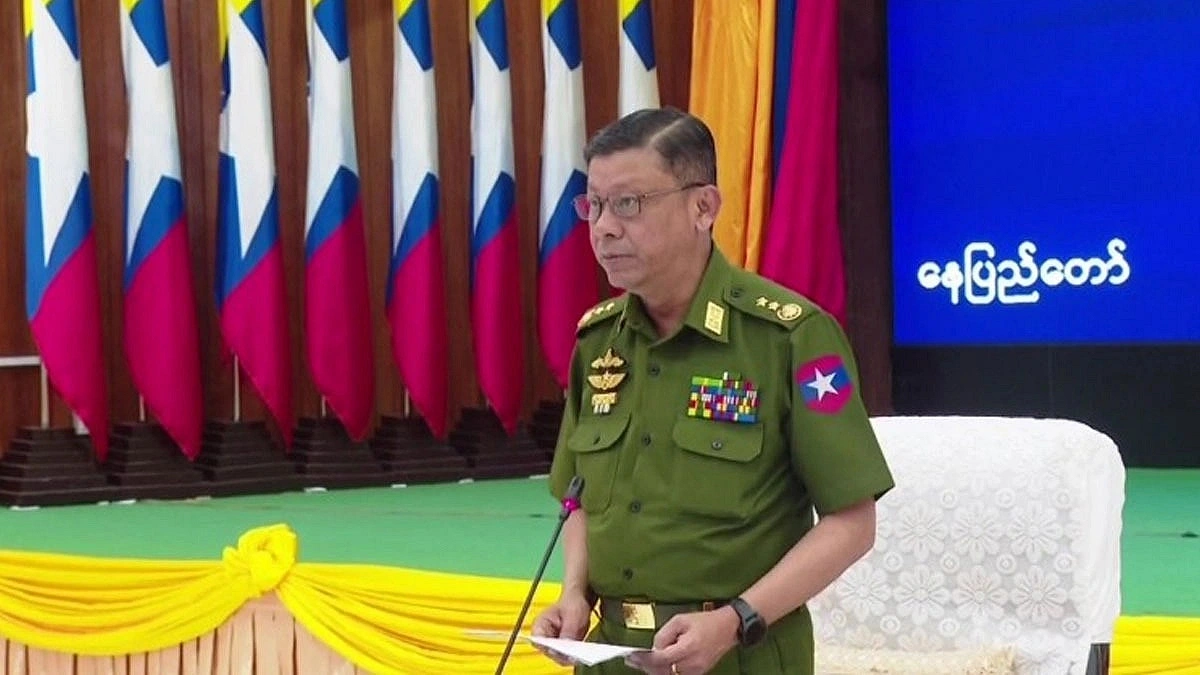
Drug-related and other criminal activities were discussed at a meeting of Myanmar's Central Committee on September 17. Photo courtesy: MITV
Poverty is deepening in Myanmar amid civil war and economic collapse, while the law and order situation has reached an extreme level. Against this backdrop, human trafficking, uncontrolled methamphetamine (meth) production and cross-border cybercrime have increased alarmingly in the country.
At the same time, China and the United States have intensified bilateral pressure on the junta to address the ongoing crisis and protect their respective economic interests.
According to data produced by Myanmar authorities, at least 83 human trafficking cases have been uncovered since the beginning of this year. A total of 235 people have been accused in the cases, while 143 victims have been rescued. Two-thirds of the incidents involved young Myanmar women being forced into marriages with Chinese men. Other cases involved forced labour, prostitution, sexual exploitation and even the removal of human organs.
Before the 2021 military coup, human trafficking was largely confined to conflict-affected areas in Kachin and northern Shan states. However, the current economic collapse and the influence of social media have allowed the practice to spread across Myanmar.
As poverty deepens under junta rule, trafficking incidents are also increasing at an alarming rate. According to the government’s own figures, authorities investigated 139 human trafficking cases nationwide last year and accused 402 people. The previous year, only 53 cases were reported. Of these, 35 involved forced marriages, while 34 were linked to China. However, the actual number of cases is believed to be much higher.
Myanmar’s Home Affairs Minister Nyunt Win Swe said traffickers are now luring young people into traps through fake job advertisements and promises of quick wealth on social media. Since January, junta-controlled media outlets have reported several cases in which women from low-income families were forced to marry Chinese men or give birth through surrogacy.
Before the 2021 military coup, most victims were residents of conflict-affected areas in Kachin and northern Shan. They were lured with promises of jobs in restaurants or factories. However, following the coup, economic collapse, mass displacement and the deterioration of law and order have caused trafficking to spread across the country. Social media has further facilitated the process.
China’s National Narcotics Control Commission warned last week that the Golden Triangle, where Myanmar, Thailand and Laos meet, remains one of the world’s largest methamphetamine production hubs, with most of the drug being produced in Myanmar’s Shan State. The information was presented at the Global Public Security Cooperation Forum held in Lianyungang.
Chinese officials said that in 2024, nearly half of the methamphetamine seized worldwide was confiscated in East and Southeast Asia. The figure increased by 48% the following year, reaching a record 349 tonnes.
The United Nations Office on Drugs and Crime (UNODC) issued a similar warning, stating that methamphetamine production in Shan State has increased exponentially since the 2021 military coup.
The commission said northern Myanmar has become a major hub for the smuggling of precursor chemicals, the key ingredients used to manufacture drugs. More than 100,000 tonnes of precursor chemicals enter the region every year, enough to produce around 1,200 tonnes of methamphetamine.
Beijing claimed that, based on information it provided, Myanmar authorities destroyed 13 drug laboratories and seized more than 1,400 tonnes of precursor chemicals along with 2.47 tonnes of methamphetamine during an operation in northern Shan State in January. It was the largest drug seizure in the country’s history, according to Beijing.
Meanwhile, Washington this week accused the Myanmar junta of failing severely to meet its international obligations on drug control. The United States said the junta had taken no effective measures to control Myanmar’s drug economy, turning the country into the world’s largest supplier of opium and one of the leading suppliers of methamphetamine. The list also includes neighbouring China, India and Laos as major drug production and transit hubs.
A UNODC report published in July said that syndicates operating in the Lancang-Mekong region are now involved not only in drug trafficking but also in cyber fraud, human trafficking and illegal hundi, or underground banking. Their integration of these activities has made cross-border criminal networks more complex and extremely difficult to suppress.
One of the main hubs is Tachileik, a border town in the Shan hills. Since January, the junta government has conducted raids there and arrested more than 500 Chinese nationals. They were allegedly involved in criminal activities together with citizens of Myanmar and other countries. When law enforcement operations intensify, criminals generally choose these remote border areas because they provide easy access to cross-border escape routes.
The junta government claimed that it had uncovered a massive online gambling network operating across several townships in Yangon. Thirty-six suspects were arrested and numerous computers, phones and bank accounts were seized. The authorities also claimed that around 400 million kyats (US$190,520) had been frozen.
The alleged mastermind of the criminal network was not a Chinese gangster from mainland China but a Taiwanese national named Pai Chih-yu. An investigation found that he had been running the operation from abroad since April 2025. Proceeds from the gambling operation were transferred to his overseas accounts. Locally, platforms such as 99 Legends were reportedly operated like professional companies, with human resources officers and accountants also employed.
In addition, junta forces raided two locations in Mandalay, the country’s second-largest city. They detained a Chinese ringleader named Cheng Shao-dai, five other Chinese nationals, and citizens of Indonesia, Malaysia and Myanmar, bringing the total number of detainees to 28.
The group allegedly defrauded victims of large sums of money by promoting fake or low-quality “anchored stones” and artificial jade through “livestream lucky draw” sales. After receiving the money, they would block the victims.
Source: The Irrawaddy
