
BMD has modern technology but lacks manpower to operate it

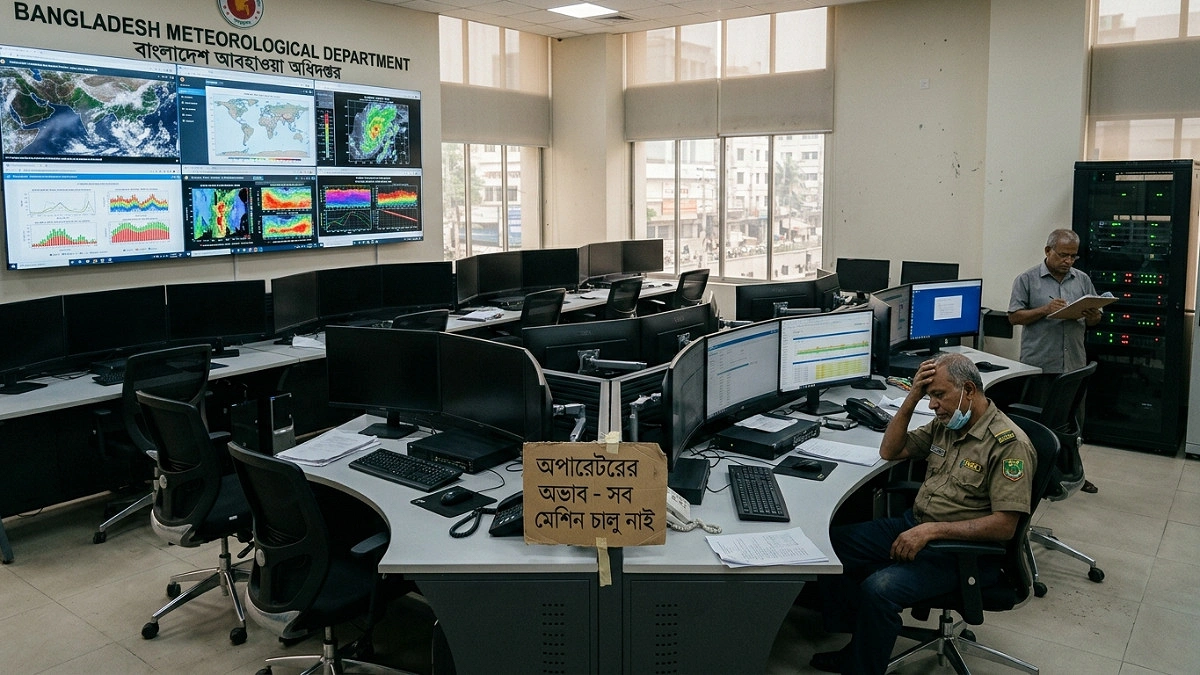
Photo drawn by AI.
The Bangladesh Meteorological Department works around the clock to answer questions such as whether a storm is approaching, when rain will begin, where temperatures are rising, and which direction a cyclone is heading. Weather stations across the country collect data at regular intervals on temperature, atmospheric pressure, humidity, wind speed and direction, and rainfall. Upper-air data is also collected. The information is then verified, analyzed, and reviewed to prepare forecasts and warnings.
However, the Meteorological Department, on which the country relies for early disaster warnings, is now facing a severe manpower shortage. Against 1,338 approved positions, only 580 officers and employees are currently working across the country. In other words, critical operations such as weather monitoring and forecasting are being carried out with less than half of the required workforce.
According to meteorologists, a minimum of 10 to 12 personnel are required to keep a weather station operational 24 hours a day. However, some stations across the country are being managed by only two or three employees. As a result, when an employee falls ill or goes on leave, additional responsibilities fall on the others. During emergencies, they are often required to work continuously for hours.
The first-class meteorological observatory in Maijdee, the district headquarters of Noakhali, regularly collects weather-related data, including temperature, rainfall, atmospheric pressure, and humidity. However, the center's normal operations have been disrupted by a prolonged manpower shortage.
Although the center is supposed to have 10 positions, only four officers are currently working there. The situation is almost identical at the first-class meteorological observatory in Hatiya, an island upazila of the district. The important center is operating with just three officers.
The manpower shortage is also acute in Bhola. The district's meteorological station has only two employees—an officer in charge and an observer. However, operating a station on a regular basis requires considerably more personnel.
The shortage is not limited to field-level stations; the central forecasting system is also facing a manpower crisis. According to relevant officials, the central office should have at least 20 officers and employees, but currently has only 15 to 16.
The entire weather-monitoring process operates 24 hours a day. Data must be collected from various stations at regular intervals and promptly sent to the central office. The information is then verified, plotted, stored, and analyzed. Finally, forecasts and warnings are prepared. A shortage of personnel at any stage of this lengthy process places pressure on the entire system.
Meteorologists concerned said that ensuring uninterrupted services would require more than simply filling the approved positions. Alternative or reserve personnel would also be necessary. Since the work is specialized and continues around the clock, the absence of even one employee places additional pressure on others.
Meanwhile, climate change is also altering the country's weather patterns. Changes are being observed in the behavior of storms, rainfall, floods, and cyclones. At times, certain weather events pose new challenges to forecasting.
However, the weather forecasting system has undergone significant changes in recent years. The use of numerical weather prediction models has increased. Data obtained from radars and satellites is also being utilized more effectively than before. The increased use of technology has improved forecasting capabilities.
However, manpower has not increased in line with technological advancements. As a result, despite having access to modern technology, meteorologists are often forced to work under pressure due to inadequate staffing.
Several meteorologists, speaking on condition of anonymity, said that operating many stations on a regular basis has become difficult with the existing workforce. The crisis is worsening day by day due to the lack of new recruitment.
They said employees are often required to work for extended periods during emergencies. In many cases, there are no dedicated backup teams to fill in when an officer falls ill or goes on leave.
Professor Dr. Md. Zillur Rahman of the Department of Disaster Science and Climate Resilience at the University of Dhaka said the stations of the Bangladesh Meteorological Department need to be further modernized. Many stations have become dysfunctional. At the same time, manpower must be increased to operate these facilities, he said.
“Bangladesh is a disaster-prone country. Therefore, the capacity of institutions such as the Meteorological Department must be further strengthened. Simply recruiting personnel will not be enough; they must also be trained to improve their skills,” he said.
Professor Zillur Rahman further said weather forecasting is a specialized, science-based task that requires talented and skilled personnel. “Issuing early warnings is not an easy task. To perform this work properly, it is essential to ensure adequate manpower alongside skills and training,” he said.
Those concerned also blame long-standing recruitment complications for the manpower shortage. Against 1,338 approved positions at the Meteorological Department, only 580 officers and employees are currently working.
According to officials, the department's manpower structure had long been governed by the 1984 recruitment rules. However, complications arose in the new recruitment process after the previous rules and orders were repealed. Department officials said new recruitment has effectively been suspended since 2017.
Mohammad Monwar Hossain, an administrative meteorologist in the administrative division of the Bangladesh Meteorological Department, said their recruitment process had been stalled for nearly 10 years.
“Although the organizational structure has been approved, the recruitment rules, or service rules (SRO), have yet to be finalized. As a result, we cannot proceed with new recruitment. The previous recruitment rules were repealed and are no longer in effect. This has also created complications in the promotion process,” he said.
He said the new organizational structure has been approved and the process of finalizing the recruitment rules is also nearing completion.
“We hope it will be finalized soon. In addition, a writ petition related to recruitment was filed on January 19, 2026. Once these issues are resolved, it will be possible to begin the promotion and new recruitment processes,” he said.
At a time when climate change is rapidly altering weather patterns, the challenges facing forecasting systems are also increasing. Modern technology has created new opportunities to address these challenges. However, alongside technology, adequate and skilled manpower is essential.
