

186 Bangladeshis Brought Home From Iran

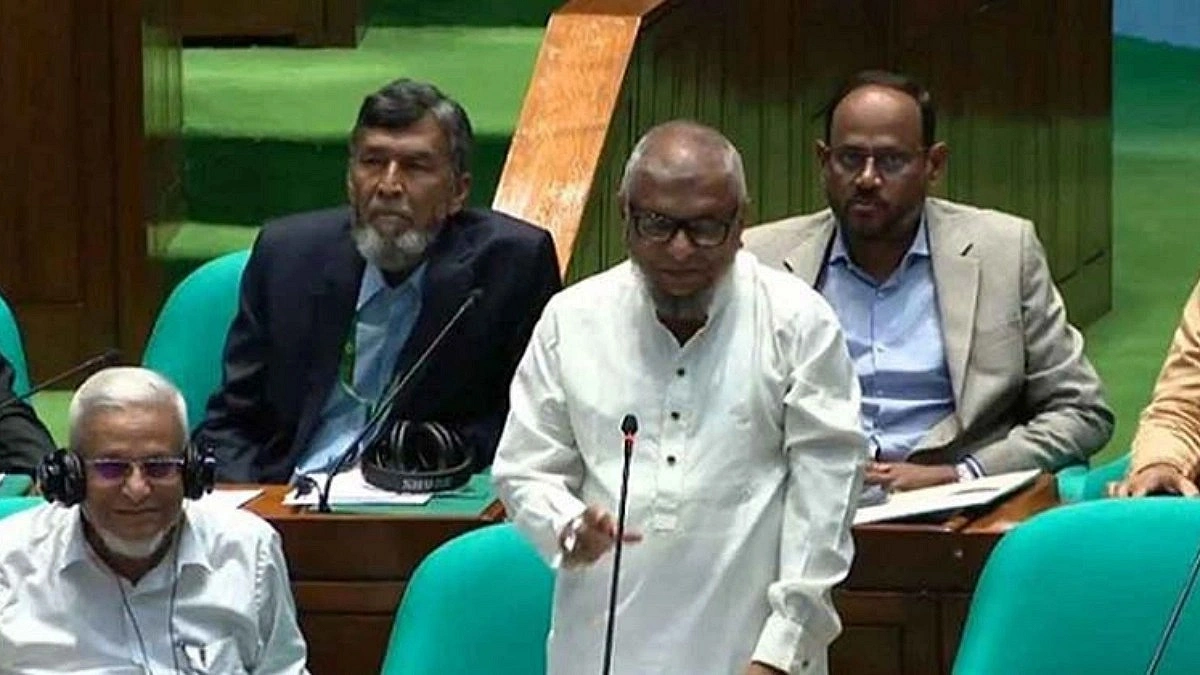
Expatriates’ Welfare and Overseas Employment Minister Ariful Haque Choudhury
A total of 186 people, including 12 women and eight children, have been brought back from Iran with funding from the Wage Earners’ Welfare Board amid the ongoing conflict in the Middle East. Expatriates’ Welfare and Overseas Employment Minister Ariful Haque Choudhury disclosed the information.
Bangladeshi migrant workers have also been repatriated from different countries at various times due to natural disasters and war situations.
The minister made the remarks on Thursday in the Jatiya Sangsad while responding to a question from BNP lawmaker Nilufar Chowdhury Moni of the reserved women’s seat. The question-and-answer session was chaired by Speaker Hafiz Uddin Ahmed.
The expatriates’ welfare minister said that 12 Bangladeshi expatriates have died so far in the Middle East conflict. Of them, one was buried in the respective country and the bodies of nine others have been brought back to Bangladesh. Their families have been provided financial assistance of Tk 35,000 for burial expenses from the airport and a special grant of Tk 50,000 each. Among the deceased, five died in Lebanon, three in Saudi Arabia, two in the United Arab Emirates, and one each in Iraq and Bahrain.
In response to a question from Meherpur-2 lawmaker Nazmul Huda, Minister Ariful Haque Choudhury said that bilateral discussions were held in April with a high-level Malaysian delegation regarding the recruitment of workers to Malaysia. The prime minister recently visited the country. A Malaysian delegation is scheduled to visit Bangladesh in July. “It is hoped that the path for sending Bangladeshi workers to the country will be eased very soon.”
Replying to a question from Chandpur-4 lawmaker Abdul Hannan, the expatriates’ welfare and overseas employment minister said that due to instability in the Middle East, initiatives have already been taken to reopen the Malaysian labor market and expand labor markets in Thailand, South Korea and Japan. The final draft of an agreement on worker recruitment has been sent to the Thai government.
In addition, Bangladesh embassies in different countries have been instructed to submit specific action plans to increase manpower exports after assessing labor demand in their respective countries.
In response to a question from Kushtia-2 lawmaker Abdul Gafur, the minister said that according to data from the Bureau of Manpower, Employment and Training (BMET) server, a total of 10,918,009 Bangladeshis has gone to various Middle Eastern countries for overseas employment from 2004 through June 30 this year. However, a large number of them have returned home after completing their overseas employment. Since there is no data on returning workers, it is not possible at present to provide the exact number of those currently employed abroad. A memorandum of understanding has already been signed between BMET and the Special Branch (SB) of Bangladesh Police to facilitate the exchange of information on returning workers.
Responding to a question from Lalmonirhat-1 lawmaker Md. Hasan Rajib Pradhan, the expatriates’ welfare minister said that four of the 30 Bangladeshi workers who went to Russia under employment contracts and were later forcibly sent to war have died. Diplomatic efforts are underway through the Bangladesh Embassy to bring the remaining workers back home.
The minister said that on April 24, three recruiting agencies — holding RL license numbers 1455, 1428 and 2505, sent 30 Bangladeshi workers to Russia after obtaining manpower clearance from BMET.
He said that after receiving information that the workers were being forcibly prepared for war and efforts were being made to send them from camps to the battlefield after arriving in Russia, the government took action. Accordingly, on June 15, a letter was sent to the Bangladesh Embassy in Moscow, Russia, instructing it to take necessary measures to rescue the distressed Bangladeshi workers and bring them home.
Ariful Haque Choudhury said, “According to the latest information received, four of the 30 workers have died. The government hopes to bring back the remaining workers through communication with the relevant Russian authorities.”

