

Where Danger Is Not Fiction

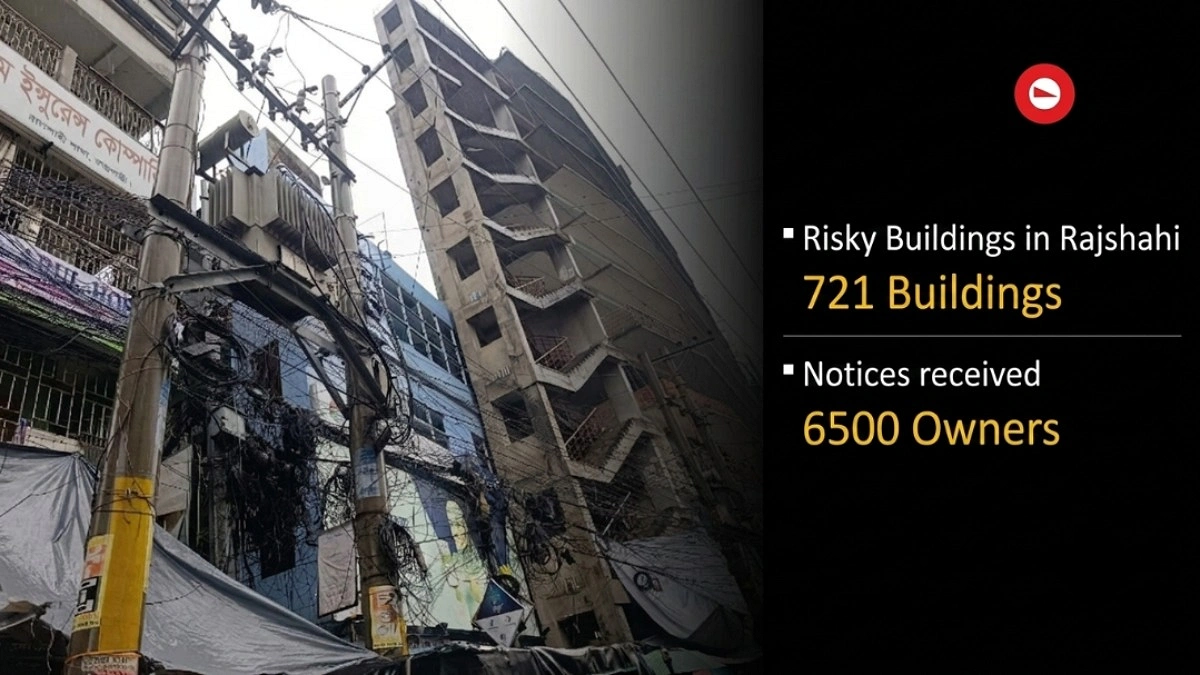
Graphics: Agamir Somoy
Rows of multi-story buildings rise on both sides of narrow streets in Rajshahi city, creating a dense urban landscape filled with traffic, crowds, and constant noise. At first glance, everything appears normal. But a closer look reveals a different reality.
In many places, buildings stand dangerously close to one another. In others, there is no open space at all. Some lanes are so narrow that even fire service vehicles would struggle to enter. Without the awareness of city residents, potential disaster zones are quietly being formed across the city.
Experts say this danger is not fiction,it is real and growing.
According to Rajshahi Fire Service data, at least 721 buildings in the city are currently classified as highly vulnerable. Meanwhile, the Rajshahi Development Authority (RDA) reports that out of 1,245 multi-story buildings in the district, 848 were constructed either without leaving required road space or in violation of building codes.
These figures are more than statistics. They represent the safety and lives of thousands of people.
Once known as one of Bangladesh’s most planned and clean cities, Rajshahi was recognized for its wide roads, open spaces, and orderly residential areas. However, over the past two decades, that image has changed significantly.
With rising population, increased housing demand, and commercial expansion, the city skyline has filled with multi-story buildings. Behind this visible development lies a growing concern.
Two decades ago, the 10-story Life Insurance Corporation building was the tallest structure in the city. Today, buildings of 8, 10, 12 stories and even higher dominate different areas. However, a large portion of these structures has been constructed without adhering to safety regulations and building codes.
RDA data shows that nearly 68 percent of multi-story buildings were constructed without maintaining required road space. As a result, emergency response operations in these areas could face serious challenges.
In areas such as Uposhohor, Shaheb Bazar, Laxmipur, Vodra, Kadirganj, and Shiroil, field observations reveal buildings standing directly along road edges. In some locations, the gap between two adjacent buildings is so narrow that even sunlight barely reaches inside.
Urban planners warn that such irregularities are not merely aesthetic concerns but a major threat to public safety.
A nine-story building near New Market intersection in the Uposhohor area has become a widely cited example of these concerns.
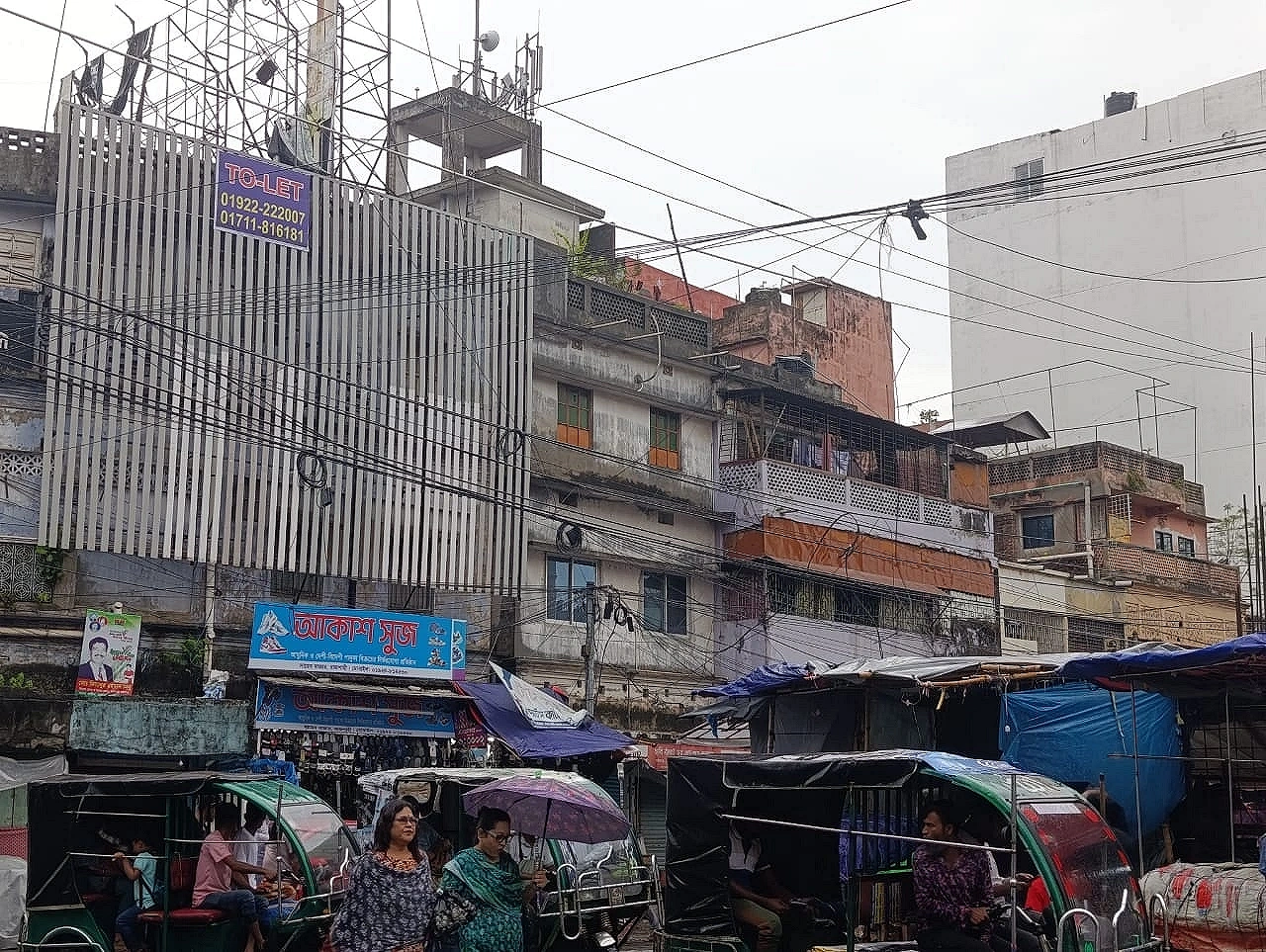
Regular Monitoring Is Essential to Ensure Planned Urbanization
Sources familiar with the matter say the building in question was developed and sold as residential flats through a private real estate developer. The Rajshahi Development Authority (RDA) later discovered that the structure had been built without the required approvals, prompting a case to be filed. A similar allegation has also been raised against the 12-story SS Tower in the Shaheb Bazar area.
In many cases, building owners reportedly obtained approval for up to seven stories but later added two or three additional floors without authorization. Officials say such practices have not only violated regulations but have also significantly increased structural vulnerability and accident risk.
Rajshahi Fire Service and Civil Defense Assistant Director Mohammad Abdur Razzak said 721 buildings in the city—including residential houses, educational institutions, and commercial markets—are currently in a highly vulnerable condition.
“Many of these buildings lack fire safety systems. In some cases, emergency exit routes are too narrow, while in others, fire-fighting equipment is insufficient. Due to non-compliance with building regulations, there is a serious risk of major accidents or disasters in the future,” he said.
Local resident Abu Khayer Chanmia expressed concern over emergency response challenges. “With buildings being constructed so closely together, it is doubtful whether fire service vehicles could even enter if a major fire breaks out. In the event of an earthquake, the situation could be even worse,” he said.
Experts warn that the risks extend beyond fire hazards to include earthquakes. Buildings constructed without adherence to building codes are more likely to suffer severe damage during strong tremors. Unauthorized additional floors, structural deviations, and design flaws could significantly amplify potential losses.
Professor Dr. Md. Abdul Wakil, head of the Department of Urban and Regional Planning at Rajshahi University of Engineering and Technology (RUET), said enforcement must go beyond notices and lawsuits.
“It is not enough to simply issue notices or file cases. Illegal portions of unauthorized buildings must be demolished. The RDA must take a stricter field-level approach and strengthen mobile court operations. Otherwise, these irregularities will not stop,” he said.
He added that regular monitoring is essential to ensure planned urban development.
Meanwhile, a section of city residents allege that collusion between certain officials and influential groups has enabled unauthorized construction, with violations allegedly being overlooked in exchange for financial benefits. The RDA, however, has denied these allegations.
RDA Acting Supervising Engineer Md. Abdullah Al Tarik said more than 150 mobile court operations have been conducted over the past five years, leading to the removal of illegal extensions from 140 buildings. He said enforcement drives against violators will continue.
RDA Chief Executive Officer Md. Mashiur Rahman stated that legal procedures, including notices and lawsuits, take time but insisted that there is currently no scope for approving plans through undue influence.
According to RDA sources, more than 6,500 building owners have been issued notices over the past decade for unauthorized construction. At present, 14 related cases are pending in court.
However, the question remains: despite years of notices, legal action, and enforcement drives, why do hundreds of risky buildings still stand across Rajshahi?
Experts warn that achieving planned urbanization is not just about increasing infrastructure—it requires strict enforcement of safety regulations and the rule of law. Without it, today’s statistics may translate into tomorrow’s tragedies, turning the city’s skyline into a stage for a preventable human disaster.

