
Finance Bill 2026 Passed in Parliament
- Opportunity to whiten black money scrapped, along with several amendments

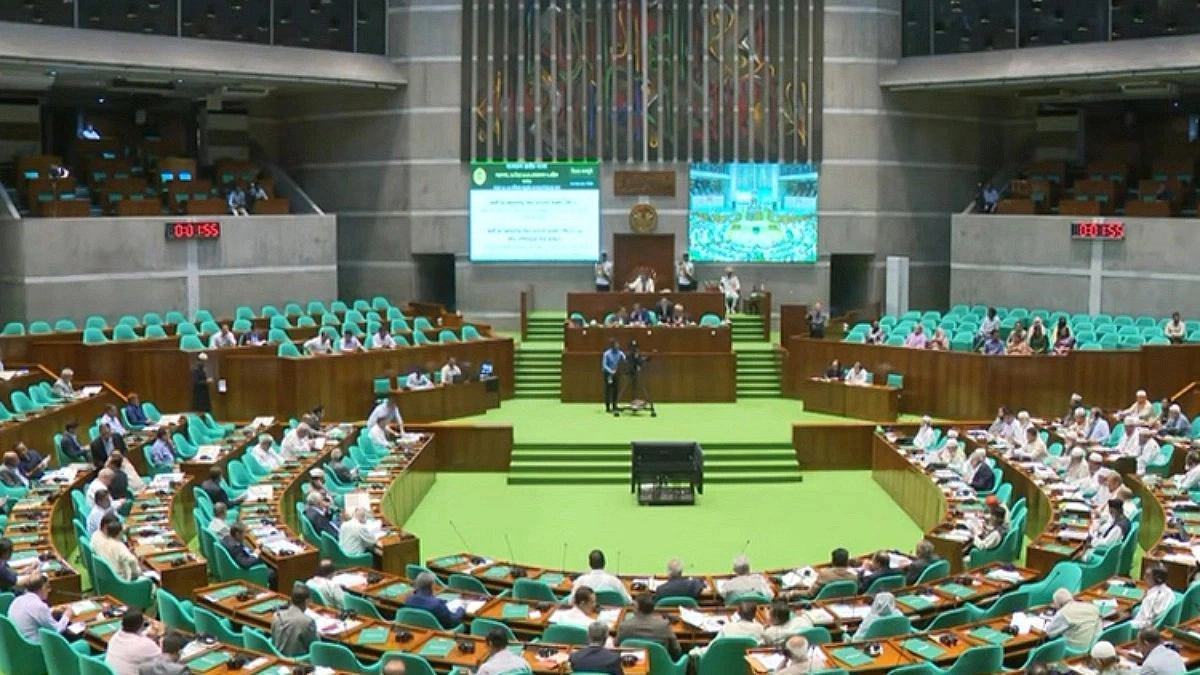
National Parliament. Photo: Collected.
The Finance Bill 2026 was passed in the National Parliament today (Monday) afternoon by voice vote, after incorporating several amendments including the removal of the scope for whitening black money.
Under the passed bill, the tax-free income limit for individuals has been raised to Tk 4 lakh.
Earlier, there was a lengthy and lively discussion on the proposals for public scrutiny of the bill tabled by Members of Parliament, as well as on the general principles of the bill. At the start of the session, Finance Minister Amir Khosru Mahmud Chowdhury moved to have the "Finance Bill, 2026" taken up for immediate consideration in Parliament to implement the government's fiscal proposals and amend certain laws.
After the bill was placed on the table, several members, including independent MP Rumeen Farhana from Brahmanbaria-2, raised questions on various issues—such as the large deficit budget, the burden of taxes and VAT, unprecedented corruption in the banking sector, mismanagement in health and education, and the reality of loan assurances from the Prime Minister's China visit—and moved for further scrutiny of the bill through a proposal for public opinion.
Following lengthy discussions on these criticisms and proposals by the MPs, the Finance Bill was finally passed with multiple amendments.
In his concluding remarks on the budget after the bill was passed, Finance Minister Amir Khosru Mahmud Chowdhury said that although the current government inherited an extremely weak economy and fragile institutional framework, it is fully optimistic about steering the country towards sustainable growth. No matter how big the challenges, Bangladesh will be able to overcome all obstacles through effective leadership, strong institutions, efficient public administration, and active participation of the people.
In response to questions raised about the budget's inflation target of 7.5% and GDP growth target of 6.5%, the Finance Minister said that the current government inherited a devastated economy due to long-standing policy failures, unchecked corruption, money laundering, manipulation of exchange rates, and geopolitical instability in the Middle East. However, he expressed confidence that the crisis can be overcome through positive trends in agriculture, industry, services, and remittances, along with the government's firm policy measures.
Other key changes in the passed bill include:
Tax on private universities reduced: The proposed budget had maintained a 10% tax on private universities. The Finance Bill has reduced it to 5%.
VAT on digital advertising lowered: The proposed 15% Value Added Tax (VAT) on advertisements on online video-based services, social media, and search engines has been reduced to 5%.
VAT redefined for the gold business: The VAT structure for ornaments made of gold, silver, platinum, and diamond has been newly determined. Additionally, a provision for tax deduction at source at the rate of 50 paisa (0.5%) has been added for the purchase of these ornaments.
VAT exemptions in fish and telecom sectors: VAT at the supplier level for fish supply, and the VAT imposed on the revenue share of the telecommunications regulatory authority, have been withdrawn.
Customs duties reduced for local industries: Customs duties and taxes on the import of raw materials for various industries—including the shrimp industry, pharmaceutical industry, electrical cables, PVC and PET resins, refined copper, and fire safety equipment—have been reduced or withdrawn.
Additional tax for low dividend payouts: If a listed company distributes dividends of less than 30% of its net profit after tax, it will have to pay an additional 10% tax on the shortfall. However, banks, insurance companies, and financial institutions will remain outside the purview of this provision.
