

Hospital Elevators or ‘Moving Coffins’!
- Exposed Wires, Broken Panels Taped with Scotch Tape, and No Operators Either

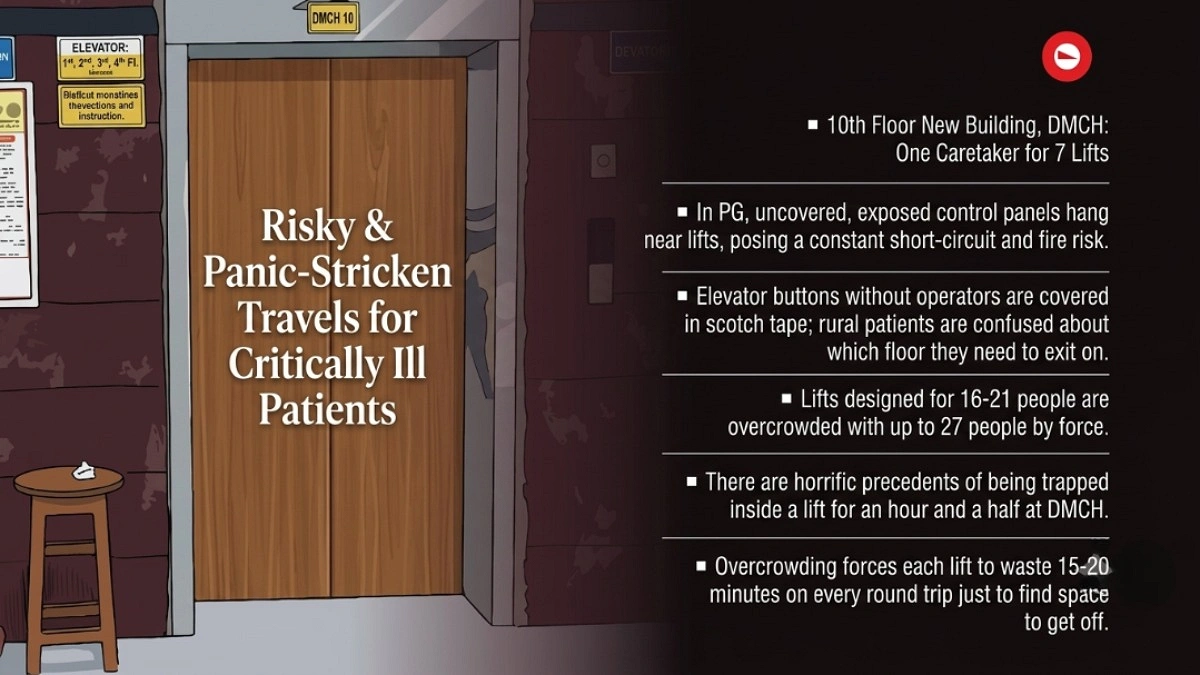
Graphics: Agamir Somoy generated by AI
There are multiple elevators, but only one staff member is assigned. Who even ensures whether that person is actually performing their duty? As a result, it is impossible to know who is on duty and who signs the attendance register and goes home. Many elevators are in a dilapidated condition. This is how elevator safety is being monitored in the two major hospitals of the capital.
Despite visible safety gaps, patients, attendants, and even doctors are forced to rely on these systems daily.
In Madaripur District Hospital, 10 people, including women, were recently trapped inside an elevator and rescued by firefighters after two hours. Although the incident occurred on June 16, hospital authorities have shown little visible improvement in elevator safety management in Dhaka’s major hospitals.
At Dhaka Medical College Hospital, the emergency department remains overcrowded from morning onward, with critically ill patients arriving from across the country. While elevators are available to ease movement across multi-story buildings, most operate without attendants.
A visit to the hospital’s National Fistula Center building revealed patients and relatives struggling to understand which elevator or floor they needed. In one case, a button panel had been patched with tape, raising fears among users.
55 year old Asha Begum, who traveled from Barishal, said her patient has been admitted to the fifth floor for two days. “At my age, climbing stairs is impossible. I just stand outside because I cannot figure out which button goes up or down. I only enter if someone else is inside,” she said.
Across five elevators in the same building, none were found to have dedicated operators. The situation is even more chaotic in the hospital’s new 10-story building, which has seven elevators serving thousands of daily users—but only one caretaker assigned.
The caretaker appears disengaged, often sitting away from the elevator area. With capacities ranging from 16 to 21 passengers, elevators are routinely overcrowded. Passengers rush in without queue discipline, often exceeding limits and preventing doors from closing.
Arguments inside elevators are common, particularly over who should exit. According to visitors, this has become a daily occurrence.
Hamza Sheikh, a patient attendant from a rural area, described a recent experience in which 25 people entered an elevator designed for 16. “Even a stretcher was inside. The door would not close due to overload, but no one wanted to get out. It turned into a chaotic argument,” he said.
He added that without an operator, elevators feel like 'moving coffins,' warning that emergency situations could turn deadly if systems fail mid-operation.
A similar situation exists at Bangabandhu Sheikh Mujib Medical University (BSMMU). Five elevators in the Laboratory Service Center building operate without any attendants, while only one caretaker manages two elevators in the Basic Science building.
In Block D, one person is responsible for four elevators. As a result, overcrowding is routine. In one instance, the lower control panel of an elevator was found exposed, with electrical components, lights, and switches hanging without protective covers—raising concerns over potential short circuits or electrical hazards.
Faisal Ahmed, a 35-year-old patient, said heart patients visiting hospitals daily are at serious risk. “If an elevator gets stuck mid-way, panic and lack of oxygen could trigger heart attacks. Having dedicated operators could prevent such situations,” he said.
Even in Block C, where four elevators serve heavy traffic, attendants are often absent from their posts.
Past incidents highlight the risks. On May 12, 2024, at Shaheed Tajuddin Ahmad Medical College Hospital in Gazipur, heart patient Momtaz Begum (50) died after being trapped inside a malfunctioning elevator during a power outage. No operator was present at the time, and firefighters later recovered her body.
In another incident at Dhaka Medical College Hospital last year, four people were trapped in an elevator for nearly an hour and a half after a power failure left the cabin stuck between floors.
Experts warn that such incidents are preventable.
Professor Dr. Hasan Mohammad Mostafa Afroze of the Department of Mechanical Engineering at DUET said modern elevators are equipped with multiple redundant safety systems. “In advanced countries like Japan or Singapore, elevator accidents are extremely rare because systems are properly maintained,” he said.
“In our country, breakdowns occur frequently due to poor maintenance and, in some cases, substandard equipment. This is a serious issue and must be treated as such—especially in hospitals and critical public facilities,” he added.
He cited his own university as an example, noting that elevators there undergo monthly maintenance and annual full-system inspections using a checklist of nearly 40 items to ensure safety.
Public health experts and engineers say hospital elevators are far more sensitive than those in shopping malls or residential buildings, as they regularly carry stretchers and wheelchair-bound patients. They stress that every elevator must have a trained operator on duty at all times.
Without urgent intervention, they warn, the current situation could lead to catastrophic mechanical failures or even fire-related disasters at any time.

