
How did we become such an anti-child society?

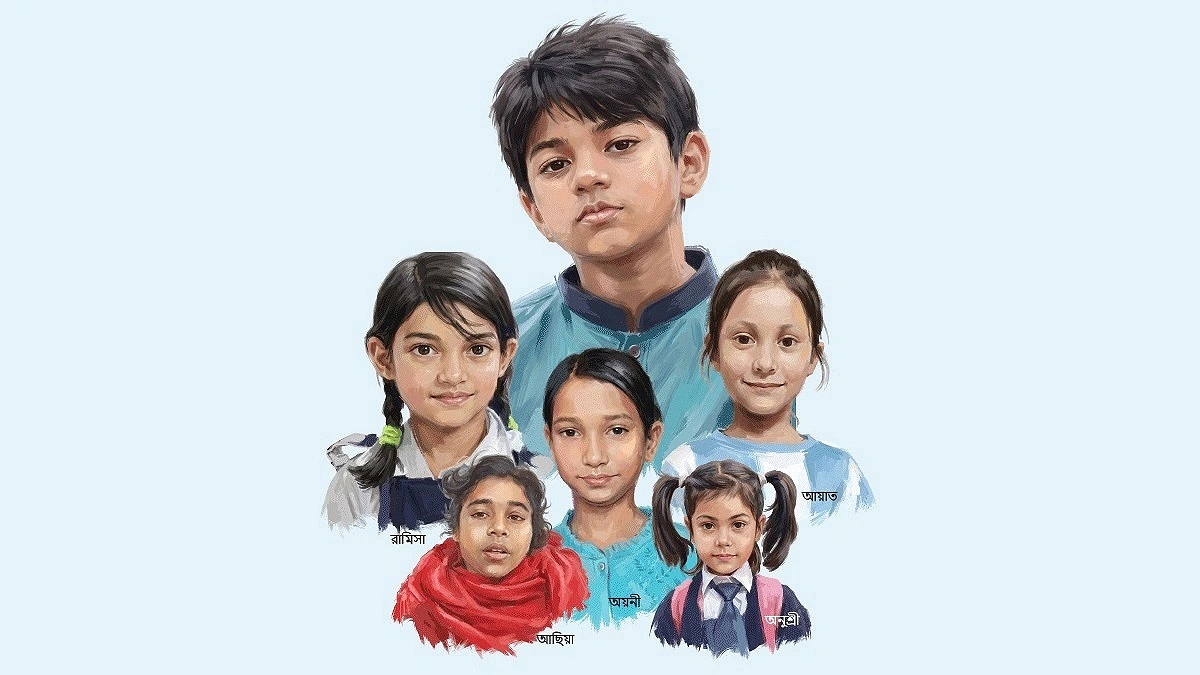
Graphics: Agamir Somoy
A group of children are coming along laughing and making noise. School is over. It is afternoon and the sun is shining. There is a wide road for walking with a separate space for bicycles. Everything around seems to allow children to speak. There are no horns and no unnecessary chatter. Then comes a road crossing. All the vehicles become fully alert. The most important members of society are moving forward. The children cross the road together and bow their heads to say thank you. Inside the cars, with our hands on the steering wheels, we respond with softened eyes and hearts. Perhaps this is what the human world is supposed to be like.
You can understand how human friendly a state is by looking into the eyes of its children. You can understand how much a society has truly become a society by observing how an adult speaks to a child. Does a car stop when a child crosses the road? Where does the child go when afraid? Does anyone listen when the child says no? Can the child go out in the afternoon and return home safely? The character of a state is written in these things. When I went to Japan, I first understood that a child is part of a larger plan. The child has been considered in the planning of society, the state and the roads. As an anthropologist, I understand that people are shaped. Children are also taught that the human body has dignity.
Then I look at my own country. Do we have a country? A state or a society? Apratim was supposed to go out to take pictures. He was supposed to return home. What could be more normal than this for a 13-year-old child? Yet Apratim is not alone. In the first eight months, the bodies of 36 children were recovered after they went missing. Another 155 children were killed in various incidents of murder and abuse. Among 15,717 children who went missing in the first seven months of the year, 2,038 were still missing at the time. Stop for a moment at the number 2,038. That means 2,038 homes and 2,038 families waiting. We quickly forget how many people’s lives a number carry.
We are also quick to come up with explanations. Children stay on their phones. Social media is ruining them. Teenagers are involved in gangs and taking drugs. There are real crises. But we cannot cover up the larger truth with these explanations. What have we left for children? Playgrounds? Safe sidewalks? Libraries? Places to walk in the afternoon? Families where children can disagree? Schools where they have value beyond their grades? We have taken away their playgrounds. We have taken away their roads and their time. We have taken away their control over their own bodies. Then when they search for their own world on a small screen, we blame the screen. We have turned both the inner and outer worlds of children into violent jungles.
We also talk about teenage gangs as if some teenagers have created criminal institutions on their own. Yet gangs can sometimes also be organizations of belonging. Who am I? Who belongs to me? Who will stand beside me? Where am I important? If society does not provide healthy answers to these questions someone else will. Sometimes it is an older brother figure. Sometimes a gang. Sometimes drugs. So when a teenager turns to drugs and we simply say that the child has been ruined, I am left with a question. What happened before the child was ruined? We always fight against the final scene while leaving the earlier scenes untouched.
The minds and bodies of our children have long been caught in the waste grounds of state budgets, family power, institutional reputation and politics. Children are humiliated. When they are beaten, we call it discipline. When they are frightened, we say we are teaching them how to become better people. We think everything will be fine if children grow up quickly. But it does not. Our surroundings are filled with traumatized children. They grow older and then we are surprised and ask why people are so violent. Why is politics so cruel? A child who has learned that they must remain silent before powerful people, that beating is discipline, humiliation is education, fear is politeness and questions are disobedience, will not suddenly become a democratic person at the age of 18. Childhood is our first school of politics.
That is why I believe almost all of our conventional politics is anti-child. Children are present in speeches as the next generation, the future of the country and the Bangladesh of tomorrow. But where is the child of today? They do not have the right to vote. As a result, their sidewalks, playgrounds, bodies, mental health, leisure, safety and privacy do not become major political questions. We push children toward a time called the future and by the time they reach it their childhood is already over. In the name of the future, we are consuming the present.
Then a child is killed. We protest, change our profile pictures, light candles and demand justice. A few days later another incident happens. Another child, another picture and another protest. But what does a protest achieve if it does not create lasting memory and lasting action? If the society that made that death possible remains unchanged, then after each death we are only creating noise for a few days. If that death does not leave a permanent mark somewhere, our grief also becomes a consumer product. We grieve and then scroll. We are the enemies of childhood.
This entire world seems like a living protest. A child being unable to cross the road safely is a protest. Not having ownership of one’s own body is a protest. The body of a poor child being worth less is a protest. A boy being unable to cry is a protest. A girl’s world being made smaller in the name of her safety is a protest. A teenager needing a gang to feel important is a protest. Wanting to escape the world through drugs is also a protest. These are not separate crises. They are different faces of the same anti child society.
We protest. We change governments. We dream of a new state. We talk about development. But where does our politics lead if we do not change the world for children? Apratim was supposed to return home. Not only Apratim but every child. A child will go out in the afternoon, spend time with friends, take pictures, play, make mistakes, be a little late and eventually return home. In a humane society, this cannot be a luxury.
We often say that children are our future. I no longer believe that. Children are not the future. They are human beings. They have the right to their fears, joy, curiosity, privacy, disagreement, dignity and the right to see the world in their own way. The test of a society is not only what we will leave for children in the future. It is also how much we allow them to live today. And if a society cannot keep the small human beings of its present safe then no matter how much we talk about politics, development or civilization, somewhere we are still surviving by consuming our children.
Writer: Anthropologist and Teacher
