
13,000 Lawsuits Acting as ‘Speed Breakers’ to Smooth Education

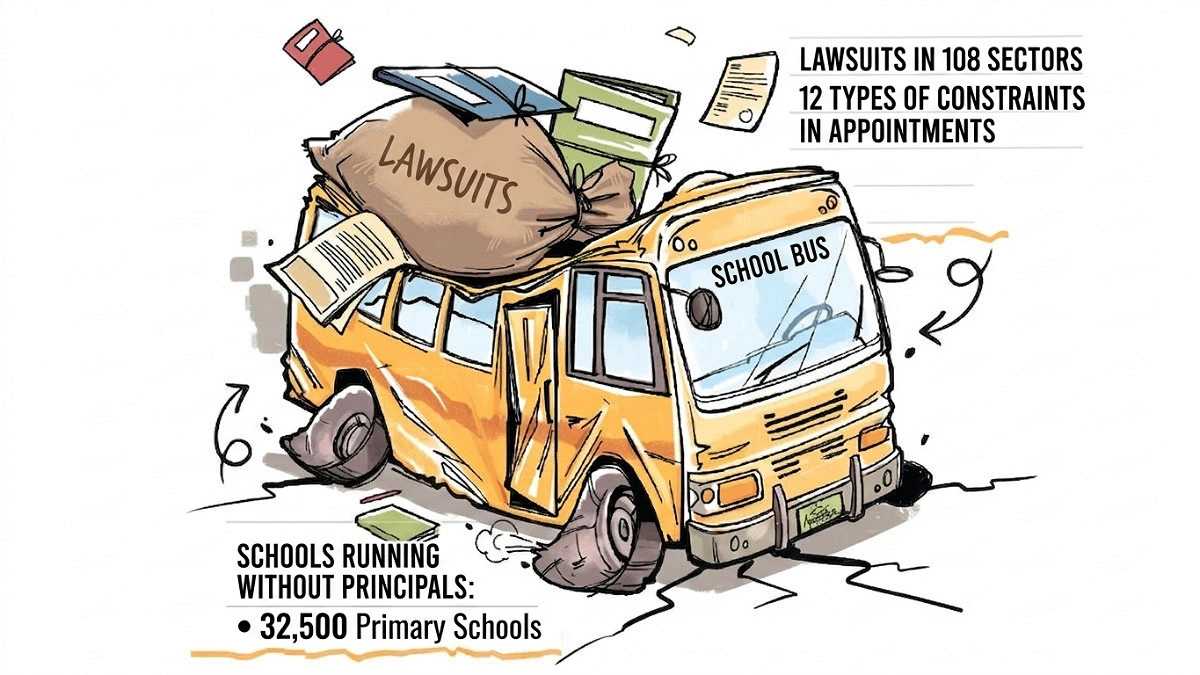
Agamir Somoy image regenerated by AI.
Ali Ahmed School and College in Khilgaon, the capital, now lies in eerie silence. Despite having around 2,500 students, the institution has virtually shut down due to counter-lawsuits over control of the principal’s chair. For the past six months, teachers and staff have not been paid. As a result, teachers have stopped coming to school, and students have gradually drifted away from their studies.
This is not an isolated case. Across the education and primary and mass education ministries, their three divisions and 16 departments, 11 education boards, and public and private universities, a total of 13,078 lawsuits are currently pending. These cases are severely disrupting normal operations, including teacher recruitment, promotions, supervision, MPO (monthly pay order) processes, and the formation of managing committees. Stakeholders describe these lawsuits as “speed breakers” slowing down the entire education sector.
According to information from the legal wings of the ministries, nearly 30 percent of the ongoing cases were filed after the political changeover of 5 August 2024. Most of these cases revolve around school and college governing committees and the appointment of heads of institutions. As a result, hundreds of educational institutions are facing administrative crises. In some places, teachers are drawing salaries without attending school; in others, salaries have been completely suspended. Elsewhere, recruitment and promotions remain stalled while institutions wait for court directives. The situation is worst at the primary level.
Expressing his frustration, Education and Primary and Mass Education Minister Ehsanul Haque Milon said that wherever he turns, he encounters legal complications. As a result, he is unable to take many important decisions. He questioned whether he should spend his time fighting lawsuits or focus on education policy. The situation, he said, has become so dire that special courts or dedicated benches are needed to ensure the speedy disposal of education-related cases. He added that the matter has already been discussed with the Law Minister.
The minister noted that since most of the cases are filed against the ministry or its directorates, normal operations and policy-level decisions have come to a standstill. Due to ongoing litigation, the ministry has been unable to grant promotions to 32,500 primary school teachers. Without these promotions, the recruitment of another 32,000 new teachers has also become impossible.
Investigations further reveal that hundreds of teachers appointed under the “SESDP” project, launched to promote science and technical education at the secondary level, are also entangled in legal disputes. These teachers, who played a key role in improving mathematics and science results between 2007 and 2017, are still facing cases regarding the permanency of their jobs and their appointments. Even if the ministry wants to deploy them, it cannot do so. As a result, laboratory equipment worth crores of taka in hundreds of schools across the country remains locked away and is gradually being damaged due to lack of use.
Documents from the legal wing of the ministry show that under the two education ministries there are three divisions, 16 departments, and 11 education boards. In addition, there are 170 public and private universities. Across these bodies, a total of 13,078 cases are pending. Of these, 9,652 cases fall under the Ministry of Education alone—8,493 in the Secondary and Higher Education Division and 1,159 in the Technical and Madrasa Education Division. Meanwhile, the Ministry of Primary and Mass Education has 3,426 cases, of which 3,282—around 96 percent—are against the Directorate of Primary Education. The remaining cases include 54 at the Bureau of Non-Formal Education, 54 at the Compulsory Primary Education Implementation Unit, and 11 at the Shishu Kalyan Trust.
5,831 Lawsuits at DSHE: Secondary and Higher Education Division Bears the Heaviest Burden
The education sector faces the highest number of lawsuits in the Secondary and Higher Education Division, with a total of 8,493 cases. Of these, the Directorate of Secondary and Higher Education (DSHE) alone accounts for 5,831 cases—about 68 percent of the total. As a result of these cases, teacher recruitment in schools and colleges has stalled, and in many institutions even salary and allowance payments have been suspended. Most DSHE-related cases involve challenges to recruitment and promotions, the formation of school and college managing committees, MPO-related issues, in-situ postings, and OSD attachments. The case list also includes disputes over salary bills, MPO approvals obtained using forged documents, and student admission issues.
1,663 Lawsuits Involving Education Boards
Across the country’s 11 education boards, there are 1,663 pending cases. Of these, 1,552 are under the nine general education boards, while 111 involve the Technical and Madrasa boards. The Dhaka Board tops the list with 273 cases, followed by Comilla with 263, Rajshahi with 209, Dinajpur with 183, and Mymensingh with 163. Sylhet Board has the fewest cases at 69. The Technical Board has 54 cases and the Madrasa Board 57. Legal officers of the education boards say that about 71 percent of all board-related cases stem from disputes over the formation of school and college managing committees, re-scrutiny of examination results, governing body conflicts, and challenges to various administrative decisions. They note that courts are often being used in power struggles to take control of committees, resulting in prolonged delays in budget approvals, salary disbursements, and development work in schools and colleges.
In addition, there are 585 cases at NTRCA, 273 at the University Grants Commission, 163 at the National University, 88 at NCTB, and 78 at the Education Engineering Department.
30 Percent of Cases Filed After 5 August
About 30 percent of all cases were filed after the political changeover on 5 August 2024. A large share of these cases relates to the dissolution of ad hoc school and college committees or the formation of new ones. Former committee members have gone to court either to regain their positions or to challenge the legality of newly formed committees. More than 1,700 such cases have been filed. As a result, academic activities are being severely disrupted in at least 577 institutions. Many of these institutions have no regular head and, in some cases, multiple competing committees. This has left ministries, boards, and directorates unable to officially correspond with them.
108 Categories of Litigation, 12 Types of Recruitment Disputes
Education administrators and legal officials have identified 108 categories of cases, with 25 to 30 issues recurring regularly. The largest number of cases arise from recruitment and promotion disputes, grading and seniority conflicts, and MPO and salary-related problems. Other frequent causes include departmental disciplinary action and dismissals, quota and nationalization issues, sibling quotas in admissions, school fees and extra charges, forged certificates and fake appointments, pension disputes, audit objections and financial irregularities, and legal challenges to decisions by education boards and universities. There are also cases related to public examinations and anti-corruption matters. Case records show that recruitment processes alone generate litigation due to 12 different types of procedural flaws, while 18 types of cases challenge school and college managing committees. In addition, at least 32 other types of cases related to promotions, absorption, quotas, and admissions are regularly being filed.
Crisis of Panel Lawyers and Inadequate Fees
The ministries and directorates appoint separate panels of lawyers to handle these cases, but here too there is a severe shortage. Due to a lack of sufficient legal experts and weaknesses in presenting documents, the state often loses important cases. The Ministry of Finance has set a fee structure for panel lawyers: 20,000 taka for preparing petitions and replies, 20,000 taka for final hearings, and 3,000 taka for legal opinions, with slightly higher fees in the Appellate Division. This structure discourages experienced lawyers from taking up government cases. As a result, plaintiffs may hire lawyers charging hundreds of thousands of taka, while the government relies on lawyers paid only 20,000 taka. Panel lawyer Barrister Syed Nafiul Islam said that the fees paid by ministries and directorates are extremely low, and that he handles such cases mainly out of a sense of duty to the country.
Expert Opinion and Lack of Coordination
Professor Borhan Uddin Khan of the University of Dhaka’s Law Department believes that most education-related cases are driven by personal interests. He suggests that before entering legal battles, strong administrative tribunals should be formed at the departmental level to resolve disputes. He also emphasizes the need to appoint permanent legal experts in each directorate rather than relying solely on panel lawyers, and to ensure regular monitoring.
There is already a high-level monitoring committee, chaired by the Cabinet Secretary, to oversee government cases. The committee meets once every three months and includes secretaries from the law, legislative, and home ministries. However, the rate of case disposal remains very slow. Although ministries and divisions are supposed to hold monthly meetings, these are not held regularly. Officials from the legal wing of the education ministry say that a lack of coordination between government prosecutors and directorates is a major reason for delays. Failure to submit documents to courts on time often results in the government losing cases.
