

Government Employees Top the List of Bribe-Takers, Politicians Follow

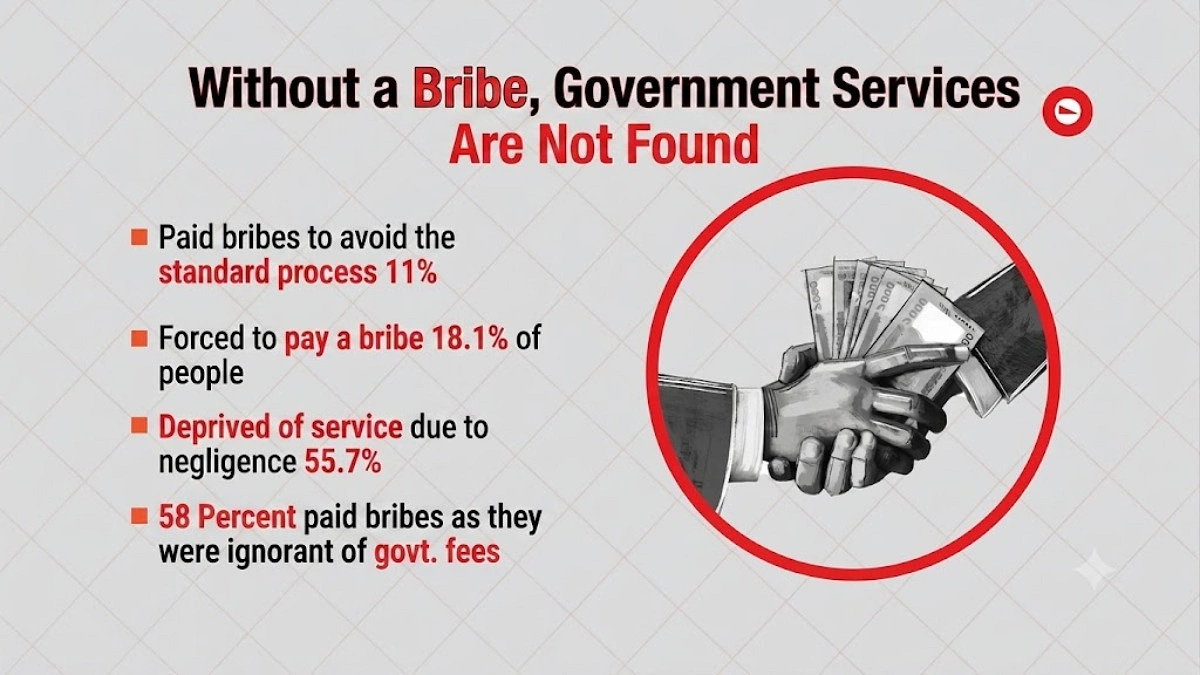
Agamir Somoy graphics regenerated by AI.
The number of people falling victim to bribery in the country has increased. Government employees are at the top of the list when it comes to taking bribes. Out of every 100 government employees, 91 take bribes — a figure nearly five times higher than any other sector.
These statistics emerged from the latest report by Transparency International Bangladesh (TIB). According to the data, politicians come next after government officials. Out of every 100 political figures or public representatives, 19 take bribes. Following politicians on the bribe-taking list are brokers (middlemen). Last Thursday, TIB published its report on the findings of the "National Household Survey-2025," in which members of 15,715 families participated.
An analysis of the information provided by the participants revealed that 91.2% of government employees take bribes. Among political figures and public representatives, 18.9% take bribes, and 18.1% of brokers are next on the list. The survey even found evidence that security guards also accept bribes.
The Question is: When calculated in percentages, how does the total number of bribe-takers exceed 100?
The Answer comes as follows: TIB's Executive Director, Dr. Iftekharuzzaman, provided the explanation. He said, "An individual receives services through multiple channels. As a result, they have experiences in multiple places. These are mixed here. Many respondents gave multiple answers. That is why the sum exceeds 100."
TIB's observation indicates that bribery and irregularities remain major challenges in accessing public services. The survey results have brought significant allegations not only against government officials and employees but also against public representatives, once again highlighting the urgent need to ensure transparency and accountability in public service delivery.
According to the report:
98.1% of people are forced to pay bribes to receive public services.
Of these, nearly 82% believe that without paying a bribe, the expected service cannot be obtained from government institutions.
More than 33% think that they must pay bribes to get their work done on time.
58% are forced to pay bribes because they are unaware of the official fees.
23.1% paid bribes in collusion with employees to gain extra benefits.
Of these, more than 11% paid bribes to bypass established procedures.
Other forms of harassment and deprivation in service delivery (as per the survey):
55.7% of people were deprived of expected services due to negligence of duty.
39% faced harassment or misbehavior while seeking services.
Nearly 11% were forced to accept unnecessary services.
7.5% faced harassment due to brokers.
7.2% fell victim to fraud.
6.8% faced embezzlement.
2.3% faced political interference.
TIB's Recommendations:
TIB states that merely enforcing laws is not enough to control bribery and corruption. Simultaneously, effective accountability, institutional transparency, and strict oversight must be ensured in government institutions, public representatives, and relevant service sectors. It has also recommended implementing reformative measures to ensure harassment-free and corruption-free services for citizens.

