

A lone trafficking route generates Tk 4,000 crore in ransom for syndicates

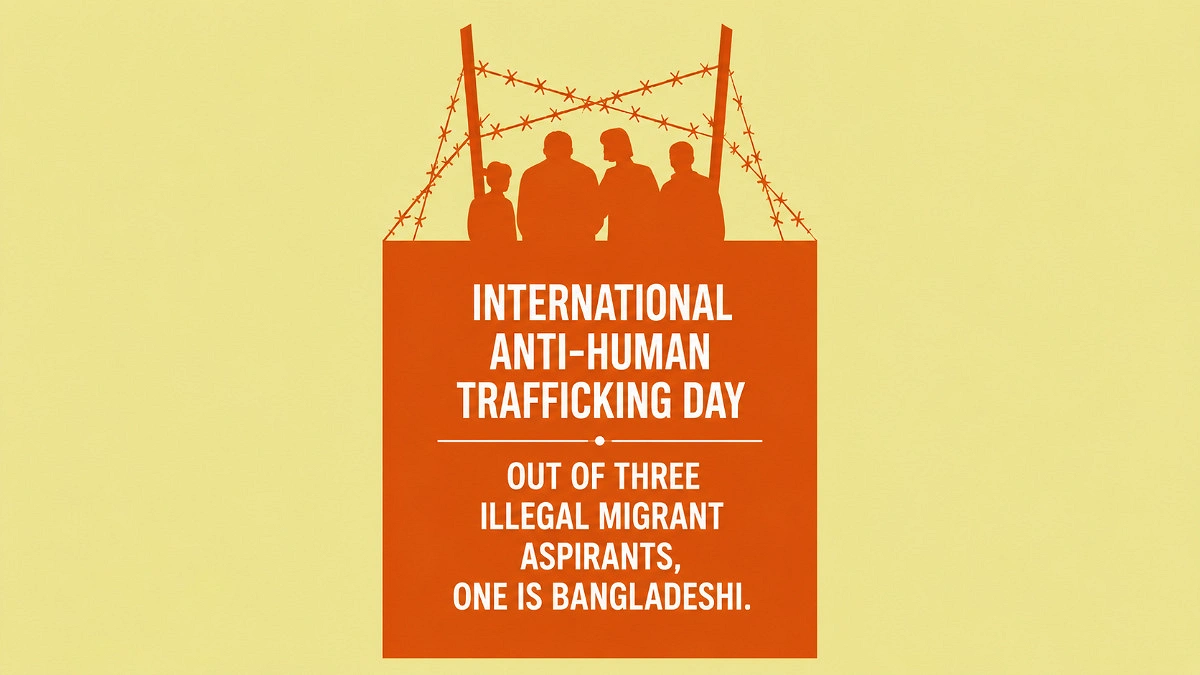
Agamir Somoy graphics regenerated by AI.
Ershadul Mia (32), from Mithapukur in Rangpur, used to work as a rod-binder in Dhaka. He became acquainted with a mason from Shariatpur. The mason often spoke over the phone with a relative living in Libya about going to Italy via Libya. Eventually, Ershadul too fell for their lure.
Ershadul told Agamir Somoy that he went to Benghazi, Libya, in August 2024. But for a year, he had no work there. An armed group in Libya once tried to abduct him. Later, he returned home through the International Organization for Migration (IOM).
Various international organizations and research institutions say that organized international trafficking rings are active along the dangerous route to Europe. After reaching Libya, Bangladeshi migrants have become "golden geese" for traffickers—subjected to torture in game houses, ransom demands, and finally the cost of crossing the sea—all adding up to huge profits.
On this occasion, July 30 is being observed as International Anti-Human Trafficking Day, with various programs organized by the government and domestic and international agencies.
According to data from the NGO BRAC, the cost of migrating to Libya in 2010 was Tk 5.42 lakh. By 2025, that cost has risen to approximately Tk 20.30 lakh. Research by the renowned Mixed Migration Centre (MMC) indicates that in 2024, the illegal trade centered on Bangladeshi migrants along the Libya–Italy–Greece route generated at least $160–190 million annually, or roughly Tk 2,300 crore. According to UNHCR data, 20,259 Bangladeshis went illegally to Italy in 2025. At an average cost of Tk 20 lakh per person, the illegal trade that year amounted to Tk 4,051.80 crore.
Libya–Italy route: The Mixed Migration Centre (MMC) has conducted research on the dangerous migration route from Bangladesh to Italy via Libya. The report, titled "Navigating New Corridors: The Evolving Route of Bangladeshi Migration to Italy through Libya," was published last March, funded by Denmark and an international organization. According to MMC data, the current main route to reach Libya is Dhaka–Dubai–Egypt–Benghazi (Libya). When Dhaka airport tightens restrictions, brokers send migrants overland to India. From there, they are taken via Sri Lanka to Dubai or Kuwait, and then on to Libya. Ershadul stated that he was a traveler on the second route.
The MMC report analyzed data from nearly 14,000 Bangladeshi migrants who reached Italy in 2024. It states that the trafficking network operates through a multidimensional network involving agents from different countries. From small village-level brokers to large recruitment agencies—all are part of this chain. They lure migrants by promising legal employment or selling "Italy-bound packages," sending them to Libya.
However, the Secretary General of the Bangladesh Association of International Recruiting Agencies (BAIRA), Ali Haider Chowdhury, claims that no agency is involved in human trafficking. He told Agamir Somoy that they send people abroad through legal procedures. If someone is lured away or flees from there, that is their own responsibility.
Migration-related organizations say Bangladeshis top the list of people attempting to cross the Mediterranean to enter Italy. However, by 2026, Bangladeshis have also taken the top spot in terms of entering Greece. Among them, on March 21, at least 18 Bangladeshis died en route from Libya to Greece, 12 of whom were from Sunamganj. On the orders of traffickers, the bodies were thrown into the sea, according to international media reports.
On the Mediterranean route (from Libya to Italy or Greece), an average of 2,000 to 2,500 migrants die or go missing each year. IOM data shows that a significant portion of those killed or missing on the Mediterranean route are Bangladeshi. An IOM report titled 'Displacement Tracking Matrix' published last March stated that 24,318 Bangladeshis entered Europe by sea and land routes in 2025. This rate is 59 percent higher than in 2024. One in every three irregular migrants on this Mediterranean route is a Bangladeshi.
Meanwhile, the UN High Commissioner for Refugees (UNHCR) said that in the last 6 months, 4,249 Bangladeshis entered Italy via sea routes, accounting for 29.5 percent of the total entrants. This is followed by Somalia (11.4 percent) and Sudan (9.5 percent). During the same period, 3,608 Bangladeshis traveled by sea from Libya to Greece.
When asked about the government's decision regarding irregular migrants, State Minister for Expatriates' Welfare and Overseas Employment Md. Nurul Haq told Agami Samay, "Instructions have been given to bring the fraudulent incidents of sending people abroad under the purview of the law. We are considering how to activate BMET to increase legal employment."
Meanwhile, under the initiative of IOM and the Ministry of Foreign Affairs, 344 people were rescued from Tripoli, Libya, and brought to Dhaka in two phases on June 1 and 24.
Enormous annual business: It costs $10,000–$14,000 for a migrant to reach Italy from Bangladesh. However, including ransoms and additional extortion in Libya, it often exceeds $17,000. By this estimate, the cartel pocketed $160–190 million on the Bangladesh–Libya–Italy route in 2024, which amounts to Tk 1,920 crore to Tk 2,280 crore in Bangladeshi currency. Providing this data, the MMC stated that the expenses of those who died in Libya or could not reach Italy are not included here. If this calculation is considered, the total amount in taka would be even higher.
According to MMC data, local broker and agency networks active in Bangladesh, international transit syndicates based in Dubai and Egypt, local Libyan sponsors, drivers, militia groups, 'game operators' or boat operators, and social media-based luring networks are involved in this. Many migrants are "sold" from one trafficker to another. Even if the Libyan Coast Guard catches them at sea, the migrants are not freed; they are handed back to the trafficking rings. Ransom demands are also made.
Following the MMC report, Agami Samay spoke with a returnee youth from Libya, Enayetullah Riyad (24), from Singrail Union in Nandail Upazila, Mymensingh. He used to trade fertilizer in his area. He fell into the broker's trap and decided to go to Italy via Libya.
According to Enayetullah, he paid Tk 5 lakh to the broker network before going to Libya. After arriving in Libya, the network took another Tk 5 lakh, promising to send him to Italy; but they did not. Instead, they held him hostage and demanded an additional Tk 5 lakh, following which his family sent Tk 3.5 lakh. When he was sent out to sea on a trawler bound for Italy, the Libyan Coast Guard arrested him and sent him to prison. From there, the ring rescued him and tortured him again. Later, his family sold and mortgaged land and sent another Tk 7 lakh, after which Enayetullah was freed. According to Enayet, the ring took a total of Tk 18.5 lakh from him.
93 percent are held captive in camps: BRAC, a private organization, has analyzed the journey of irregular migrants heading to Libya and stated that most people traveled from Dhaka to Libya via Egypt, Dubai, or Turkey. Even though they went lured by promises of good jobs, 75 percent did not get any job or work. On the contrary, they had to remain captive. Among them, 93 percent were held in camps. 79 percent of them were subjected to physical torture. In addition, after reaching Libya, 69 percent had their freedom of movement curtailed. Most did not get proper food. Shariful Hasan, Associate Director of BRAC, told Agami Samay, "Traffickers are now using information technology. In comparison, law enforcement agencies are lagging behind. Overall, the situation is alarming."
Commenting that both domestic and international rings are involved in human trafficking, Tasnim Siddiqui, Founder Chairperson of the Refugee and Migratory Movements Research Unit (RAMRU), told Agami Samay that the issue is not being taken seriously internationally. They only impose a kind of control by shifting responsibility onto the source countries.
Tasnim Siddiqui also said that some recruiting agencies in Bangladesh bear responsibility. Previously, such incidents would be tried under the Human Trafficking Act. But the 2013 Immigration Act is not that strong. That is why recruiting agencies are getting away with it. To stop this trafficking, strict enforcement of the law is necessary.