
World Bicycle Day
The Bicycle Bell’s “Cring Cring” is being Lost Amid Loud Honking

Picture: Agamir Somoy image regenerated by AI
Before dawn fully breaks, a school teacher slowly pedals along a rural dirt path. A bag rests on the rear carrier, while his feet turn the pedals in a gentle rhythm. Ahead, a few pedestrians walk along the road. To alert them, he rings his small bicycle bell—cring… cring…. The sound is soft, familiar, and intimate. People step aside, sometimes turning back with a warm smile. That “cring cring” was not just a signal; it was once part of everyday life, a melody of a slower, more composed existence.
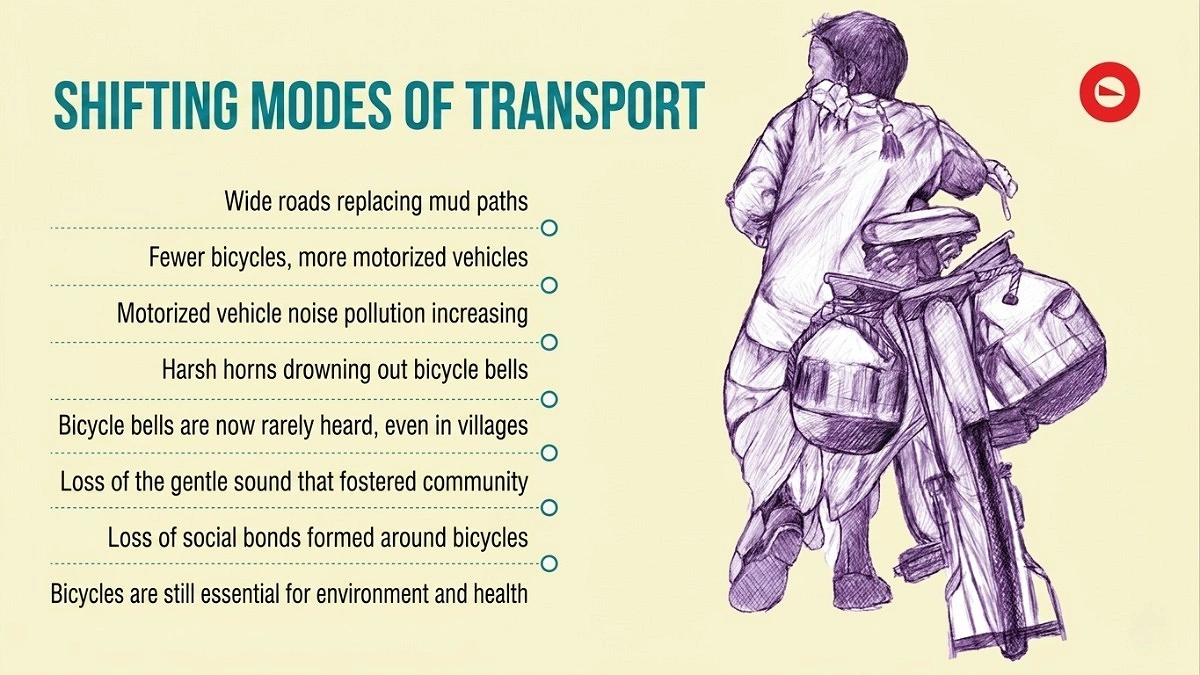
Today is World Bicycle Day. It is not only a celebration of the bicycle but also a reminder of a time when movement followed the rhythm of human footsteps. The bicycle once served as a primary means of transport. Over time, the wheel of change has turned. Dirt paths have been replaced by wide roads. The number of bicycles has declined while motorized vehicles have increased. Today, the gentle “cring cring” has been drowned out by the harsh horns of buses, trucks, motorcycles, and private cars. In cities and even in many villages, the sound of a bicycle bell is now rarely heard.
In rural Bangladesh, the bicycle was once the most dependable mode of transport. Students, college-goers, postmen, teachers, agricultural officers, and even doctors regularly used bicycles. For many families, a bicycle was both a symbol of dignity and necessity.
At that time, road traffic was minimal. People were not in a hurry to reach their destinations. The sound of a bicycle bell served as the language of the road, met with understanding rather than irritation.
With economic development, urbanization, and technological progress, patterns of mobility have changed. In a fast-paced life, saving time has become the top priority. As a result, the use of motorcycles, private cars, and other motorized vehicles has increased significantly. Along with this, noise pollution has also grown. Standing on a busy city street today, it is often difficult even to hear conversation due to continuous honking.
Experts say that the decline in bicycle use is partly due to the lack of proper integration of cycling into modern urban transport systems. The absence of safe cycling lanes and the inability of bicycles to compete with high-speed vehicles are major reasons behind this decline.
A bicycle is not just a means of transport; it is part of social culture. Evening rides with friends, trips to village markets, ringing the bell to call a friend on the way to school—these are deeply rooted memories in many people’s childhood and adolescence. Today’s younger generation is increasingly detached from such experiences, as motorized transport has replaced bicycles in daily life. As a result, a form of social bonding centered on cycling is also disappearing.
Globally, however, due to climate change, fuel crises and urban traffic congestion, the importance of bicycles is rising again. Many countries are adopting bicycle-friendly urban planning. Among health-conscious youth, interest in cycling is also increasing. In Bangladesh as well, various cycling organizations and youth initiatives are reviving interest in bicycles. On holidays, cycling groups are increasingly visible on the streets of the capital and district towns.
The bicycle may never again become the dominant mode of transport. But as environmentally friendly and healthy transport is being widely discussed globally, its relevance is returning. The loud horns of mechanized transport may have buried the “cring cring” of bicycles, but it has not disappeared entirely. On quiet city mornings, rural paths or in the ride of a school-going child, the familiar sound can still occasionally be heard.
That “cring cring” reminds us that no matter how fast life becomes, not all beauty lies in loudness—some of it exists in the soft ring of a small bell.
Even in Dhaka, there are still thousands of bicycles. They help reduce air pollution, even if only slightly. If these riders were using fuel-powered motor vehicles instead, they would be emitting carbon dioxide and other pollutants.
To encourage cycling, it is necessary not only to build separate lanes but also to establish bicycle parking facilities under metro stations. From there, citizens could pick up or park bicycles, contributing to reduced urban pollution and a more sustainable city system.
