


Leaving Dhaka: 0.65 Million People to Make Their Journey A Day Ahead of Eid

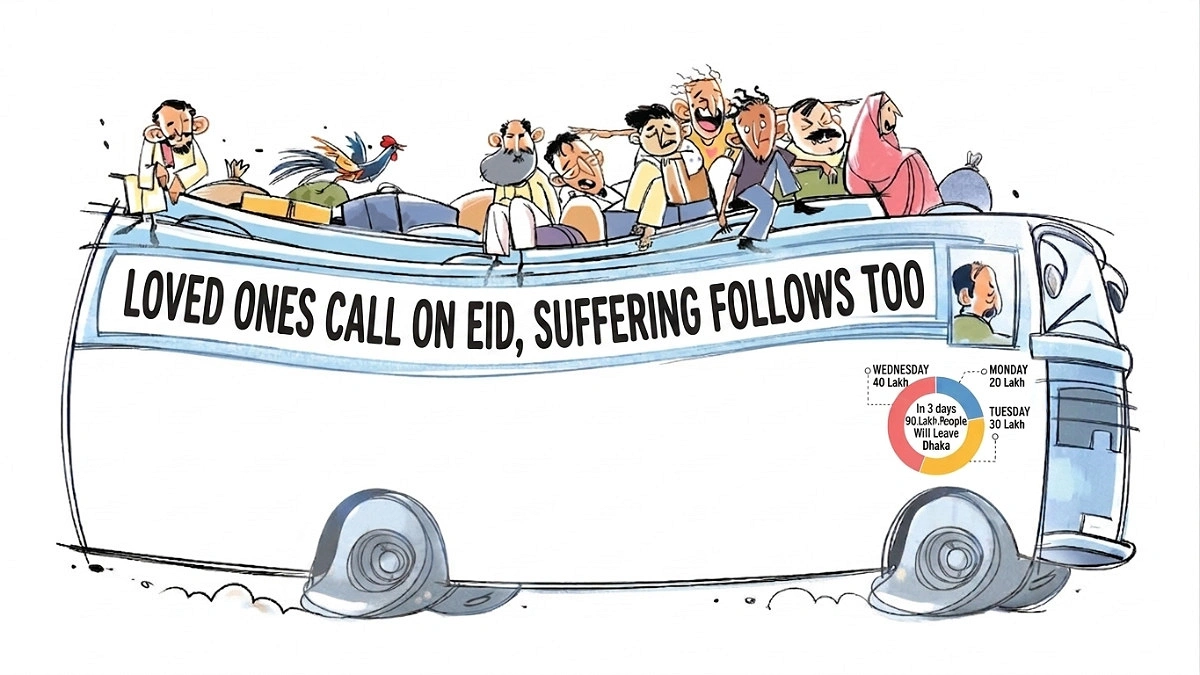
Agamir Somoy Image regenerated by AI.
No matter what, people must return home—to see a mother’s face, to take a child on lap in affection, to respond to loved ones waiting and to visit the playgrounds of childhood. For responsibility carried along. To stand in prayer with friends, to gather in the familiar corner of a field at dusk. To do all this, one has to go home.
But the journey is never easy.
Challenge galore such as broken roads, crowded cattle markets. and endless traffic jams. On top of this, dark, rain-heavy skies are there. Everything must be endured. Even securing a seat becomes a challenge like climbing a peak. Finding a way out of the capital is often the hardest part.
Dhaka is the country’s nerve center. Yet amid the crush of millions, life itself feels hard to find. Everyone is busy—constantly running. Even to catch one’s breath, people must run home. The reason is simple: a fragile transport system. Boarding poor-quality vehicles and just securing a place is a battle in itself.
On normal days, Dhaka has the capacity to send about 650,000 passengers to their destinations. Before Eid, that number surges to an average of 3 million a day. It is then that the full scale of the breakdown in the country’s public transport system becomes glaringly clear.
An analysis of data from government and private agencies and road-sector organizations shows that on the coming Monday, Tuesday, and Wednesday, about 9 million people will leave Dhaka and surrounding areas—an average of 3 million per day. Yet the combined daily passenger capacity of buses, trains, and launches is only 574,796. Adding 6,606 airline passengers and another 60,000 who can travel by motorcycle or private and rented cars, the total daily capacity reaches just 651,402. In other words, the system is expected to carry at least five times more passengers than it is designed to handle.
So how can this crisis be resolved?
Transport owners argue that such extreme pressure occurs only 20 to 25 days a year, even when the two Eid holidays coincide with other long breaks. They see no justification for expanding year-round capacity to address a problem that lasts only a few days. And no one wants to give up the opportunity to make higher profits during this peak period.
Agamir Shomoy spoke with the state minister for the Road Transport and Highways Division, Habibur Rahid, about the Eid travel crisis, possible solutions, future steps, and what the ministry is doing. He acknowledged that the capacity required to ensure safe and comfortable Eid travel simply does not exist. “We have limitations,” he said. “Even so, we try to make the best possible use of what capacity we have. Pressure on roads and railways increases the most. We try to decentralize these where possible. But on the days before Eid, huge numbers of passengers arrive at railway stations and bus terminals all at once.”
Public transport experts, however, place the responsibility squarely on state institutions. BUET professor and transport specialist Moazzem Hossain Chowdhury said private operators will not maintain excess capacity year-round for just a few days of demand. “But government institutions cannot think only in terms of business,” he said. “On roads, you cannot simply add more vehicles at will—the roads themselves have limits. But in rail and waterways, government operators can maintain higher capacity. That option exists. More trains and launches can be added if there is the will. The system is there; what’s needed is initiative.”
Passenger Welfare Association figures cited by Agamir Shomoy paint an even starker picture. According to their estimates, 2 million people will leave Dhaka on Monday, 3 million on Tuesday, and 4 million on Wednesday. In addition, after Eid, another 1.2 million people will return home from Dhaka and nearby areas.
Despite everything—the chaos, the shortages, the hardship—people will still make the journey. Because home, in the end, is not optional.
The calculated data show that under normal conditions, a maximum of 480,000 passengers can be transported per day from Dhaka by bus. The number of train passengers stands at 39,796, while launches carry about 55,000 passengers daily. It is also estimated that around 20,000 passengers travel by motorcycle each day. However, there is no clear count of the many more people who rush to their destinations by riding on train rooftops, in open trucks, on city local buses, or by breaking their journeys across various small vehicles.
State Minister for Road Transport Habibur Rashid said that efforts are made to increase train capacity by adding extra coaches. On roads, buses operated by BRTC are added to the system. Even so, in some cases passengers take risks by climbing onto train roofs. In such circumstances, he claimed, even with goodwill, it is impossible to manage the pressure of hundreds of thousands of passengers with limited manpower.
1.5 million bus passengers in three days:
According to BRTA records, there are 58,589 registered buses in the country. In reality, however, so many buses do not exist. The government has no proper records of how many buses have become inoperable, dumped, destroyed, or scrapped.
Bus operations in the country are effectively controlled by three organizations: the Dhaka Road Transport Owners’ Association, the Bangladesh Road Transport Owners’ Association, and the Bangladesh Bus Truck Owners’ Association. Data from the Bangladesh Road Transport Owners’ Association show that during Eid this year, 8,000 buses will regularly operate from Dhaka. On shorter routes, some buses can make multiple trips, but congestion can disrupt long-distance trips. With 8,000 buses making an average of 12,000 trips, and each bus carrying an average of 40 passengers, a total of 480,000 passengers can be transported. That means, in the three days before Eid, there is capacity for just over 1.45 million bus passengers at best.
Transport owners also appear helpless. Asked about possible solutions, the association’s joint general secretary, Kazi Md. Jobayer Masud, bluntly said, “There will be problems for two days—there’s no avoiding it.” In his view, the main pressure comes in the two days before Eid. “This year too, heavy passenger pressure will build on May 26 and 27. Neither the police, nor BRTA, nor we together can manage that pressure. The other days remain normal. But the bad reputation of those two days follows us throughout the year,” he said.
218 trains to run:
During Eid, 218 trains will depart from Dhaka to different regions—118 to the eastern zone and 100 to the western zone. This figure covers the total number of trains running between May 23 and May 27. On average, 43 passenger trains will depart daily from Kamalapur. In the five days before Eid, total seating capacity across all classes amounts to 159,187 seats. Additionally, about 25 percent more passengers will travel with standing tickets. On average, 39,796 passengers per day will have legal access to train travel.
So how will the rest travel? When asked when train passenger capacity would increase, Railway Director General Md. Afzal Hossain replied candidly that meeting Eid demand is impossible. “Even with long-term planning to increase coaches, locomotives, and manpower, not even a quarter of the demand can be met. Still, efforts are underway to increase train capacity,” he said.
That even a quarter of demand cannot be met becomes clear from ticket demand alone. During Eid, the railway ticketing system recorded 221.5 million online hits, with a single-day peak of 55.5 million hits.
Launches on water, planes in the sky:
According to the Launch Owners’ Association, 121 launches are ready to operate from Sadarghat. These launches will make around 150 trips per day. Combined, they can transport between 50,000 and 55,000 passengers daily, which amounts to around 150,000 passengers over three days.
During the last Eid, around 400,000 people traveled home by launch, according to information provided by the association’s secretary general, Siddiqur Rahman Patwary. He said the number is expected to be similar this time as well. “All kinds of preparations have been taken to handle the pressure. Compared to other times, demand for cabins has increased this year,” he added.
The civil aviation authority has provided estimates of passenger movement on domestic air routes. Last year, 2,411,437 passengers traveled by air within the country, which means an average of 6,606 passengers per day. If no additional flights are added during Eid, seat availability is expected to remain at roughly the same level.
Passengers will also travel by motorcycle and even ambulance. During the COVID-19 pandemic, motorcycles effectively turned into a form of public transport, and that pattern has not changed since. Some riders carry passengers for a fee, while others ride home themselves. It is estimated that around 10,000 motorcycles carry about 20,000 people home each day.
During Eid, transport shortages also lead to people renting ambulances to travel home. In some cases, someone is even made to pose as a patient to hire an ambulance. Alongside this, private cars and rented microbuses are also used. Transport-sector estimates suggest that around 50,000 passengers can travel per day using these modes.
At the last moment, overcrowding is also seen on train roofs. During Eid-ul-Azha, trucks carrying cattle into Dhaka are later used by people traveling back home. In industrial areas such as Gazipur, Savar, and Narayanganj, floating laborers often reserve city local buses to make long-distance journeys out of the metropolitan area. No one keeps track of how many passengers travel through these risky and informal means.
Speaking about the last-minute chaos, Mozammel Haque Chowdhury, secretary general of the Passenger Welfare Association, said the country has not built the capacity to manage the surge in passengers before Eid. “As a result, people are forced to ride empty trucks returning after delivering cattle. They climb onto train roofs and take risks to get home. Even at extra cost, they have to set off for home by city local buses, microbuses, and motorcycles,” he said.

