
Mustafa Monwar Receives Guard of Honor

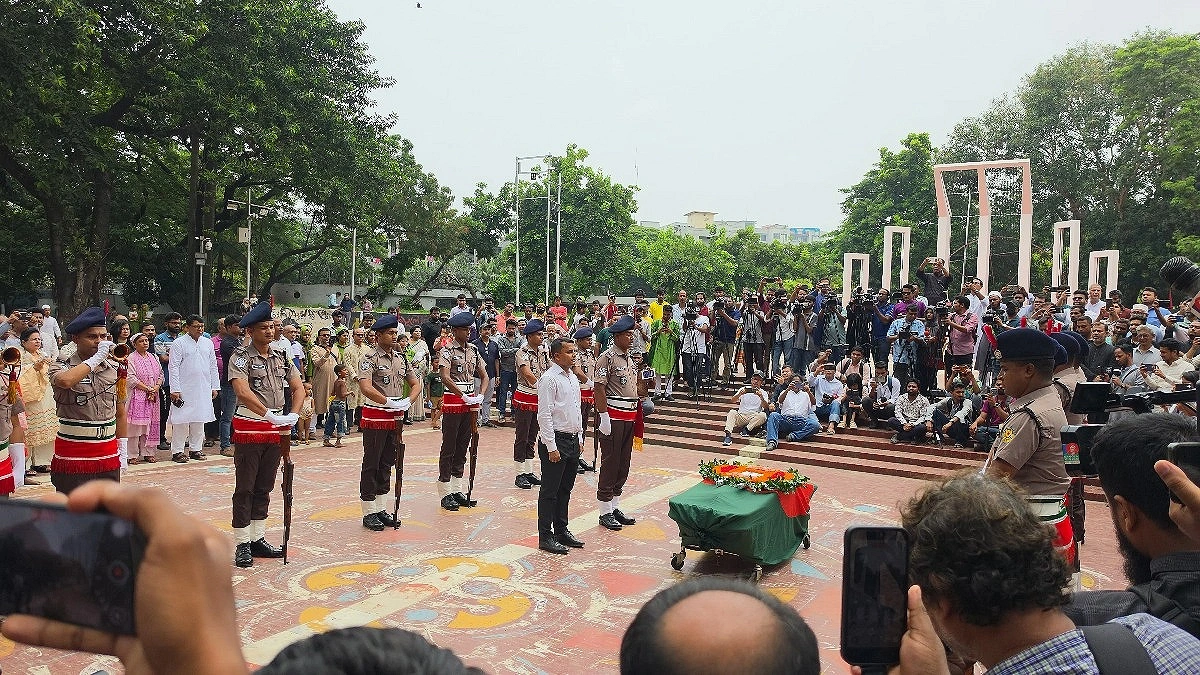
Photo: Agamir Somoy
Bangladesh bid a final farewell to renowned artist Mustafa Monwar on Tuesday with a state guard of honor, floral tributes, heartfelt remembrances, and a moving rendition of his favorite patriotic song, Dhana Dhanya Pushpa Bhara.
Artists, cultural figures, colleagues, students, and admirers gathered to honor the legendary painter, television pioneer, and puppet artist, describing his passing as an irreplaceable loss to the country’s cultural heritage.
Monwar’s body was taken to the Central Shaheed Minar around 11 am, where people from all walks of life paid their final respects. Representatives of cultural, social, and political organizations laid wreaths as a solemn atmosphere enveloped the national monument.
Earlier in the morning, a tribute ceremony and his first funeral prayer were held at the Bangladesh Television (BTV) headquarters.
Following the tribute at the Shaheed Minar, Monwar’s longtime colleagues, former students, and admirers reflected on his remarkable artistic legacy.
Veteran theater personality Ramendu Majumdar praised Monwar’s mastery of watercolor painting and his pioneering role in the early development of Bangladesh Television.
“He was unmatched in producing children’s programs. His television productions Raktakarabi and Mukhra Romoni Boshikaron remain timeless milestones in the history of Bangladeshi television drama,” Majumdar said.
Remembering Monwar’s contribution to puppet theater, he added that the artist had breathed new life into the medium, elevated Bangladeshi puppetry to the international stage, and used it to educate and entertain children.
“His passing feels like losing the roof over our heads. This enormous void can never truly be filled,” he said.
Actor and theater director Mamunur Rashid said Monwar played a defining role in shaping television’s visual identity during its early years in what was then East Pakistan.
“We never imagined what television presentation could look like. As an exceptional visual artist, he created a distinctive screen language. The dramas he produced in a tiny studio and adjoining veranda will continue to influence audiences for the next hundred years,” Mamunur Rashid said, also recalling Monwar’s contributions to Bangladesh’s autonomy movement and the Liberation War.
Actor Keramat Mawla, one of Monwar’s former students and colleagues at Bangladesh Television, said he learned nearly everything during his 35-year television career from the late artist.
“He amazed us by creating visual illusions of sunrise, blooming flowers, and shifting light on television screens using only the limited resources available inside the studio,” Mawla said.
Prominent painter Hashem Khan recalled that Monwar quickly became a beloved teacher after joining the Faculty of Fine Arts.
He also noted that when Bangladesh Television was established in 1964 under the leadership of Kalim Sharafi, Monwar, along with Jamil Chowdhury and Shahid Quadri, ensured that official documents, appointment letters, and artists’ payment records were prepared entirely in Bangla despite the military rule of Ayub Khan, describing it as a quiet artistic revolution.
Among those paying tribute were actors Tariq Anam Khan, Nima Rahman, Shahiduzzaman Selim, theater personalities, musicians, painters, government officials, and representatives of numerous cultural organizations.
The Embassy of India in Bangladesh also paid tribute through its representative, Gokul V K.
Organizations including Bangla Academy, Bangladesh National Museum, Bishwo Shahitto Kendro, Chhayanaut, Bangladesh Udichi Shilpigosthi, Children’s Film Society Bangladesh, and many others also laid wreaths in his honor.
The tribute ceremony concluded with a collective performance of Dhana Dhanya Pushpa Bhara, Monwar’s favorite song, followed by a one-minute silence in his memory.
After public tributes ended, the artist received a state Guard of Honor before his body was taken to the Dhaka University Central Mosque for a second funeral prayer.
Final Tribute at the Faculty of Fine Arts
Following the second funeral prayer, Monwar’s body was taken to the Faculty of Fine Arts, University of Dhaka, where artists, teachers, students, and cultural activists gathered for an emotional farewell.
Among those present were artists Hashem Khan, Anukul Das, Tamanna Tithi, Kawsar Hasan Togor, Alaptinagir Tushar, Munira Zaman, and Rashid Amin.
Luba Nahid Chowdhury, chairperson of the Bengal Foundation, remembered Monwar as a multidimensional creative force whose work extended far beyond painting to music, theater, and puppetry.
“He never confined art to a single medium. Instead, he built a broad artistic philosophy by integrating multiple forms of creative expression,” she said.
Following another minute of silence, the body was taken to the Channel i headquarters for a final tribute.
Farewell at Channel i
At Channel i, employees, artists, writers, theater personalities, and cultural activists joined another funeral prayer.
Before the prayer, Channel i Director and Head of News Shykh Seraj said Monwar had been a mentor to generations of media professionals.
“We have shared a long relationship with him. About four years ago, we named one of our studios after Mustafa Monwar in recognition of his immense contributions,” Shykh Siraj said.
Following the funeral prayer, Monwar’s body was taken to Banani Graveyard, where one of Bangladesh’s greatest cultural icons was laid to rest.
