

Digital Monitoring Hits a Snag: Data Missing from 713 Projects

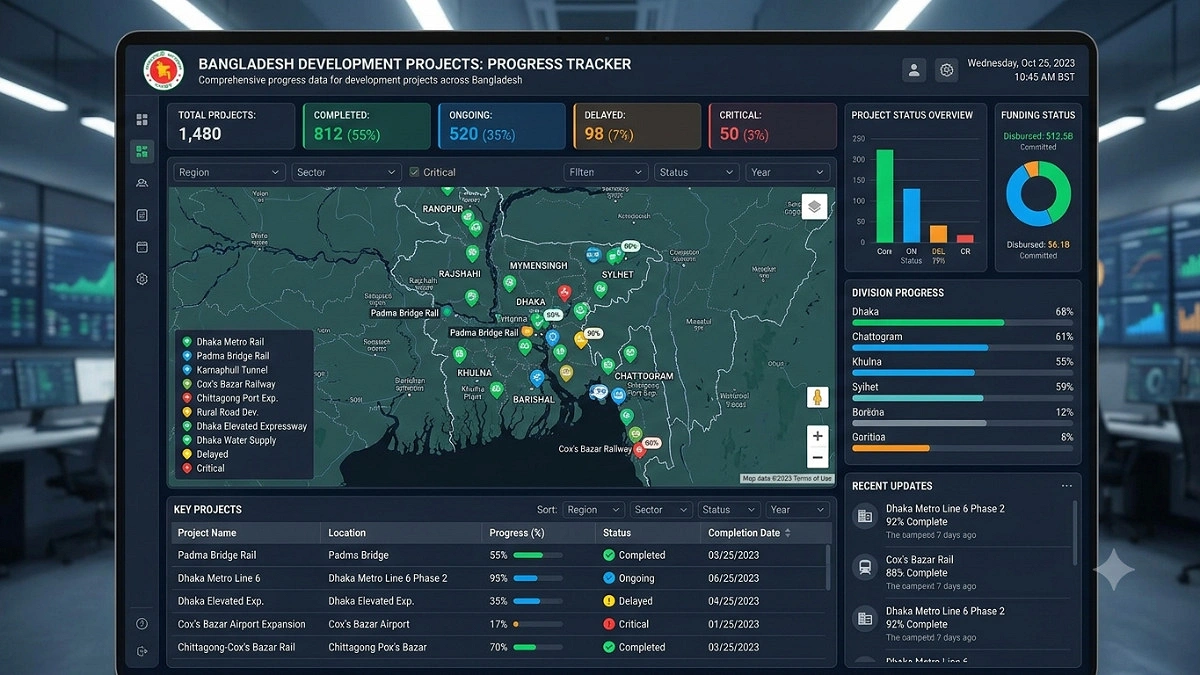
AI generated image.
A familiar picture has long plagued development projects in the country—slow progress, rare instances of timely completion, and cost overruns and deadline extensions seeming almost like an unwritten rule. On one hand, this results in thousands of crores of taka in government funds being wasted; on the other, invaluable time is lost.
To change this reality, the government has undertaken an initiative to bring all ongoing projects under a centralized digital dashboard for regular monitoring. However, from the very outset of this initiative, alarming issues have emerged. Data from most projects is unavailable, many projects still lack appointed project directors, and in some cases, contact with the relevant authorities has been lost. As a result, this new effort to ensure accountability and oversight in development projects is now facing significant challenges.
According to government sources, on May 18, at a meeting of the National Economic Council (NEC), Prime Minister and NEC Chairman Tarique Rahman directed the creation of a central dashboard for regular project monitoring. The matter was subsequently adopted as an NEC decision. The objective is to monitor the progress of all ongoing development projects from a single platform and to facilitate swift decision-making.
However, once work on the dashboard began, it was found that out of the 1,359 development projects currently underway, data from only 646 have been incorporated. Reports for the remaining 713 projects remain unavailable. Furthermore, 23 projects still have no appointed Project Director (PD). Additionally, contact with the authorities responsible for 36 projects has been lost.
In this context, today (Tuesday), Finance Minister Amir Khosru Mahmud Chowdhury and Planning Minister Zonayed Abdur Rahim Saki are scheduled to test the new dashboard. According to sources, they will access the dashboard from their respective offices to evaluate its functionality.
Wahida Hamid, Joint Secretary (Coordination) of the Implementation Monitoring and Evaluation Division (IMED), which is responsible for creating the dashboard, told Amar Samoy that the biggest problems are the lack of data and negligence on the part of the officials concerned. She said that although there is a requirement to regularly update project information in the e-PMIS software, many agency heads and project directors do not even bother to open the software, let alone provide the required data.
IMED sources indicate that once the dashboard is fully operational, the Prime Minister, Finance Minister, and IMED Secretary will be able to centrally monitor the progress of all projects across the country. Additionally, ministers, secretaries, and agency heads will only be able to view projects under their respective ministries. The dashboard will also be accessible via mobile phones. In phases, through registration, additional secretaries, project directors, and heads of planning wings will also be able to log in and update information.
Among the projects for which data is missing, the highest number falls under IMED's Sector-3, where reports for 135 projects are absent. Additionally, data is unavailable for 106 projects in Sector-4, 88 in Sector-6, 83 in Sector-5, 73 in Sector-1, and 47 in Sector-2. Despite repeated reminders, IMED is now considering special initiatives to address the issue of non-submission of reports.
On the other hand, 23 development projects are moving forward without Project Directors. The government has allocated Tk 358.98 crore for these projects. Among them are feasibility studies for the development of district judge court buildings, district judge residences, and the Bangladesh Judicial Academy; construction of the Padma Oil Company's head office; various infrastructure development projects under Dhaka South City Corporation; service development for Rohingya and local populations; and safe water supply projects in the context of climate change.
Also on the list are projects for enhancing the capacity of the River Research Institute; conservation of the banks of the Dhaleshwari and Lohajang rivers as well as rivers in Tangail; development of the Salta River in Khulna; monitoring of vitamin fortification in edible oil; development of the National Museum; upgrading the National Heart Institute to international standards; and a feasibility study for the development of Pirojpur Science and Technology University.
The list further includes development surveys for Begum Rokeya University, Barishal University, and Naogaon University; feasibility assessment for constructing a tourism building in Mohakhali; infrastructure development at Gazipur Agricultural University; and the second phase of the income-generating training project for women at the district level.
Officials say the central dashboard could play a vital role in ensuring transparency and accountability in development projects. However, if the reluctance of stakeholders to update data, negligence in responsibilities, and lack of administrative coordination are not addressed, this digital initiative will fail to deliver the expected benefits.

