
Has Nepal's Foreign Policy Changed After 100 Days?

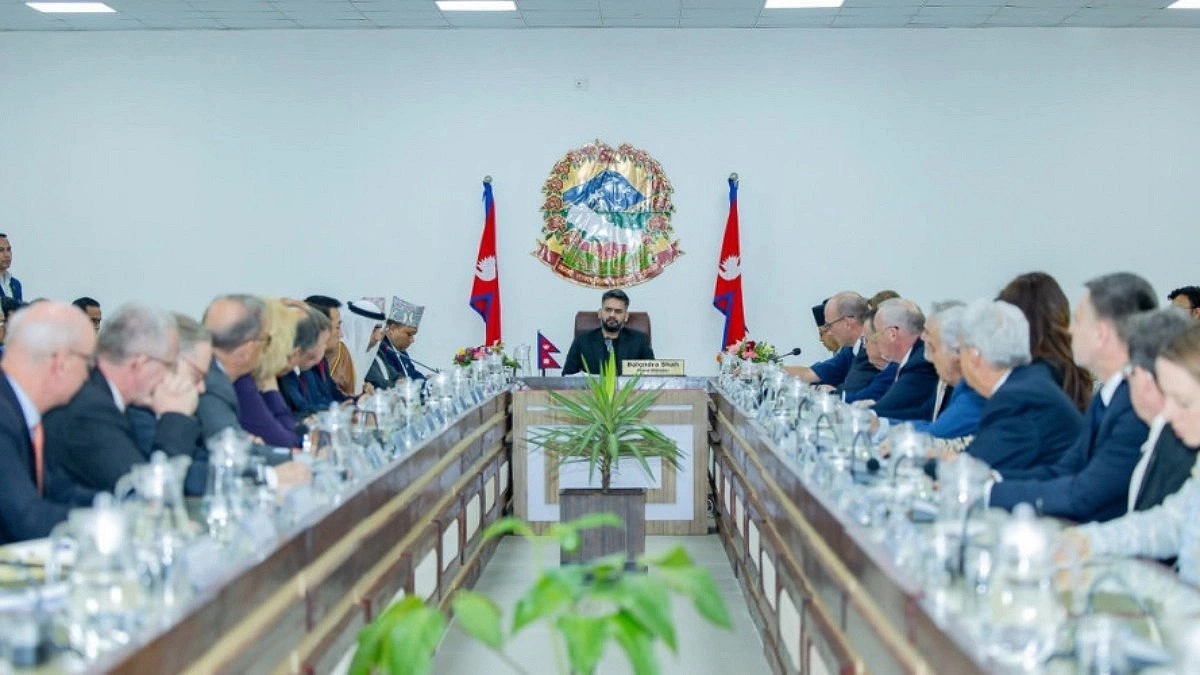
Prime Minister Balendra Shah meets 23 European Union ambassadors and deputy heads of mission in Kathmandu in May.
Nepal’s new government entered office promising sweeping reforms, including significant changes to Nepal’s foreign policy. After completing its first 100 days in power, however, analysts say the government of Prime Minister Balendra Shah has brought more change to diplomatic style and procedure than to the substance of foreign policy.
Shah has broken with long-standing diplomatic practice by avoiding one-on-one meetings with ambassadors stationed in Kathmandu and several visiting foreign dignitaries. Instead, he has favored group engagements and stricter protocol standards. He declined meetings with several senior U.S. officials, including President Donald Trump’s special envoy Sergio Gor, and also did not grant an audience to Indian Foreign Secretary Vikram Misri. Misri’s planned visit to Nepal was later postponed.
Despite these procedural shifts, Nepal’s core foreign policy priorities remain largely unchanged. Relations with India and China continue to dominate Kathmandu’s diplomatic agenda. Soon after the government took office, Foreign Minister Shishir Khanal visited both neighboring countries and assured them that Nepal respects their strategic sensitivities.
Relations between Nepal and India remain strained over several issues, including Nepal’s tariffs on goods imported from India and New Delhi’s restrictions on Nepali tea imports. At the same time, India extended a warm welcome to Ravi Lamichhane, president of the State Independent Party. During the visit, he advocated strengthening Nepal-India cooperation through what he described as “development diplomacy.”
According to Shah’s close associates, the prime minister wants institutions, not individuals, to lead Nepal’s foreign relations. Foreign policy analysts, however, argue that the government has demonstrated more continuity than transformation.
“Nepal’s foreign policy has not changed very much. The fundamental issues remain the same. Only the diplomatic style has changed,” said Lok Raj Baral, Nepal’s former ambassador to India.
According to Baral, Shah’s cautious leadership initially created uncertainty in both India and China about the new government. However, “gradually, both countries have started engaging with the government.”
The government has placed comparatively greater emphasis on economic diplomacy. During visits by senior US officials and discussions with Washington, Nepal focused less on broader strategic issues and more on attracting investment, developing the digital economy, advancing artificial intelligence and information technology, establishing data centers, and implementing projects under the (MCC).
Foreign Minister Khanal has consistently argued that diplomacy must deliver measurable economic benefits. His ministry has prioritized attracting foreign direct investment, increasing exports, promoting tourism, expanding overseas labor markets, and engaging the Nepali diaspora.
“Our diplomacy must ultimately contribute to Nepal’s economic transformation,” Khanal has repeatedly said.
The government has also pledged to improve services at Nepali missions abroad, strengthen protections for migrant workers, encourage diaspora investment, and establish institutional dialogue mechanisms with development partners.
As part of its initial reforms, the Foreign Ministry introduced an open application process for ambassadorial appointments instead of relying solely on political nominations. More than 4,000 people have applied. However, Nepal has yet to appoint ambassadors to several key missions, including those in India, China, and the United States.
The delay reflects broader institutional weaknesses within Nepal’s diplomatic system. The country currently has no ambassadors in 17 diplomatic missions. Limited budget allocations have also hampered efforts to attract investment and conduct public diplomacy initiatives. In addition, the government has faced controversy over a passport-related process involving German and French institutions.
Analysts say these institutional shortcomings will ultimately determine whether the government can translate its foreign policy goals into tangible results. At the same time, Nepal must advance climate diplomacy and deepen engagement with multilateral institutions while navigating growing strategic competition among India, China, and the United States.
Outlining the government’s approach, Khanal recently said, “Our primary objective is to maintain balanced relations with our two neighboring friends, India and China, as well as with all other partners. We aim to prioritize economic diplomacy, advance foreign policy based on national interests, and strengthen constructive and cooperative relations with all countries.”
Source: Kathmandu Post (adapted)
