
The Tournament That Swallows the Planet


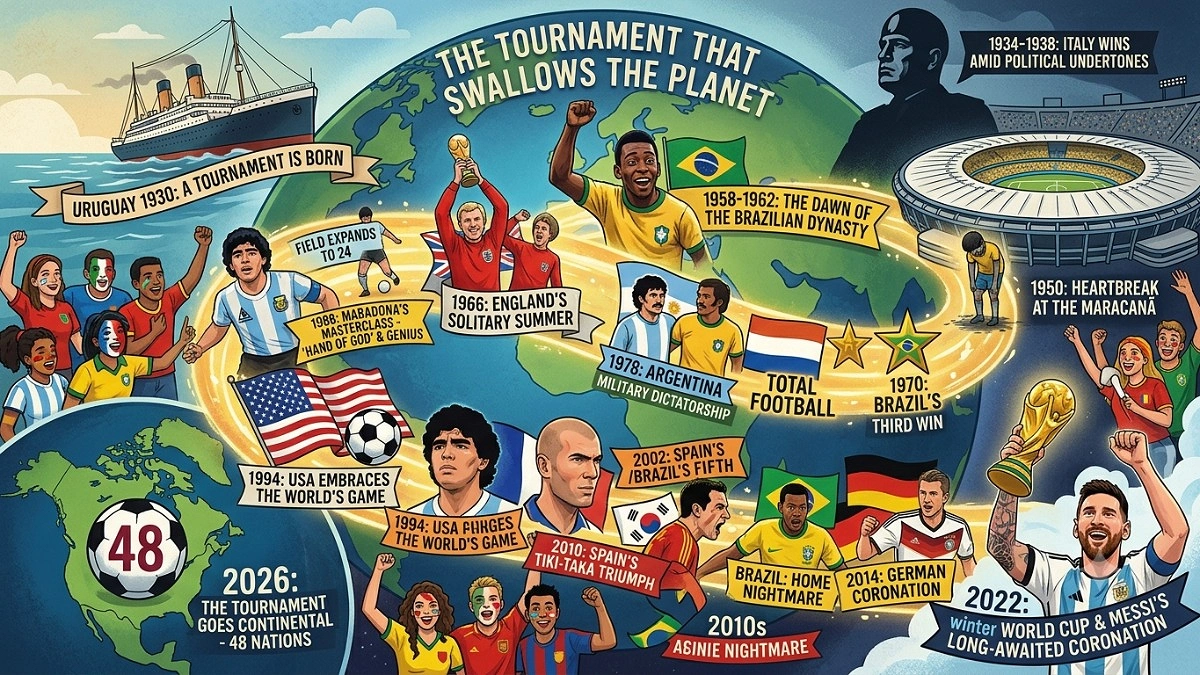
Graphics: Generated by AI
Every four years, something strange happens to the world. Offices empty out in the middle of the afternoon. Strangers in bars scream at screens together like old friends. Streets in cities thousands of miles from the host nation are painted in the colors of teams that most of the locals will never see play in person. For one month, a single sporting event manages to do what no war, treaty, or diplomatic summit ever could: it gets almost the entire human race looking in the same direction at the same time.
That event is the FIFA World Cup, and its pull on the global imagination is almost impossible to overstate. The most recent edition drew a combined television audience estimated in the billions, with roughly a billion people tuning in for the final alone, a number that dwarfs the audience for any other recurring sporting event on Earth. The Olympics may spread its net wider across disciplines. The Champions League may showcase a more concentrated level of technical quality on a weekly basis. But neither can replicate the peculiar alchemy of the World Cup: the fact that for these few weeks, a footballer is not just representing a club or a paycheck, but an entire nation’s sense of itself.
This is the story of how that tournament came to be a story that stretches back over a century, through world wars, political boycotts, changing continents, and a growing cast of nations that has ballooned from a baker’s dozen to nearly fifty. It’s a story of dynasties built and broken, of iconic matches that entire generations can still recite from memory, and of the slow, complicated march toward a truly global game.
Before the Cup: Football’s Search for a Crown
To understand why the World Cup was invented, you have to understand the vacuum it filled. In the early twentieth century, football was rapidly outgrowing its status as a gentlemen’s pastime played by British public schoolboys and dockworkers. The sport had gone global, carried by sailors, soldiers, and colonial administrators to South America, continental Europe, and beyond. But there was no agreed-upon way to crown a genuine world champion.
For a while, the closest thing to a global title was the football tournament held as part of the Summer Olympics. Nations sent teams, medals were awarded, and for a period the Olympic competition carried real prestige. There was also a lesser-known, semi-official competition called the Sir Thomas Lipton Trophy, contested in the years just before the First World War, which some historians regard as an early, though largely forgotten, attempt to stage an international club or representative tournament outside the Olympic framework.
The trouble with the Olympics, however, was amateurism. By the 1920s, football was rapidly professionalizing. Clubs were paying players, leagues were forming, and the sport’s center of gravity was shifting toward something closer to the game we recognize today. An Olympic movement built around the ideal of the gifted amateur was fundamentally out of step with a sport increasingly driven by wages, transfer fees, and paying spectators. Something had to give.
The governing body FIFA, founded at the start of the century, saw the opportunity and the necessity. Plans were drawn up for a standalone tournament, open to professionals, that would crown the best national team in the world without the ideological baggage of the Olympic charter. The decision to move forward was formally made in the spring of 1928, setting in motion preparations for what would become the first FIFA World Cup.
1930: A Tournament Is Born
The organizers chose Uruguay to host the inaugural tournament — a decision that may seem unusual today but made perfect sense at the time. Uruguay’s national team had won consecutive Olympic football gold medals in the 1920s, the country was celebrating the centenary of its constitution, and its government agreed to cover the travel costs of participating nations, an important consideration in an era when crossing the Atlantic meant a long sea voyage rather than an overnight flight.
Thirteen nations made the trip, a mix of South American sides and a handful of European teams willing to endure the crossing. The tournament ran through July, and by its conclusion the host nation had earned the right to call itself first among equals. Uruguay defeated Argentina 4-2 in the final, securing the title in front of a passionate home crowd and setting a template that would be repeated in many World Cups to come: the enormous, and often decisive, advantage of playing for glory in front of your own people.
It was a modest beginning by the standards of what the tournament would become, but the idea had proven itself. A world championship, open to professionals, contested every four years, was now a fixture of the sporting calendar.
The 1930s: A World on the Brink
The next two editions of the tournament tell a story that is inseparable from the darker political currents swirling through Europe at the time. The 1934 World Cup moved to Italy, expanding to sixteen participating nations and playing out over a compressed fortnight in late May and early June. Italy won on home soil, defeating Czechoslovakia in a final that required extra time to settle, a tense, tight affair that set the tone for a team that would go on to dominate the decade.
Benito Mussolini’s fascist government threw its weight behind the tournament, eager to use football success as a propaganda tool. When Italy repeated the feat four years later by winning the 1938 tournament in France, again with sixteen nations competing in June, the political undertones were impossible to ignore. Italy became the first nation to win consecutive World Cup titles, defeating Hungary 4-2 in the final.
The association between football glory and authoritarian regimes would recur uncomfortably throughout the tournament’s history. It also produced genuinely outstanding Italian sides built around legendary figures whose reputations have long outlived the politics of their era.
Then the tournament simply stopped. The looming catastrophe of the Second World War made a global sporting competition unthinkable, and the World Cup went dark for twelve years — the only interruption to the tournament’s four-year rhythm in its entire history.
1950: The Birth of a Football Nation
When the World Cup returned in 1950, it did so in Brazil, a country whose relationship with the sport was about to enter a new, almost spiritual phase. Fifteen nations took part in a tournament staged during the South American winter of June and July, and the host nation built the Maracanã, a stadium of such scale that it seemed designed to make a statement about football’s place in the national identity.
That statement, however, ended in one of the most famous heartbreaks in sporting history. Rather than a single knockout final, the 1950 tournament decided its champion through a final group stage, and Brazil entered the last match against Uruguay needing only a draw to be crowned champions in front of a staggering home crowd. Uruguay won 2-1, inflicting a wound on Brazilian football, remembered by generations of fans simply as the ‘Maracanazo’, that would take decades and an entirely new golden generation of players to heal.
The 1950s: Total Devastation, Then Total Brilliance
The next three tournaments, held in Switzerland in 1954, Sweden in 1958, and Chile in 1962, each featured sixteen participating nations and cemented a rotation between European and South American hosts that would largely endure for decades.
Switzerland 1954 produced one of the great underdog stories in the tournament’s history: West Germany, rebuilding a national identity in the shadow of the recent war, defeated a heavily favored Hungarian side 3-2 in the final, an upset still referred to in German football culture as the ‘Miracle of Bern.’
But if 1954 belonged to an upset, the rest of the decade and the one that followed belonged to Brazil, and specifically to the emergence of a teenage forward whose name would become synonymous with the sport itself. Sweden 1958 saw Brazil finally exorcise the ghosts of the Maracanazo, defeating the host nation 5-2 in the final. Four years later in Chile, Brazil repeated the feat, beating Czechoslovakia 3-1 to claim back-to-back titles. Brazil had arrived not just as a football nation but as the standard against which the rest of the world would measure itself.
The 1960s: England’s Solitary Summer
The 1966 tournament, hosted in England, remains one of the most fiercely debated in the competition’s history. Sixteen nations gathered in July for a tournament that England, the nation that had more or less invented the modern game, had never previously won. On home soil, in front of a Wembley crowd desperate for exactly this outcome, England defeated West Germany 4-2 after extra time, securing the country’s only World Cup title to date.
The match has been picked apart for decades, most notably because of a contested England goal that may or may not have crossed the line, a controversy still debated in pubs and podcasts whenever the two nations meet. Regardless of the arguments over the details, the result stood, and it remains the single most significant moment in English football history, a touchstone referenced every time the national team enters a subsequent tournament with any degree of hope.
The 1970s: Total Football and a New Argentine Chapter
Mexico hosted the tournament for the first time in 1970, again with sixteen nations, and the result was a coronation. Brazil, fielding a team many still consider the finest ever assembled, defeated Italy 4-1 in the final to claim a third title. The achievement was significant enough that Brazil was allowed to keep the original World Cup trophy outright, as the competition’s rules at the time awarded it permanently to any nation that won three championships.
Four years later, in West Germany, the tournament introduced the world to a revolutionary tactical philosophy from the Netherlands, a fluid, position-swapping style that came to be known as ‘Total Football.’ Despite the brilliance of the Dutch side, it was the host nation that prevailed, with West Germany defeating the Netherlands 2-1 in the final. To this day, many football romantics regard the result as one of the sport’s great injustices, believing the more innovative team deserved the trophy.
The decade closed in Argentina in 1978, another sixteen-nation tournament staged under the shadow of the country’s military dictatorship, which, much like Mussolini’s Italy four decades earlier, saw an opportunity to use football triumph as a tool of national image management. On the pitch, the host nation defeated the Netherlands 3-1 after extra time to claim its first World Cup title, though the tournament remains permanently entangled with the political context in which it was staged.
The 1980s: Expansion, Maradona, and West German Consistency
Spain 1982 marked the first great structural change to the tournament since its inception: the field expanded from sixteen to twenty-four nations, a recognition that football’s growth, particularly in Africa and Asia, could no longer be accommodated by the old format. Italy won its third title, defeating West Germany 3-1 in the final.
Four years later, the tournament returned to Mexico, again with twenty-four nations, and produced a competition forever associated with a single Argentine genius. Diego Maradona’s performances throughout the 1986 World Cup, including a quarter-final masterclass against England that featured both the infamous ‘Hand of God’ goal and one of the greatest individual goals ever scored, turned the tournament into a personal showcase. Argentina defeated West Germany 3-2 in the final to claim a second title.
West Germany, for its part, kept returning to football’s biggest stage, even in defeat, and the pattern reversed in 1990 when the tournament, again featuring twenty-four nations, returned to Italy. This time, West Germany gained revenge on Argentina, winning 1-0 in a final remembered more for its tense, physical, and cautious play than for any moment of brilliance. The victory closed out the decade and, in a broader historical sense, marked the end of the era of a divided Germany competing separately from its eastern neighbour.
The 1990s: America Embraces the World’s Game
The 1994 World Cup made its way to the United States, a nation with no deep footballing tradition to speak of but an enormous appetite for spectacle and infrastructure to match. Twenty-four nations competed across a summer tournament that ran from mid-June to mid-July, and the event is often credited with jump-starting the slow, decades-long project of building a genuine football culture in American sporting life. Brazil won the final against Italy on penalties after a 0-0 draw through regulation and extra time, claiming a fourth title in a match remembered as much for its cautious, goalless tension as for the sudden-death drama of the shootout.
Four years later, the tournament expanded to thirty-two nations, a format that would remain in place for the next several editions, and returned to France, which became the third country after Italy and Mexico to host the World Cup twice. Playing on home soil, France produced one of the most emphatic performances in World Cup final history, defeating Brazil 3-0 to claim its first title, with captain Zinedine Zidane emerging as a national hero through his performances during the tournament.
The 2000s: New Continents, New Champions
The new millennium opened with a tournament that broke from convention in a different way. In 2002, the World Cup was co-hosted by South Korea and Japan, marking the first time the tournament had been staged in Asia and the first time it had been jointly hosted by two nations. Thirty-two teams competed across the peninsula and the archipelago, and the final saw Brazil defeat Germany, now a reunified nation, 2-0 to claim a fifth World Cup title, which remains a record and cements Brazil’s status as the most decorated country in the tournament’s history.
Germany got its own measure of home comfort in 2006, hosting a thirty-two-nation tournament remembered almost as fondly for its atmosphere, a summer of good-natured national pride dubbed a ‘summer fairytale’ by the German media, as for its football. The final, however, belonged to Italy, who defeated France on penalties after a 1-1 draw. The match is forever overshadowed by the French captain’s infamous headbutt in what proved to be his final act as a professional footballer, a bizarre coda to an otherwise storied career.
South Africa hosted in 2010, the first World Cup held on the African continent, again with thirty-two competing nations across the middle of the year. Spain claimed its first title, defeating the Netherlands 1-0 after extra time in a final notorious for its physical, foul-heavy tenor, but the win nonetheless completed an extraordinary run for a Spanish ‘tiki-taka’ generation that had already claimed a European Championship and would go on to add another.
The 2010s: Brazil’s Home Nightmare, and a German Coronation
If 1950 represented Brazilian heartbreak on home soil, 2014 delivered something even more shocking. Brazil hosted the thirty-two-nation tournament amid enormous public expectation, and while the host nation reached the semi-finals, it did so only to suffer one of the most stunning defeats in football history, a rout so severe that it remains a live wound in Brazilian football memory. The final, contested between Germany and Argentina, was settled 1-0 in Germany’s favour after extra time, delivering the reunified nation its fourth World Cup title.
Russia hosted in 2018, another thirty-two-team tournament running through the height of a Russian summer, and France claimed its second title, defeating Croatia 4-2 in a final that showcased a talented, youthful French squad built around a teenage forward who would go on to become one of the sport’s defining figures of the following decade.
The 2020s: A Winter World Cup and a Long-Awaited Coronation
The 2022 tournament broke from a century of tradition in a fundamental way: rather than the usual summer slot, it was staged in Qatar across the winter months of late November and December, shifted to avoid the punishing heat of a Gulf summer. Thirty-two nations took part in a tournament that reshaped the domestic footballing calendars of leagues across Europe to accommodate the unusual timing.
On the pitch, it produced arguably the greatest final in the competition’s history: Argentina, inspired by a generational captain playing in what was widely understood to be his last realistic shot at the trophy, went back and forth with France across a breathless ninety minutes, extra time, and ultimately a penalty shootout before claiming the title. It was a fitting, if dramatically overdue, coronation for a player many consider among the greatest to ever play the game, closing the loop on a career that had, until that tournament, lacked only this single achievement.
2026: The Tournament Goes Continental
The upcoming edition marks the most significant structural shift in the World Cup’s history since the move to a thirty-two-team format. Scheduled to run from mid-June to mid-July across Canada, Mexico, and the United States, the 2026 tournament will expand the field to forty-eight participating nations, the largest in the competition’s history, and will be the first World Cup jointly hosted by three countries. It represents both a geographic and structural leap for a tournament that has been steadily growing since its thirteen-nation debut nearly a century earlier, and it will test, in real time, whether the World Cup’s particular magic can scale to an even larger stage without losing what makes it distinct.
The Numbers Behind the Legend
Strip away the individual stories and the World Cup’s history resolves into a fairly small set of dynasties. Brazil sits alone at the top of the all-time table with five titles from seven final appearances across twenty-two tournament appearances, a level of sustained excellence and finals pedigree no other nation has matched. Germany follows with four titles from a remarkable eight final appearances across twenty tournaments. No country has reached more finals, even if its conversion rate trails Brazil’s. Italy also has four titles from six finals, giving it, proportionally, the best finals-to-titles ratio among the sport’s superpowers.
Argentina’s three titles from six finals place it firmly in the sport’s next tier, ahead of France’s two titles from four finals and Uruguay’s two titles from two finals, a perfect record built entirely in the tournament’s earlier, smaller-field decades. England and Spain round out the list of World Cup winners with a single title apiece, while the Netherlands stands out as the most storied nation never to have won, having reached three finals without lifting the trophy. It is a haunting statistic for a country that gave the sport one of its most influential tactical philosophies. Hungary and Czechoslovakia each reached two finals without ever winning, becoming ghosts of the tournament’s mid-century decades, while Sweden and Croatia have each finished as runners-up once.
Why It Still Matters
Nearly a hundred years after FIFA first decided to organize a standalone professional tournament, the World Cup’s basic appeal has not changed much. It is still built on the same premise that made Uruguay 1930 possible: football, unlike almost any other global institution, gives ordinary people a legitimate and emotionally uncomplicated way to support their country against the rest of the world. Politics has repeatedly tried to hijack that emotion, from fascist governments in the 1930s and military juntas in the 1970s to image-conscious petrostates in the 2020s. While those associations linger uncomfortably in the historical record, they have never managed to fully capture or corrupt the tournament itself.
What’s left, every four years, is still remarkably simple: eleven players per side, ninety minutes, and a nation’s pride riding on the outcome. As the tournament heads toward its first forty-eight-team, three-country edition in North America, that basic formula remains unchanged, even as everything around it, including the number of participants, the size of the audiences, and the money involved, continues to grow at a pace the tournament’s original organizers could scarcely have imagined.


