Snail harvesting threatens biodiversity in Netrokona haor

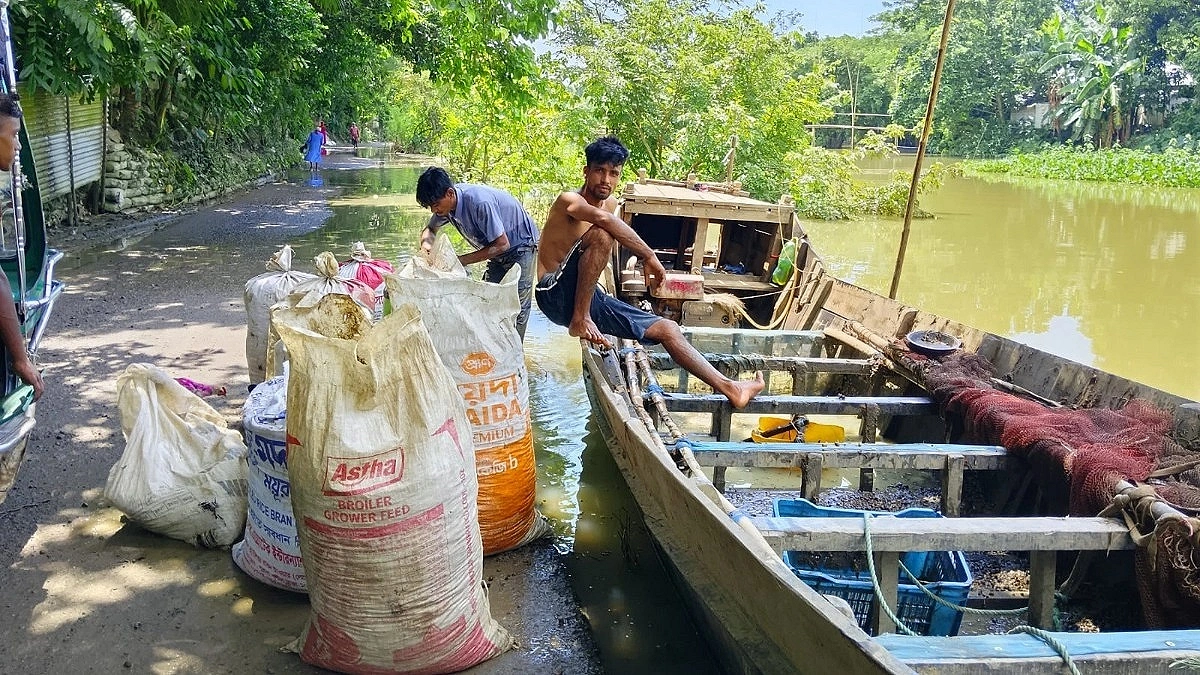
Photo: Agamir Somoy
Locals and syndicates are indiscriminately harvesting and selling snails throughout the monsoon season at Dingaputa Haor in Mohongonj, Netrokona. The daily mass collection threatens the haor’s natural balance and biodiversity.
Environmentalists and concerned parties warned that the continued slaughter of snails will severely damage the breeding and food chain of aquatic life.
Field observations showed that the collection and sale of snails have continued in various haors of the upazila since the beginning of the rainy season. Local trading has increased due to the demand for snails in duck farms and fish cultivation.
During the floating water season, many individuals are collecting snails alongside fishing in various parts of Dingaputa Haor.
Locals claimed that around 400 to 500 crates - equivalent to 200 to 250 sacks - of snails are collected daily using 15 to 20 boats. The market value of these snails is estimated to be between Tk 80,000 and Tk 90,000.
Rajib, a snail collector from Tetulia village, told Agamir Somoy, “Duck farmers and fish farmers from various parts of Mohongonj place orders in advance. After that, snails are collected from the haor throughout the night and brought to the ghat by boat. Later, they are sold in sacks by the roadside.”
He said each crate of snails sells for Tk 150, and a sack, which holds two and a half crates, costs between Tk 300 and Tk 375.
Snail collection occurs from night until dawn. At the Tollaghat area of Tetulia Union, snails are unloaded from boats and piled up. Then duck farmers and fish cultivators from different upazilas in the district purchase them. Workers employed in snail collection are also paid wages.
An anonymous duck farmer from Birampur village told Agamir Somoy, “I buy snails from here every day for duck feed.” During the observation, snails ordered in advance were being bagged and sent to Kalmakanda.
On Monday morning in Tetulia village, several people engaged in bagging snails refused to comment on the matter.
Locals complained that despite the unchecked collection, no raids, cases, or mobile court activities have been seen. According to experts, snails are a vital part of the aquatic ecosystem, serving as food for various fish, birds, and other animals, and playing a key role in maintaining the environmental balance of water bodies.
Indiscriminate collection risks damaging the breeding, food chains, and biodiversity of aquatic life.
Under the Wildlife (Conservation and Security) Act, 2012, hunting, collecting, destroying, buying, selling, or transporting wildlife without permission is prohibited. A government notification published on 10 July of the same year included snails as wildlife.
Violating the law can result in up to one year of imprisonment or a maximum fine of Tk 50,000. However, officials said the Fisheries Department cannot take effective action because the Fish Conservation Act lacks specific provisions regarding snail collection.
Tetulia Union Parishad Member Md Bazlu Mia told Agamir Somoy, “I have repeatedly warned the snail collectors in the Shyampur, Noapara, and Tetulia areas. They have been informed that catching snails is a punishable offense. Although it has decreased slightly this year compared to last year, miking is necessary to increase awareness.”
Upazila Fisheries Officer Anik Rahman said, “The matter is within our notice. Recently, a complication has arisen due to a case filed against about 1,200 people in another incident. However, initiatives will be taken to conduct raids again.”
He added that snails are primarily used in the livestock sector rather than the fisheries sector, requiring a coordinated initiative among relevant departments. Snail harvesting is harmful to biodiversity and should be viewed with importance from an environmental perspective.
Mohongonj Upazila Livestock Officer Utpal Kumar Sarkar told Agamir Somoy, “Our department does not work on snail issues.” He suggested contacting the Fisheries Department.
Netrokona Assistant Forest Office Acting Officer (SFNTC) Abdur Rafiq said, “The matter is not under the jurisdiction of the Forest Department. The Department of Environment will be able to provide necessary opinions on this.”
Netrokona Forest Department Range Officer Ramkrishna told Agamir Somoy, “Snails are an important part of the life cycle of aquatic animals in the haor region. If the indiscriminate collection of snails continues, the biodiversity of the haor will be severely damaged. This will disrupt snail breeding, reduce food for fish, and have a negative impact on future fish production.”
Mohongonj Upazila Nirbahi Officer Amena Khatun said, “I will look into the matter. Necessary measures will be taken in this regard after discussing the legal aspects with the concerned departments.”