
DSCC, DNCC to deploy new insecticides against mosquitoes

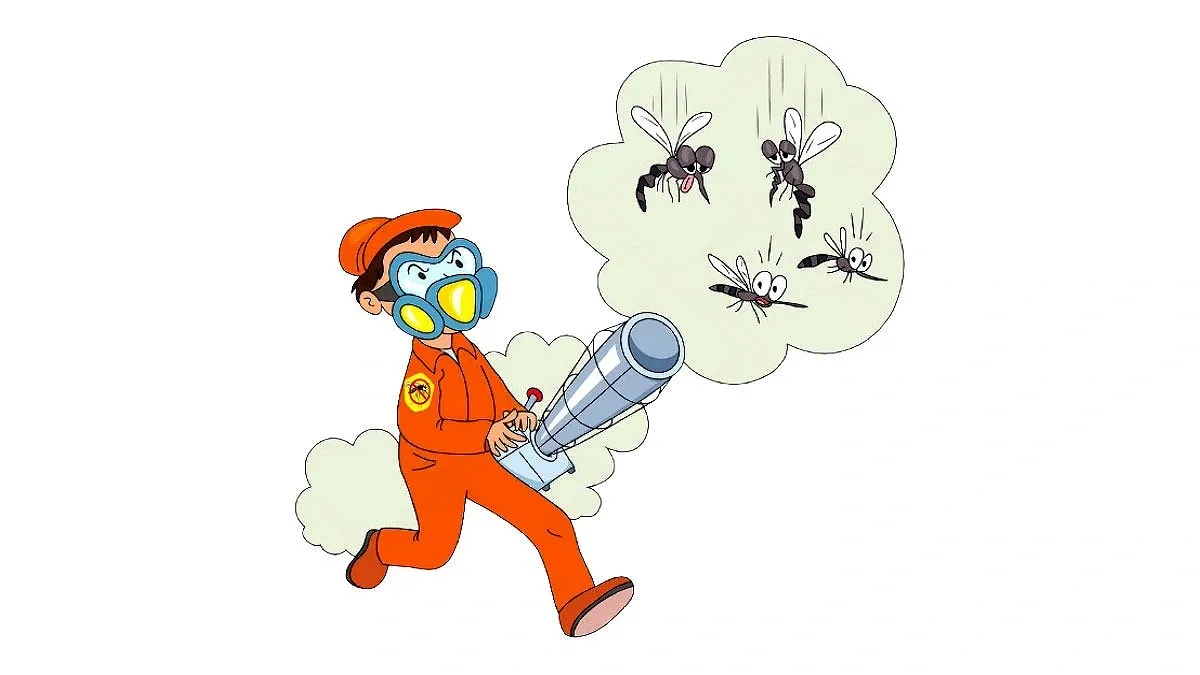
Graphics: Agamir Somoy
The two city corporations of Dhaka are planning to introduce new insecticides to combat the mosquito menace.
Dhaka South City Corporation (DSCC) has already begun processing the necessary paperwork to bring in new insecticides. Meanwhile, Dhaka North City Corporation (DNCC) has decided to introduce the combination of three (a mixture of three chemicals) and reintroduce the BTI insecticide.
However, the authorities have not yet specified an exact date for when these new insecticides will be imported.
The fear of dengue grips city residents as soon as June passes. Data from the Directorate General of Health Services (DGHS) shows that as of 24 July, 12,201 people have been hospitalized with dengue, and 39 people have died from the disease.
The rising trend of infections and deaths has also concerned the two city authorities, who have been working to bring in new pesticides. These efforts may become visible to residents by September. This time, the two cities will apply three new insecticides for mosquito control.
DSCC uses two insecticides: Temephos for larviciding and Malathion 5 percent for adulticiding. Soon, DSCC is going to apply Novaluron tablets to kill larvae in stagnant water.
DSCC officials said the Ministry of Local Government directed them to bring Novaluron tablets. While files are being processed for this, some DSCC officials believe Temephos works better for killing larvae in stagnant water or water meter holes.
However, following the ministry’s directive, DSCC plans to apply these tablets in specific areas like meter holes and construction sites where water is kept or accumulated.
DSCC Chief Health Officer Jahane Ferdous Binte Rahman told Agamir Somoy: “The ministry has instructed the use of Novaluron tablets and it will be used.” She did not provide information on when or in what initial quantity these tablets would be applied.
On the other hand, DNCC uses Temephos for larviciding and Malathion 5 percent for adulticiding, though they have been using Novaluron tablets for stagnant water for a long time. This time, DNCC will apply two additional new insecticides alongside these three.
One of these is Bacillus thuringiensis israelensis (BTI), which destroys larvae in stagnant water. The other is combination of three, a mixture of three chemicals: Dimefluthrin (0.3 percent), Meperfluthrin (0.2 percent), and Esbiothrin (0.1 percent).
DNCC claimed that the three distinct characteristics of these chemicals are capable of completely killing adult mosquitoes.
DNCC Chief Health Officer Brig Gen Imrul Kayes Chowdhury told Agamir Somoy, “One of the three chemicals in the combination of three will knock the mosquito to the ground, another will paralyze or disable it, and the third component will kill the mosquito.”
He added that the use of Malathion will continue alongside this. During the peak time for Aedes - specifically the first week of September - the combination of three will be applied in some areas as a pilot project.
Based on the results, DNCC will decide on further application. Initially, Malathion and the combination of three will be used alternately. After a certain period, following expert advice, DNCC plans to stop using Malathion and use only the combination of three.
DNCC previously used BTI in August 2023, but the activity was temporarily suspended later that month after evidence of fraud in the import process was found. Now, DNCC is bringing BTI back. BTI is an eco-friendly natural bacteria that kills mosquito larvae but cannot kill adult mosquitoes.
It is sprayed as a larvicide in stagnant water to effectively prevent mosquito breeding without harming humans, pets, or aquatic organisms.
When larvae ingest BTI, the bacteria create toxic crystals in their gut, which kills them. DNCC conducted preliminary tests with BTI in the Gulshan Lake area in March 2025, though no specific timeline for the new import has been announced.
Public health expert Be-Nazir Ahmed told Agamir Somoy, “The nature of Aedes is different. Therefore, it is not possible to reduce Aedes only through mosquito control programs; rather, two types of mosquitoes must be considered. One is Aedes and the other includes Culex and other mosquitoes. Integrated pesticide activities are needed for these two types of mosquitoes.”
He added that just like antibiotics, old insecticides can eventually develop resistance, making new ones necessary. However, Be-Nazir emphasized integrated efforts over just changing chemicals, suggesting a focus on cleaning drains, maintaining water flow, and destroying larvae and breeding sites rather than focusing only on adult mosquitoes.
