
Hilsa comes from Gujarat, where catch accounts for just 1.5% of Bangladesh's total!

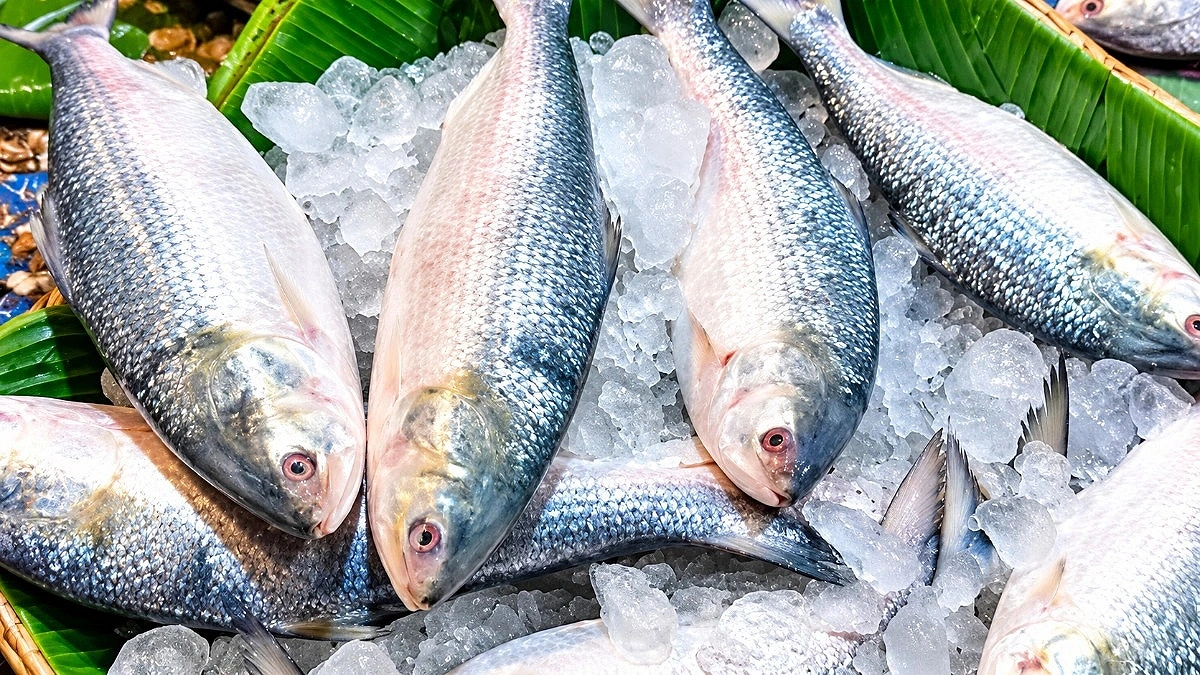
Photo edited by AI.
While Bengalis in India's West Bengal express deep longing for Bangladeshi Hilsa ahead of the Durga Puja festival, reports of Hilsa arriving in Bangladesh from the Indian state of Gujarat have sparked widespread discussion.
According to various Bangladeshi media outlets, 350,000 kilograms of Hilsa have been imported from India to Bangladesh since the start of the current fiscal year. However, a closer examination of Gujarat's fisheries data reveals that the state's Hilsa catch accounts for a mere 1.5% of Bangladesh's total harvest, rendering Gujarat's production almost negligible by comparison.
Hilsa is the national fish of Bangladesh and received Geographical Indication (GI) status in 2017. Data from the Bangladesh Department of Fisheries indicates that Bangladesh accounts for 85% of the total global Hilsa catch. Hilsa makes up 12% of the country's total fish production and contributes 1% to Bangladesh's GDP.
As a saltwater species, Hilsa migrates to freshwater rivers during the breeding season, which is when the bulk of the harvest occurs, alongside regular marine fishing. On average, Bangladesh harvests around 500,000 metric tons of Hilsa annually from its rivers, coastal areas, and shallow sea waters. In the 2023-24 fiscal year, total production reached 529,000 metric tons—comprising 281,000 metric tons from the sea and 248,000 metric tons from rivers.
Statistics show a slight drop in production during the 2024-25 fiscal year, with total landings recorded at 500,000 metric tons, split almost evenly between marine catches (251,000 metric tons) and riverine catches (249,000 metric tons).
India and Myanmar follow Bangladesh as the world's top Hilsa producers. However, putting Gujarat's production metrics side-by-side with Bangladesh highlights the vast disparity in scale:
2023-24 Bangladesh Harvest: 529,000 metric tons
2023-24 Gujarat Harvest: 8,084 metric tons
Production Ratio: Bangladesh harvested 65 times more Hilsa than Gujarat in that fiscal year.
Despite the low comparative volume, data from the Office of the Fisheries Commissioner in Gujarat shows a gradual upward trend in marine Hilsa catches along the Indian Ocean:
2008-09: ~1,600 metric tons
2010-11: Rose to 9,355 metric tons
2016-17: Dropped to 1,795 metric tons
2020-21: Surged to 11,004 metric tons
2022-23: Surpassed 14,000 metric tons
2023-24: Experienced a slight decline to 8,084 metric tons
Even with these gains, Hilsa represents a minor share of Gujarat's total marine fish catch, which stood at 704,828 metric tons in the 2023-24 fiscal year.
Located along the Arabian Sea west of the Bay of Bengal, Gujarat's primary Hilsa habitat is the estuary of the Narmada River. In recent years, significant catches have also been recorded in Navsari, Valsad, Somnath, and Porbandar. In 2022-23, Navsari recorded the highest yield at 4,706 metric tons, followed by Somnath (3,678 metric tons), Porbandar (2,538 metric tons), and Valsad (2,510 metric tons).
Citing figures from the Benapole Fisheries Quarantine Office, local media outlets reported that 353,226 kilograms of Hilsa entered Bangladesh through the Benapole land port from India during the first two months of the 2026-27 fiscal year. Imports rose from 29,880 kilograms in July to 323,346 kilograms (323 metric tons) in August. Twenty-two private importing firms brought in this consignment at a total cost of Tk6.92 crore.
This brings up the question of the origin of these imported fish. While West Bengal newspapers state that the Hilsa is being shipped from Gujarat, several Bangladeshi fish traders suspect the fish actually originates in Myanmar and enters Bangladesh via India.
This suspicion is backed by prior events. A July report by The Times of India highlighted how Myanmar's Hilsa was catering to fish lovers in Kolkata. At the time, Syed Anwar Maqsood, Secretary of the Howrah Fish Merchants' Association, confirmed that 525 metric tons of Myanmar Hilsa were held in West Bengal cold-storage facilities.
While the imported fish currently sold in Bangladesh lacks country-of-origin labeling, the reality remains that Bangladesh—the world's leading producer of Hilsa—is currently importing the fish from abroad.
