
Five-Year plan shifts focus from Dhaka to Chattogram

Graphics: Agamir Somoy
Five-Year Plan plans to make Dhaka livable by reducing pressure on the capital through a strategic shift toward Chattogram.
Planning Commission’s General Economics Division (GED) framed the strategic decisions in its “Five-Year Strategic Framework” to attract domestic and foreign investment and ensure balanced regional development.
Dhaka-centric “over-development” has accelerated the influx of people toward the capital on one hand while creating widespread inequality on the other. More than five lakh people are added to Dhaka’s population every year.
From employment opportunities to civic amenities, everything has been concentrated in Dhaka, keeping the city high on global lists of unlivable cities. Although discussions on this issue have persisted for a long time, no effective action was taken until now. Following prolonged public suffering, the government has finally stepped in to put a rein on Dhaka’s one-way development.
To relieve the suffocating pressure on the capital, planned urbanization and new job creation strategies have been drawn up under the Detailed Area Plan (DAP), incorporating Purbachal, Jhilmil, Uttara, Savar, Keraniganj, Gazipur, and Narayanganj.
Alongside this, initiatives are underway to transform Chattogram into a true “commercial capital” and to revitalize EPZs and BSCIC industrial estates to drive regional industrialization. The new plan indicates radical changes, placing maximum focus on transforming it into a primary employment hub while pulling back on Dhaka’s expansion.
Former prime minister Khaleda Zia originally declared Chattogram as the commercial capital of Bangladesh during a rally at Laldighi Maidan in Chattogram in 1992. Later, on 6 January 2003, the decision to develop Chattogram as a commercial capital was formally approved in a Cabinet meeting.
However, development stalled and aside from one or two major structures, the city experienced little growth. To this day, Chattogram repeatedly gets waterlogged during every monsoon season. Despite having potential and possessing all necessary elements to develop the entire zone, the city lacked coordinated planning and execution.
Beyond Chattogram, the strategic plan gives priority to lagging north-western districts, while ensuring that haor, wetland, and extensive coastal regions progress alongside the mainstream economy.
In Dhaka, excessive pressure from population, vehicles, and factories has made daily life unbearable, yet adequate quality jobs are not being created proportionally. On the other hand, people in marginal areas remain behind due to limited opportunities for permanent or higher income.
To eliminate this disparity, steps have been taken to reduce single-point dependency on Dhaka. According to the GED framework, around 34 percent of Bangladesh’s economic growth stems from the industrial sector, yet almost all of it is concentrated around Dhaka and Chattogram.
To ease the excessive burden of population, manufacturing plants, and service activities on Dhaka, maximum priority will be assigned to developing secondary cities growing as regional centers.
Commenting that the unicentric development model has become a major long-term obstacle to the national economy, GED Member (Secretary) Monzur Hossain said main investments, economic activities, infrastructure, and civic facilities have traditionally clustered around Dhaka and Chattogram.
He added that while this arrangement initially accelerated rapid growth through the expansion of readymade garments, construction, and logistics sectors, it gradually turned into a major bottleneck over time. As a result, cities suffer from severe traffic congestion, sky-high cost of living, and extreme pressure on urban utilities, while economic growth in other regions remains blocked.
Emphasizing that the new plan prioritizes balanced development to overcome this crisis, Monzur noted that ensuring equal growth, job creation, and basic civic amenities across all regions is essential to address regional disparities. However, he clarified that the strategy is not meant to diminish Dhaka’s importance, but rather to unburden it and turn Dhaka into a well-planned and livable city.
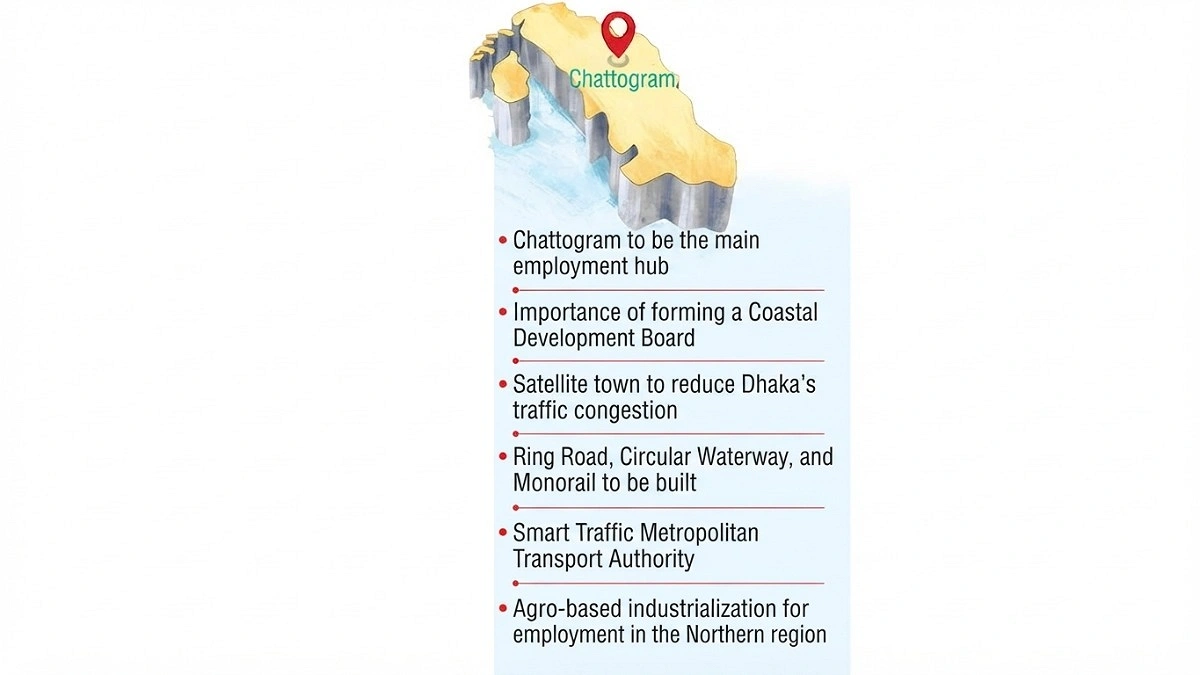
The framework outlines developing Chattogram into a major employment hub and stresses agro-based industrialization to generate jobs in the northern region.
In haor and wetland regions, focus will be placed on strengthening water-based infrastructure, disaster management, transport, electricity, health, education, fisheries, duck farming, tourism, and biodiversity conservation.
For coastal development, priorities include climate adaptation, secure livelihoods, embankments, cyclone shelters, early warning systems, the blue economy, modern aquaculture, SME growth, and the creation of a Coastal Development Board.
The broader urban strategy aims to build livable cities through zoning, land-use mapping, modern and safe urban spaces, digital services, sustainable transportation, integrated waste and water management, empowered local government, and digital land services.
Moreover, the housing policy will prioritize planned urbanization, affordable housing for low-income populations and slum dwellers, rehabilitation of homeless citizens, and the establishment of a land bank to curb corruption.
To relieve the capital from the pressure of mega-projects and restore livability, the new Five-Year Plan prioritizes modern service sectors. To tackle traffic congestion, plans involve introducing satellite towns, ring roads, circular waterways, monorails, dedicated buses for women, and electric vehicles.
Moreover, initiatives include setting up a “Metropolitan Transport Authority”, expanding CCTV monitoring, and introducing shared parking for smart traffic management, alongside promoting city heritage and tourism via eco-tourism, online portals, and the “Dhaka Food and Culture Festival”.
Welcoming the government’s initiative while cautioning about implementation hurdles and past experiences, urban planner Adil Mohammad Khan said, “This is certainly a good initiative, but past experience shows that although every government says such things verbally, the majority share of public investment ultimately ends up in Dhaka. Hundreds of crores of Taka are being poured into constructing a single metro rail - whereas with this huge sum of money, it would have been possible to completely transform any other regional city in the country.”
Highlighting Dhaka-centric development and the lack of visionary planning, he added, “The beautiful outline drawn in the Five-Year Plan documents should not remain confined to paper and ink. We want to see the real implementation of this plan.”
Balanced regional growth does not mean spreading investment indiscriminately across every district, but rather connecting marginal regions and cities into an integrated national network. GED highlighted that Bangladesh’s existing single-track growth model has reached its ultimate limit.
While Dhaka-Chattogram-centric industrialization previously drove economic momentum, severe traffic gridlock, soaring land and housing costs, and environmental degradation are now undermining productivity.
To overcome this wall, the framework recommends directly integrating second-tier cities, border zones, ports, and rural areas into the national economy and supply chain logistics.
