
Middle class savings to fall, debt burden to rise

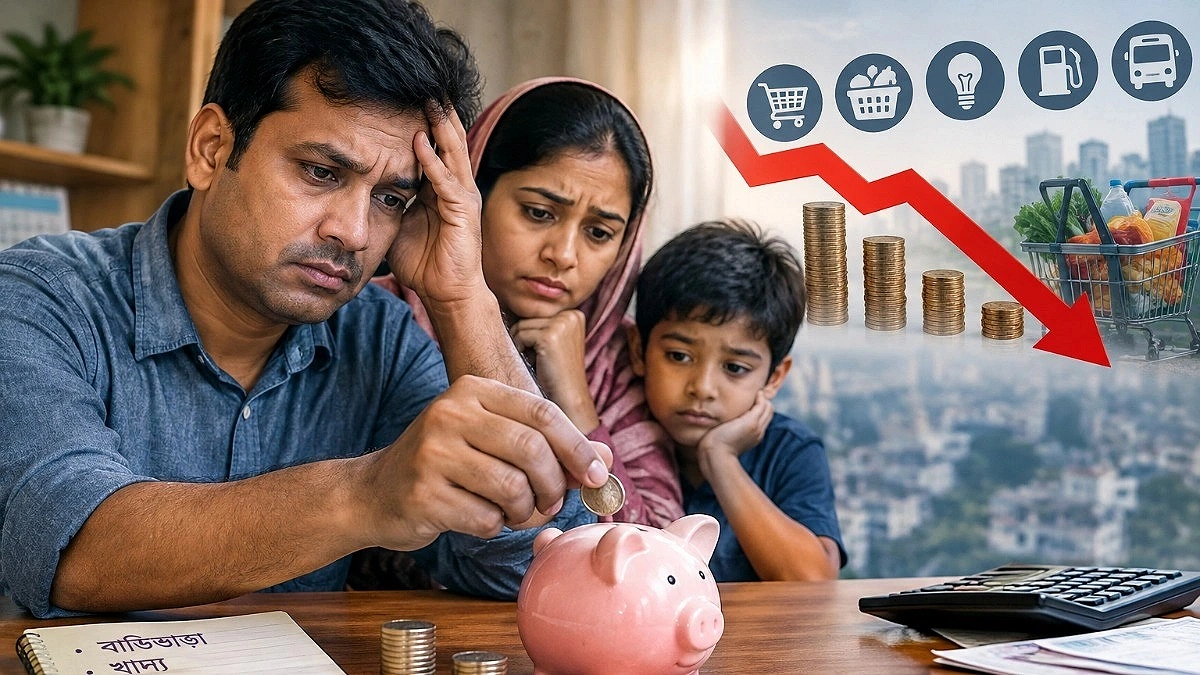
Photo generated by AI
The sharp increase of Tk 20 per liter in fuel prices will not only slow down transportation. Its impact will also hit households directly. As transportation costs rise, prices of essential commodities are also expected to increase. Diesel is widely used in the agricultural sector. The price hike will also affect irrigation pumps and agricultural machinery. As a result, crop production costs will increase.
This will directly affect the retail prices of rice and other grains. Overall, economists fear that the monthly budgets and normal lifestyles of middle-class families will be completely disrupted. They said savings of many middle-class families will decline while their debt burden will increase. The hike will also have a major adverse impact on industrial production and exports. Overall, the country’s economy will come under significant pressure.
The government recently announced the ninth pay scale for government employees. It is expected to further fuel inflation. Just two days later, the fuel price hike has created a sense of anxiety among ordinary people.
When contacted, former World Bank Dhaka office lead economist Dr.Zahid Hussain told Agamir Somoy on Monday evening that the government had no alternative to raising fuel prices because of the increase in crude oil prices in the international market and the need to manage the subsidy burden of Bangladesh Petroleum Corporation (BPC).
“Keeping fuel prices low for a long time and managing the situation through subsidies or printing money is impossible for the government. It also does not create an incentive for users to save fuel. Besides, since prices are lower than in neighboring countries, there is a risk of smuggling and stockpiling. However, the main question is not about raising prices but about the method. For the past two years, a policy of automatic price adjustment according to a formula at the end of each month has been in place. This was bypassed and the latest announcement was made suddenly based on bureaucratic discretion in the middle of the cycle. Earlier, the government did not increase prices despite having the formula in place because it wanted to remain popular. Breaking the policy and making such a decision midway undermines the credibility of the policy and public trust and makes the issue politicized. However, the government should increase monitoring to prevent excessive fares from being charged under the pretext of higher fuel prices,” the economist said.
Crisis for fixed and low-income people
The increase in fuel prices also pushes up the prices of essential commodities. People with low and fixed incomes and marginalized communities will suffer the most. As income growth remains lower than inflation, their real purchasing power falls sharply. As a result, families struggle to meet their daily living expenses.
Research has shown that the price of each food item could increase by Tk 4 to Tk 15 per kilogram due to the increase in fuel prices. If a four-member family has only one main earner with a fixed monthly income of Tk 30,000 to Tk 50,000, its monthly expenses could suddenly increase by Tk 3,000 to Tk 5,000. This would reduce the family’s savings or push it into debt. As a result, families would be forced to cut back on protein or nutritious food.
In this regard, SM Nazer Hossain, vice president of the Consumers Association of Bangladesh (CAB), said the additional costs caused by higher fuel prices in industry, business, transportation and households would ultimately be taken from consumers’ pockets. As a result, prices of daily consumer goods would rise further.
“If irregularities and corruption in the fuel sector had been stopped and loopholes had been closed for a long time, many alternative solutions could have been found. Besides, BPC had made huge profits in the past and deposited money with the Finance Ministry. A large amount of money had also remained idle. It should have been considered whether that profit could have been used during this crisis. Although the government has talked about reducing expenditure, both spending and commodity prices have increased after the announcement of the new pay scale,” he said.
“Whenever prices rise in the international market, BPC will adjust prices. However, there has been no precedent of reducing prices when international prices fall. After the announcement of the price hike on Sunday, fuel prices in the international market fell the very next day and there is a possibility that they will fall further. Therefore, the government’s decision was short sighted, ill-considered and not people friendly,” he said.
Competitiveness of industry and export sector to decline
Industry entrepreneurs believe the increase in fuel prices will raise production costs at factories as well as the cost of operating generators and transporting raw materials and goods. According to them, many industrial facilities are already being shut down due to gas shortages. The fuel crisis is now adding to the problem. As a result, businesses are seeing lower profits and export-oriented sectors will become less competitive in international markets.
Shams Mahmud, managing director of Shasha Denims, said the increase in fuel prices could hamper the pace of industrialization. He told Agamir Somoy that higher fuel prices would directly increase production and operating costs for businesses. At the same time, higher transportation costs for raw materials and finished products would increase overall production costs. This would make it difficult to maintain the prices and competitiveness of Bangladeshi products in international markets.
Shams Mahmud further said industrial establishments are already under pressure from various rising costs. Higher fuel expenses would force many businesses to bear additional costs. According to him, reducing industrial production costs and maintaining competitiveness are now extremely important. In this situation, the government needs to make careful decisions so that the increase in fuel prices does not put additional pressure on the industrial and business sectors.
Inflation concerns
Before August 2022, inflation in the country remained below 7.5 percent. However, after a record increase in fuel prices that month, inflation jumped to 9.52 percent. Transportation costs and prices of essential commodities increased as a result. Over the next four years, inflation did not return to its previous level due to higher shipping costs caused by wars, high commodity prices in international markets and the dollar crisis. Instead, inflation reached 11.66 percent in July 2024, while food inflation exceeded 14 percent.
Some new drivers have also been added to the economy. The implementation of the new pay structure for government employees will increase the flow of money into people’s hands. At the same time, Bangladesh Bank’s reduction of the policy interest rate to boost private investment has created scope for increased credit flow in the market. Overall, concerned parties fear that the combined impact of higher fuel prices and increased money flow in the market could intensify inflationary pressure in the coming days.
