
Small producers more in Chittagong, large ones more in Sylhet

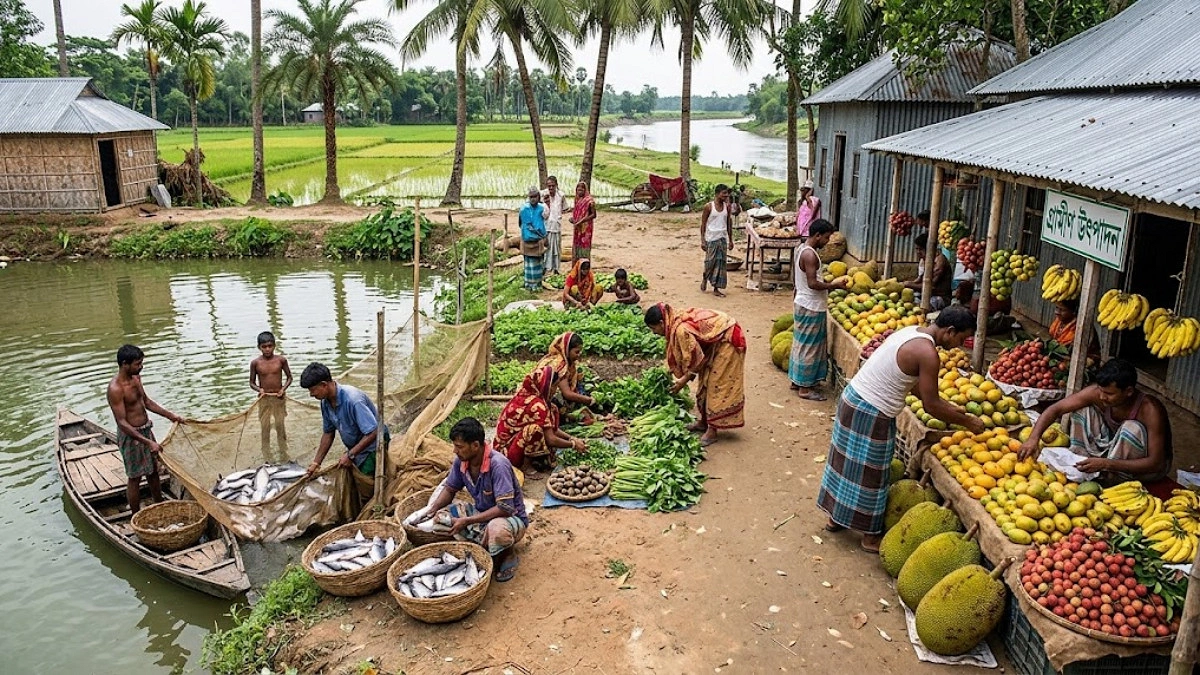
Representational image drawn by AI.
Small-scale producers play the vital role in the food production system. Nationally, 53.65% of all food producers are smallholders. Among the divisions, Chittagong has the highest proportion of small producers at 59.81%, followed by Rangpur at 59.29%.
On the other hand, Sylhet division has the highest proportion of large producers at 39.99%. These findings come from the Bangladesh Bureau of Statistics (BBS) survey on "Income and Productivity of Small Food Producers," which was recently published by the agency.
According to the report, the BBS conducted this survey to establish national baselines for SDG indicators 2.3.1 (production per labour unit) and 2.3.2 (average income of small food producers). Data was collected from 12,879 households across eight divisions and five agricultural sectors – temporary crops, permanent crops, forestry, livestock, and fisheries. The survey produced nationally representative estimates for SDG target 2.3.
Muhammad Rafiqul Islam, Project Director of the Sustainable Agriculture Statistics Project, told Agamir Somoy that based on the experience gained from conducting the survey, in Sylhet there is generally more land relative to the population. This is because much of the land is owned by people living in London or abroad. Consequently, sharecroppers cultivate those lands, and often cultivate larger areas per person. That is why Sylhet division has a higher prevalence of large-scale production. The opposite is seen in Chittagong division, where arable land is scarce and hills dominate. There, ownership is fragmented into small plots, which results in more small-scale production.
The report states that among smallholder families in Bangladesh, 10.7% are female-headed. In contrast, only 4.7% of large-scale food producer families are female-led. Across all sectors, the national average productivity per labour-day (one worker's daily output) is Tk 1,868. Small-scale food producers earn Tk 1,494 per labour-day, while large-scale producers earn Tk 2,301.
In terms of sector-specific productivity, fisheries achieved the highest productivity at Tk 11,382 per labour-day, followed by permanent crops (Tk 6,530), forestry (Tk 5,390), temporary crops (Tk 2,585), and livestock (Tk 1,459).
Notably, in the permanent crops and forestry sectors, small-scale food producers outperformed their large-scale counterparts, earning Tk 9,182 vs. Tk 4,603 per labour-day in permanent crops, and Tk 6,518 vs. Tk 4,656 in forestry, respectively.
The report also states that at the divisional level, smallholder productivity is highest in Rajshahi (Tk 2,093 per labour-day) and lowest in Mymensingh (Tk 1,135 per labour-day).
The report further notes that the national average annual income for all types of producers is Tk 78,286. For small-scale food producers, the estimated annual income is about Tk 33,639, while for large-scale producers it is Tk 129,956.


