

Who Will Sign the Death Certificate of the Kanchamatia River?

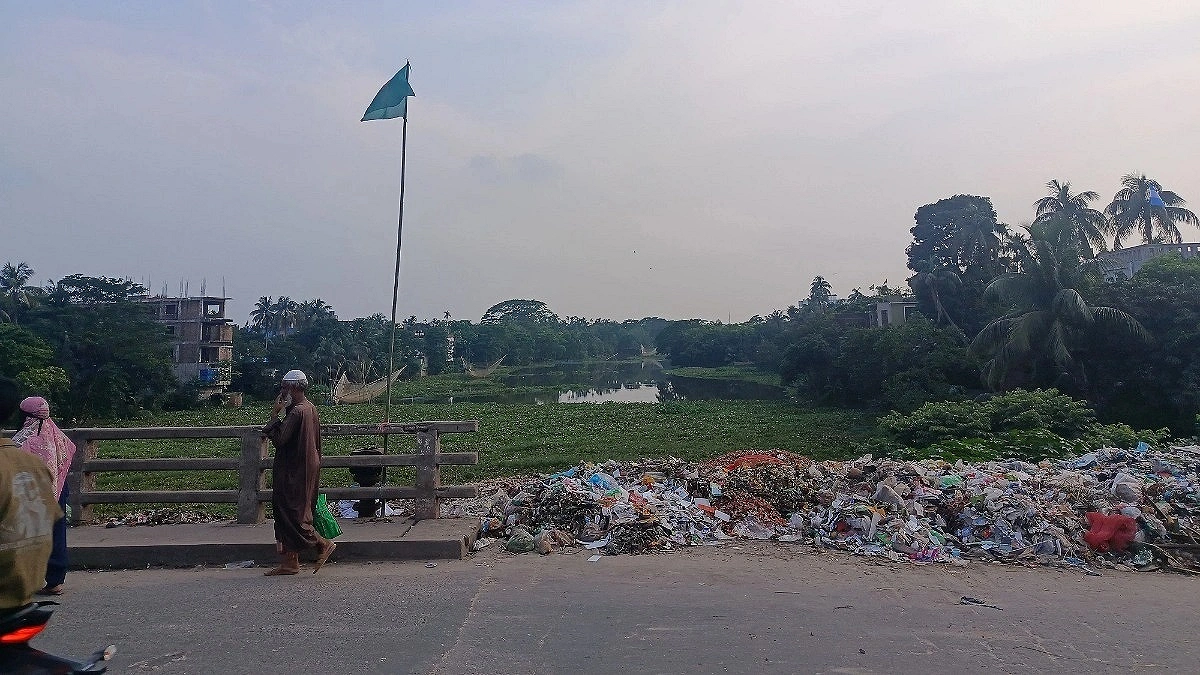
Photo: Agamir Somoy
In Ishwarganj upazila of Mymensingh, a river is slowly suffocating. Its name is Kanchamatia. Once it carried flowing currents, fish, and the sound of boats. Today, only mud, silt, and the long sigh of fading memories remain. The most painful truth is that this death has no sound, no mourning assembly, no black badges, no flags at half mast. The river is disappearing silently, and this quiet departure seems to go unnoticed.
Kanchamatia was born from the Brahmaputra. Today, it can no longer return there. Its mouth has been sealed. Silt has clogged its breath. Encroachers have blocked both banks. Waste has mixed into its bloodstream. And people stand by, describing its death as a natural process.
Among the elderly of Ishwarganj, stories of Kanchamatia still come alive. As they speak, their eyes drift far away to a time when the river was still alive. Once Kanchamatia was not just a river; it was the lifeline of the entire region. Boats drifted under the midday sun, heavily loaded vessels carrying jute docked at its ghats, and the riverside warehouses were bustling day and night with trade. On market days, the ghats were so crowded that there was barely space to stand.
With the first rains, Kanchamatia would regain life, water swelling and waves filling its body. Even in the dry season, it held water. Fishermen cast their nets, children swam joyfully, and farmers irrigated their fields with its flow. The river did not merely carry water; it carried livelihoods and hope.
Today, standing in the middle of what once was a river, one can easily say, the main current once flowed here. Hearing this feels like someone pointing at a grave and saying, my mother lies here.
If the history of Ishwarganj is ever written, it may say that the town did not begin beside roads, but beside a river. Like all ancient civilisations, the river came first, then people. Along came markets, trade, and homes. And slowly, within those homes, greed entered. That greed will remain the story behind the death of a weary river, crushed under the weight of change.
A river does not die in gunfire or explosions. It dies slowly, like an elderly person fading away. First, its flow slows down. Then its waters become blurred like failing vision. Its memory like currents become disordered. Eventually, it can no longer stand, it lies down upon its own riverbed.
The story of Kanchamatia is exactly this slow death. Its mouth narrowed, its flow reduced, and silt accumulated. Fish disappeared, fishermen changed professions, and canal connections were cut one by one. Encroachment followed. Now the river is merely a shadow of its past, neither fully alive nor completely dead. It waits for its final declaration: there once was a river here.
According to local elders, Kanchamatia once played a central role in Ishwarganj’s economy and communication system. Before roads dominated, waterways were the primary means of transport. Markets, trade, and agricultural transport all revolved around this river. Many families still recount how business once flourished around its ghats. The river was not just a water body, it was a social institution and an economic corridor.
Lal Mia, a resident of Charshihari village, runs a small business in Ishwarganj bazar. Speaking about the river, he said: I was born in 1971. Even in my lifetime, I have seen how much the river has changed. In my father’s time, jute was regularly transported through this river. I used to see boats carrying clay pots. I would throw stones at them from a distance. Sometimes I would get chased away. Near the bridge over Kanchamatia, two bamboo poles could not even reach the riverbed; it had that much water. Even during the year, it had enough water. Now, even in the monsoon, there is not even 10 feet of water. We used to catch fish with our hands. The water was clear. Now there are no fish. How could there be? The water is so polluted that fish cannot survive.
Mahmudul Hasan of Kakonhati village said: Because of dumping waste into the river, fish cannot survive. Illegal dams, obstruction of fish movement, and uncontrolled dumping of market waste have destroyed the ecosystem. Market rubbish is thrown near the bridge, and hotel waste goes directly into the river. No one takes responsibility. This is how our Kanchamatia is disappearing. The death of this river is not just environmental, it is economic collapse. Transport by boat has disappeared, fishermen’s income has fallen, and irrigation has become difficult.
Locals believe the river is not beyond revival. Restoration is possible through restoring natural flow, removing encroachments, regular dredging, controlling pollution, and ensuring community participation. Without coordinated efforts from the administration, environmentalists, public representatives, and citizens, no river can be saved.
When rivers dry up, people look for alternatives. But those alternatives are often costly, temporary, and environmentally harmful. That is why locals urge urgent action. Perhaps one day the river will disappear completely. A child in Ishwarganj may ask his grandfather, where was the Kanchamatia River?
The grandfather will point towards a dry patch of land and say, it was right there.
On that day, the river may no longer exist. Only a name will remain. Only memories will remain. The only question will be who signs the death certificate of the Kanchamatia River.
Regarding this, the Upazila Nirbahi Officer, Sanjida Rahman, said: We are working to protect the river. We have already started removing water hyacinth from the river. We had written to the Water Development Board to restore its navigability. If needed, we will write again. We have discussed the matter with the Member of Parliament. We are making strong efforts to implement a project soon.

