
Eligibility rule clouds Monira’s candidacy
- Monira Sharmin’s candidacy suspended in scrutiny
- 12 Jamaat alliance nominations found valid
- Monira urges humane consideration over legal technicality

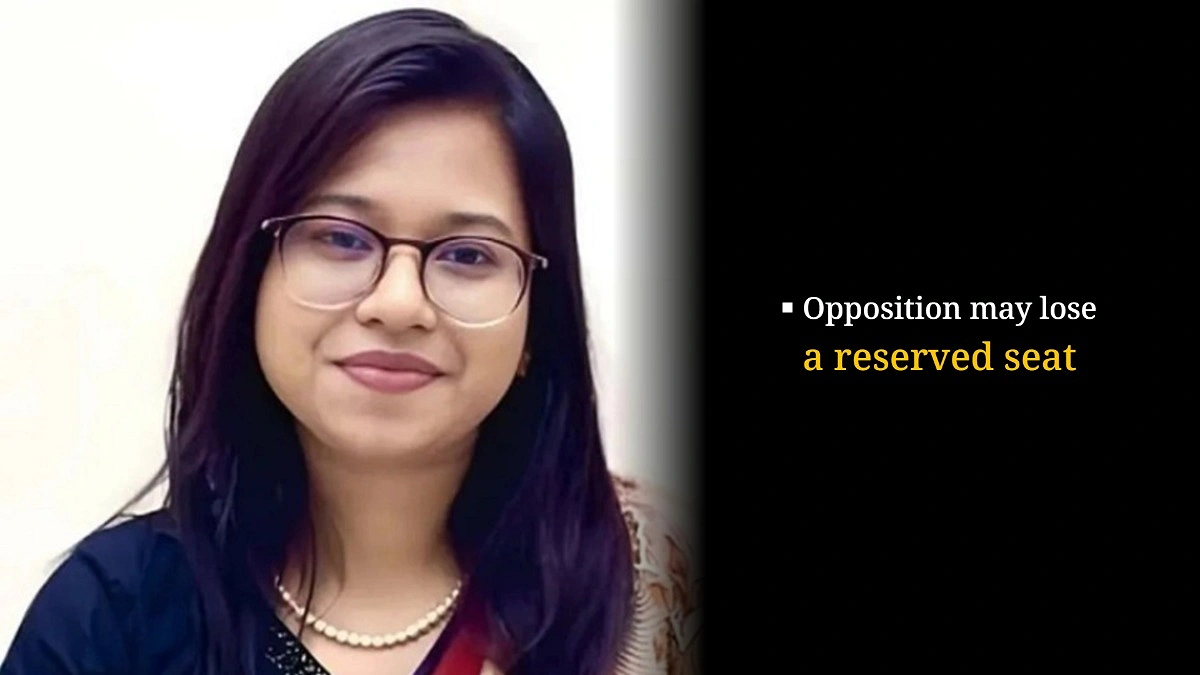
Photo: Agamir Somoy
A hard-won government job is turning into an unexpected obstacle for NCP)leader Monira Sharmin. Even after resigning from public service, her eligibility to become a Member of Parliament (MP) is now under threat due to a provision in the Representation of the People Order (RPO), putting her reserved women’s seat nomination in uncertainty.
In Bangladesh, securing a government job requires years of rigorous study and passing multiple stages of competitive examinations. Monira Sharmin went through that process and was appointed as an officer (general) at Bangladesh Krishi Bank in 2023. However, she did not remain in the post for long. Driven by her interest in politics, she resigned from the job in December 2025.
Like many political aspirants, Monira likely envisioned becoming a Member of Parliament one day. That opportunity eventually came, but she now finds herself ineligible—for the moment. Her nomination has been put at risk because she filed her candidacy before completing the mandatory three-year gap after resigning from government service.
According to the RPO, anyone who resigns from or retires from a government or statutory public position cannot contest parliamentary elections unless three years have passed since leaving service. The Election Commission has clarified that this rule also applies to reserved women’s seats.
Monira Sharmin, who is a joint convener of the NCP and a candidate under the Jamaat-led alliance, resigned from Krishi Bank only four months ago. Under the law, a minimum of 36 months must pass after resignation before a person becomes eligible to contest.
As a result, during the scrutiny of nomination papers at the Election Commission office in Agargaon, Dhaka on Wednesday (April 22), officials kept her candidacy “pending.” She has been instructed to submit necessary documents by 12 noon on Thursday.
Following the scrutiny process, Returning Officer and EC Joint Secretary Moin Uddin Khan said, “Out of 13 nomination papers, 12 have been declared valid. One nomination remains pending for decision.”
He also noted that Monira has been given an opportunity to defend her case, as her submitted documents included references to the government pay scale.
Monira has urged authorities to consider the matter from a humanitarian perspective rather than a strictly technical legal interpretation, as her political future now hinges on the interpretation of the rule.
Uncertainty grows over reserved seat allocation
Election Commission sources said the Jamaat-led alliance submitted a list of 13 candidates for 13 reserved seats. With one candidate’s nomination now pending, uncertainty has emerged over the final allocation.
Meanwhile, the nomination of another NCP candidate, Nusrat Tabassum, was not accepted as she submitted her papers after the deadline. As a result, if Monira Sharmin’s candidacy is ultimately cancelled, the concerned seat will become ‘vacant’.
In that case, a fresh election could benefit the ruling BNP-led alliance. The alliance currently holds 36 seats, and an additional seat would raise the total to 37. On the other hand, the Jamaat-led alliance’s seats could fall from 13 to 12.
However, leaders from the NCP and the opposition alliance remain hopeful. They argue that since Monira resigned from her government job before becoming permanent in the post, the matter should be considered with discretion, and her nomination should not be rejected.
Alliance coordinator and Jamaat Assistant Secretary General Hamidur Rahman Azad also expressed optimism, saying, “We believe the nomination will not be rejected.”
Rule does not apply, claims Monira
Monira Sharmin has argued that the legal provision in question does not apply in her case, noting that Bangladesh Krishi Bank, although a state-owned institution, is a specialized bank and her position was not a profit-making post of the state.
She said the reserved women’s seat is not a direct public election but based on party nomination, adding, “This is not a direct public vote; it is based on party nomination. Therefore, the provision does not apply to my case.”
Monira also stated that she served in a lower-tier position with no policymaking authority or administrative influence. She said, “The three-year rule may be reasonable for senior officials, but applying the same standard to an entry-level officer like me raises questions of fairness.”
According to her, the core purpose of reserved women’s seats is to increase women’s political participation. She warned that disqualification based on strict or overly rigid legal interpretation could undermine that objective and discourage capable women from entering politics.
Expressing respect for the law, Monira said, “The law must align with time, reality, and a sense of justice. I am not seeking loopholes; I request that the matter be considered from a humane and practical perspective.”
She also confirmed that she will file an appeal if her nomination is ultimately rejected.
Nominations declared valid
At the end of the first day of scrutiny, the Election Commission declared valid the nominations of 12 other candidates from the Jamaat-led alliance.
They include Jamaat-e-Islami nominees Nurunnisa Siddika, Marzia Begum, Sabikun Nahar Munni, Mardia Momtaz, Nazmun Nahar Nilu, Mahfuza Siddika, Sajeda Samad, and Samsun Nahar.
Among allied parties, the valid candidates are NCP’s Dr. Mahmuda Alam Mitu, JAGPA chairperson Tasmia Pradhan, Bangladesh Khilafat Majlis candidate Mahbuba Hakim, and Rokeya Begum, the mother of child martyr Jabr Ibrahim from the July uprising.
Next steps
According to the Election Commission schedule, elections for reserved women’s seats will be held on May 12. The scrutiny process will conclude on April 23, while candidates may withdraw nominations until April 29. Appeals can be filed on April 26, with hearings and disposal scheduled for April 27 and 28.
