
Released Gangsters Back in Play, Dhaka Underworld Heats Up

Graphics: Agamir Somoy
The top terrorist Humayun Kabir, also known as Murgi Milon, was known as a figure of terror in Dhaka’s underworld in the 1990s. His murder remained a widely discussed event in the capital’s criminal world for many years. Milon, a member of the notorious ‘Seven Star’ gang of top criminals at the time, was killed in a cinematic manner that was even more dramatic than Titon.
The incident took place on 27 September 2000. On that day, Murgi Milon went to the court in Old Dhaka to attend a case hearing. In the crowded premises of the judges’ court, the killers surrounded him in public and shot him at close range like a bird. Before that, a series of cocktail explosions were carried out to divert the attention of police and the public. The attack was executed by associates of another notorious top terrorist, Kala Jahangir. Following the murder, Dhaka experienced a tense period of tit-for-tat killings for several days. As the Seven Star group launched retaliatory attacks targeting their rivals, the city’s underworld became increasingly volatile.
On Tuesday, Khandaker Naeem Ahmed Titon was also killed in a similar cinematic manner on a busy road in the New Market area, shot at close range. He was listed among the top criminals in police records. The details emerging from this killing are reviving memories of Murgi Milon’s murder.
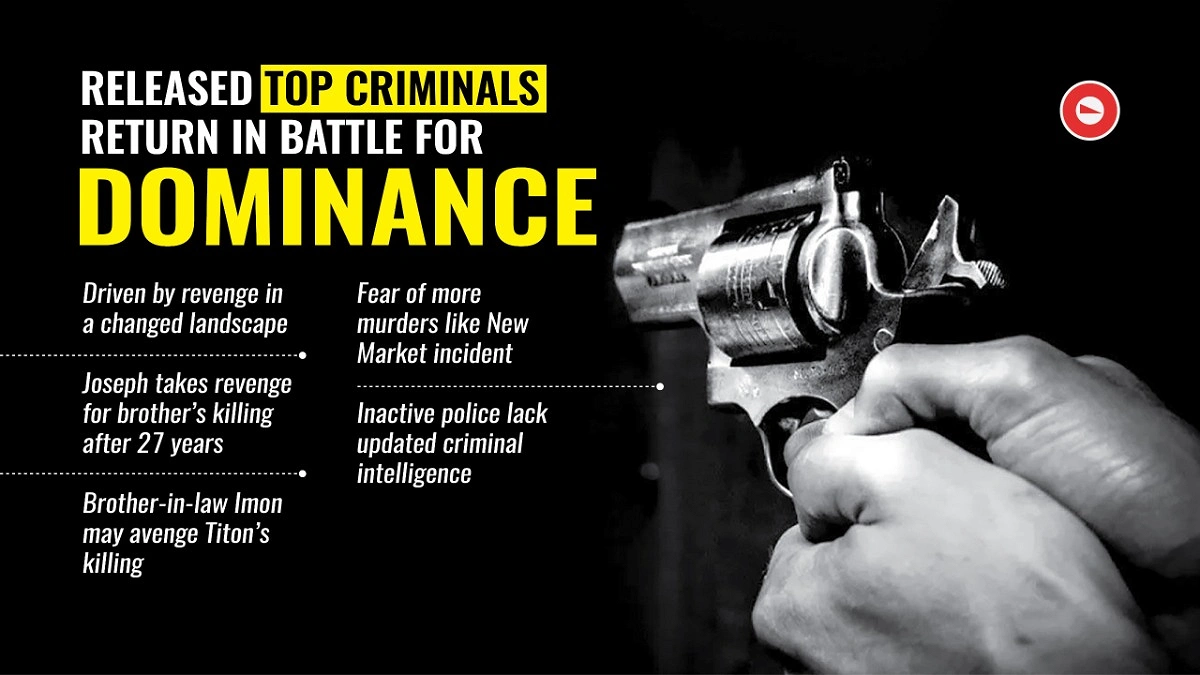
Convicted top criminals released from prison are becoming desperate in a struggle for revenge, retaliation and domination. They are taking advantage of police inactivity and the lack of updated intelligence on criminals.
A person familiar with the underworld said that, just as top criminal Joseph Ahmed took revenge for his brother’s killing after 27 years, Titon’s brother-in-law Sanjidul Islam Imon, now considered one of the most active and dangerous criminals, is unlikely to remain silent. Supporters of Titon may also become desperate to take revenge, just as members of the Seven Star gang did after Murgi Milon’s killing. Such cinematic-style killings may trigger more incidents.
Sources said that in 2001, rewards were announced for capturing 23 top criminals, and in 2004, with the launch of the elite Rapid Action Battalion (RAB), many notorious offenders fled the country, while some were arrested. During the 16-year rule of the Awami League, the Dhaka underworld was largely subdued due to extrajudicial killings under names such as ‘crossfire’ or ‘encounter killings.’ Many top criminals either operated from abroad or from prison, limiting their activities mainly to extortion from selected business groups. Even after completing sentences, several high-profile criminals reportedly chose prisons as a safer shelter to protect their lives. Over time, however, the nature of crime and criminals has changed. During the interim government period, many who were released from prison have become fully active again in the criminal world. Some are now revisiting old rivalries and settling past scores, further destabilizing the underworld.
During this period, several notorious criminals from the 1990s, including Sweden Aslam, Abbas Ali alias Killer Abbas of Mirpur, Imamul Hasan Helal alias Pichchi Helal of Mohammadpur, Khandaker Naeem Ahmed Titon of Hazaribagh, and Khorshed Alam Rasoo alias Freedom Rasoo, were released from prison. In addition, Sanjidul Islam alias Imon, once a terror figure in Hazaribagh and Dhanmondi, was released and later moved abroad. Among them, Sweden Aslam is reportedly inactive, while others remain active, according to people familiar with Dhaka’s underworld.
Earlier, Joseph Ahmed was released after his ‘top terrorist’ label was removed. He had long dominated Dhaka’s criminal underworld as a central figure.
Most of these criminals spent more than one and a half decades in prison. Some who are still in jail are reportedly lobbying hard for release.
