
Remembering 29 April 1991
150,000 Lives Lost in a Single Night

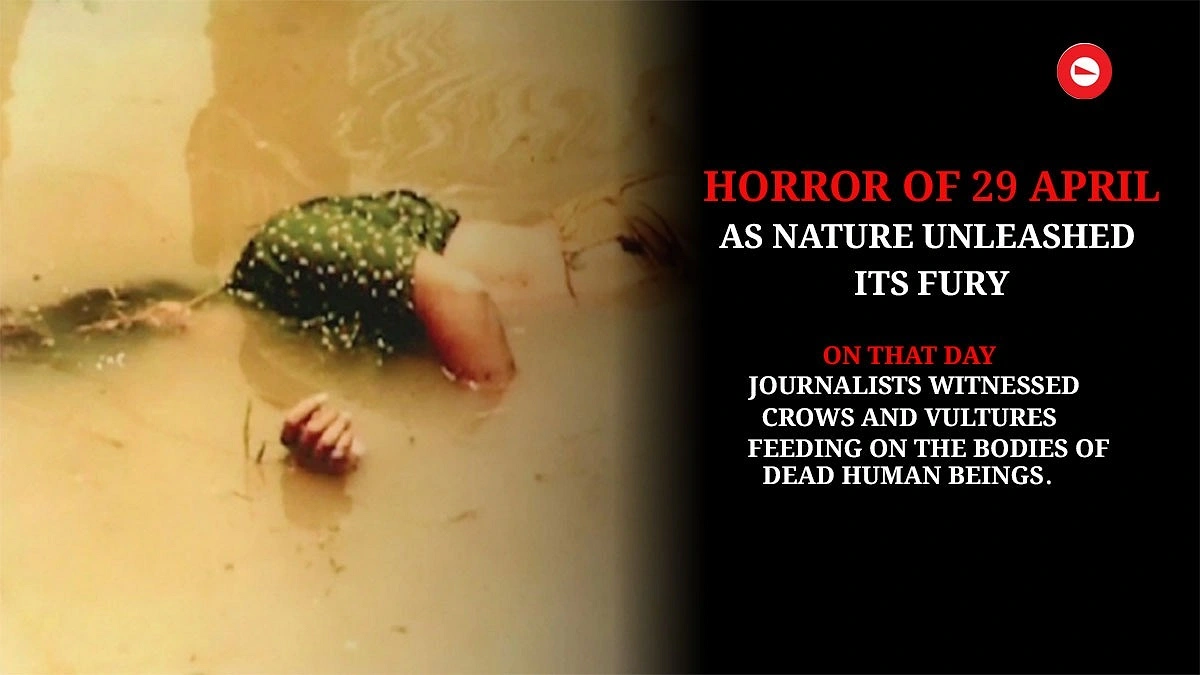
Graphics: Agamir Somoy
The devastating cyclone and storm surge of 29 April 1991 killed 138,882 people, according to official figures, along the coastal areas of Chattogram and Cox’s Bazar. Many others went missing beyond this count, while hundreds of thousands were left homeless as vast stretches of land went under water. Survivors along the coast still carry the memory of that horrific night.
The day had begun normally. The sun rose in the morning, birds were heard singing, and farmers went to the fields with their cattle. However, a sudden change in weather in the evening signaled the approaching disaster. As night deepened, nature turned violent, unleashing a cyclone and storm surge that devastated the region.
Sohel Sarwar, a resident of Gandomara Union in Banshkhali, Chattogram, was an eight-year-old child at the time. He had gone with his family to a local madrasa meeting and fair in the village. He said the weather began to deteriorate from the afternoon, but they did not anticipate the severity of the situation. After falling asleep at night, strong winds tore off the roof of their house, water flooded inside, and the door broke open.
He said they were forced to leave the house when waist-deep water rushed in within moments. His father carried three-month-old Suman on his shoulder, while his mother held one-and-a-half-year-old Shahed close to her chest. Sohel and his four-year-old brother Russell held on to their mother’s hands. However, in the strong current, his father and Suman were separated.
The family took shelter on the roof of a house, but when it collapsed, they were all swept away by the water. He said his mother made a final attempt to hold Shahed’s shirt button between her teeth. However, she could not save her child. Throughout the night, they were either struck by trees or trapped on tin roofs.
At dawn, Sohel saw only dead bodies all around. He said his mother still had the button of Shahed’s shirt in her mouth, but the child had already died. His father was later found alive, but his younger brother Suman remained missing. After losing two children, his mother Tahera Begum suffered from severe mental distress for a long time and still lives with the trauma.
Jabedur Rahim, a resident of West Raipur village in Anwara upazila, also survived miraculously that night. The 19-year-old HSC examinee had returned from Teknaf after family work and fell asleep out of exhaustion. While other family members had gone to shelters, he did not join them.
He said water began entering the house late at night, after which he managed to climb onto the roof. As the water level rose further, he took shelter on the roof of the kitchen. He then tied himself to a tree with his clothes and lost consciousness. When he regained awareness in the morning, he found himself floating nearly one and a half kilometers away.
He said his family believed he had died. They were shocked to find him alive later. On his way back home, he took a shawl from a woman, only to later realize it was from his own household.
The day after the cyclone, Chattogram city and the coastal region were filled with ruins and bodies. In 1991, Ali Abbas was a prominent photojournalist of Daily Banglar Bani in the Chattogram bureau. He captured the horrific scenes through his camera.
He said he saw bodies floating everywhere from the Karnaphuli River to Patenga sea beach. In some places, they hung from trees, while in others, human and animal bodies floated in the water.
He said hundreds of bodies lay on the Patenga coast, where crows were seen pecking at them. He was stunned after seeing the body of a newlywed bride, whose hands still carried visible traces of henna. The photograph, published the next day in newspapers, created nationwide shock. As communication systems had completely collapsed, sending the images to Dhaka was extremely difficult. His friend owned a private car, and they travelled to Feni using that vehicle. With the help of then Feni correspondent Zainal Hazari, they managed to send the photos to Dhaka via fax. This effort quickly spread the scale of the disaster across the country. He later travelled to Anwara, Banshkhali, and Kutubdia in Cox’s Bazar, where he documented even more horrific scenes.
At the time, Communications Minister Colonel Oli Ahmed and Minister Barrister Rafiqul Islam Mia visited Chattogram by Air Force helicopter to inspect the affected areas. Photojournalist Ali Abbas and journalist M Nasirul Haque accompanied them to Kutubdia, where he described the situation as even more catastrophic.
Even 35 years after the devastating cyclone, the wounds remain unhealed in the lives of coastal residents. Many families still wait for their lost loved ones. The cruel memory of nature remains a permanent and painful chapter in their lives.
