
Ride-sharing drivers in distress due to fuel price hike, earnings drop

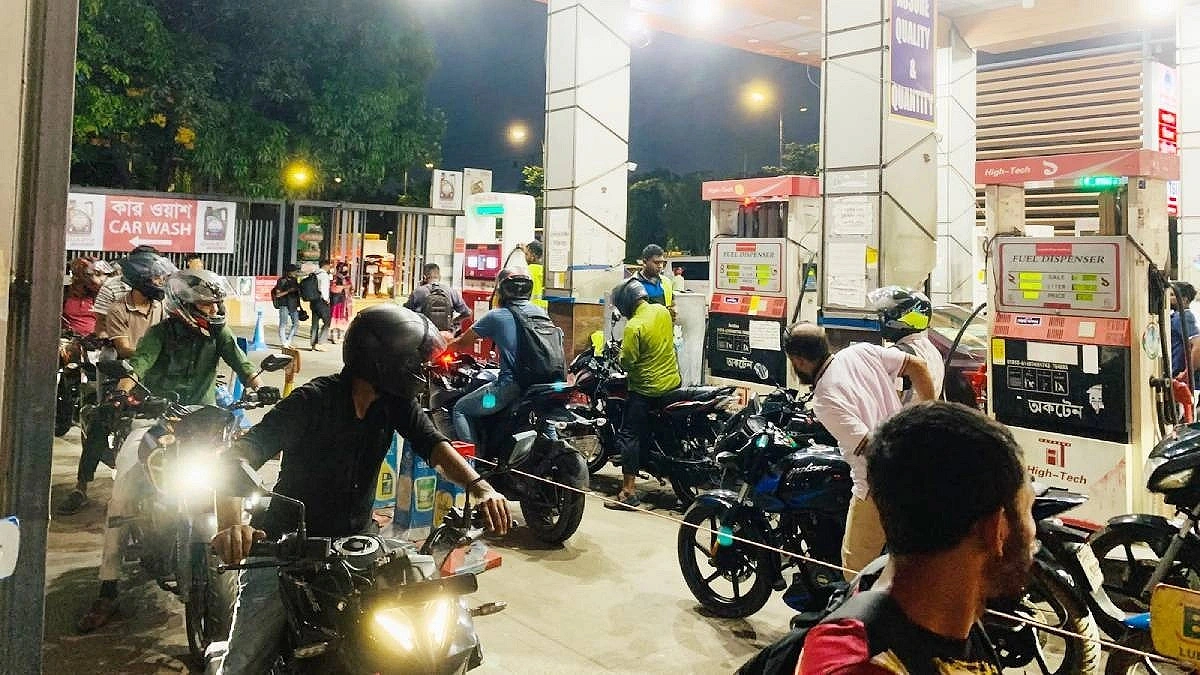
Ride sharing drivers are refueling. Photo: Agamir Somoy.
A Tk 20 per liter increase in fuel prices has thrown ride-sharing drivers into fresh darkness. Despite higher fuel expenses, their income has not increased. As a result, while operating costs per trip have risen, ride fares remain unchanged, leaving drivers with little to no money at the end of the day.
Compounding the problem is a declining number of passengers, as many are reluctant to pay higher fares. Consequently, drivers are being forced to get by on cut earnings.
Selim Hossain works at a private firm and drives for a ride-sharing service on the side to meet household expenses, which amount to around Tk 40,000 to Tk 42,000 a month.
Expressing anger over the added expenses following the fuel price hike, Selim said, "My monthly expenses are around 40,000 to 42,000 taka. But my income isn't increasing. Instead, prices of daily goods keep rising, and so do expenses. On top of that, I wake up in the morning only to hear that fuel prices have gone up."
Selim shared that he earns Tk 150 to Tk 200 per trip. However, after dropping off a passenger, he often has to wait nearly an hour to find the next trip.
If he buys a snack during this waiting time, it adds to his expenses. As a result, a major portion of the earnings from a single trip goes toward daily personal costs.
Selim added, "Right now, if I complete a trip, I earn 150 to 200 taka. But after dropping a passenger, it takes almost an hour to get a return trip. If I have a snack during that time, it incurs extra cost. It turns out that around 100 taka goes into expenses per trip. So, how much is actually left?"
Selim noted that the day fuel prices were raised marked his lowest daily earnings in the past two months, adding that daily income and expenses are never constant.
In his words, "Every day is not the same. But today was the lowest I've earned in the last two months. And when you earn less, you don't feel like spending more."
He mentioned that he usually buys fuel based on his daily requirement. On the day the price increased, he bought fuel once in the morning and did not visit a filling station again.
Meanwhile, Obaidullah, another ride-sharing driver, was waiting with his motorcycle at Bijoy Sarani. By the end of the day, he had earned only Tk 300.
According to Obaidullah, passenger numbers dropped following the fuel price hike, leading to a fall in income. He said, "Because of the fuel price hike, customers aren't even coming today. They aren't negotiating fares either. Fares haven't been increased on the ride-sharing apps, and when passengers try to go directly, they refuse after hearing a higher fare."
When asked if his motorcycle requires more fuel due to the higher price, Obaidullah explained that the fuel requirement remains the same, but buying the same quantity now costs more money.
Obaidullah said, "The fuel required is still the same. It's just that more money will be spent. Where I used to manage three days on 1,000 taka, I will now probably manage only two."
On September 20, the price of fuel was increased by Tk 20 per liter, with the new rates taking effect from midnight on September 21.
Since then, concerns over rising expenses have grown across various professions. However, ride-sharing drivers—who directly rely on fuel—are facing a much harder impact.
Although their fuel costs have surged, app-based ride fares remain unchanged, creating a widening gap between their income and expenses.
Standing with his motorcycle next to Obaidullah at Bijoy Sarani was another driver, Kabir Mia. He noted that fares on Uber have not increased compared to before, leading him to decline many ride requests coming through the platform.
Kabir Mia said, "If anyone calls through Uber or Pathao now, I don't accept it. Fares on Uber are too low to cover costs. Instead, I just take direct passengers for whatever price we agree on."
The fuel price hike has also affected petrol pumps. Rabbi, an employee at the Trust Fuel Pump near Bijoy Sarani, shared that the station experienced unusually heavy crowds the night before the price increase took effect.
He added that while the crowd was thinner the following morning, people began lining up to refuel again during afternoon office-closing hours.
