
Fuel prices could have been raised in phases

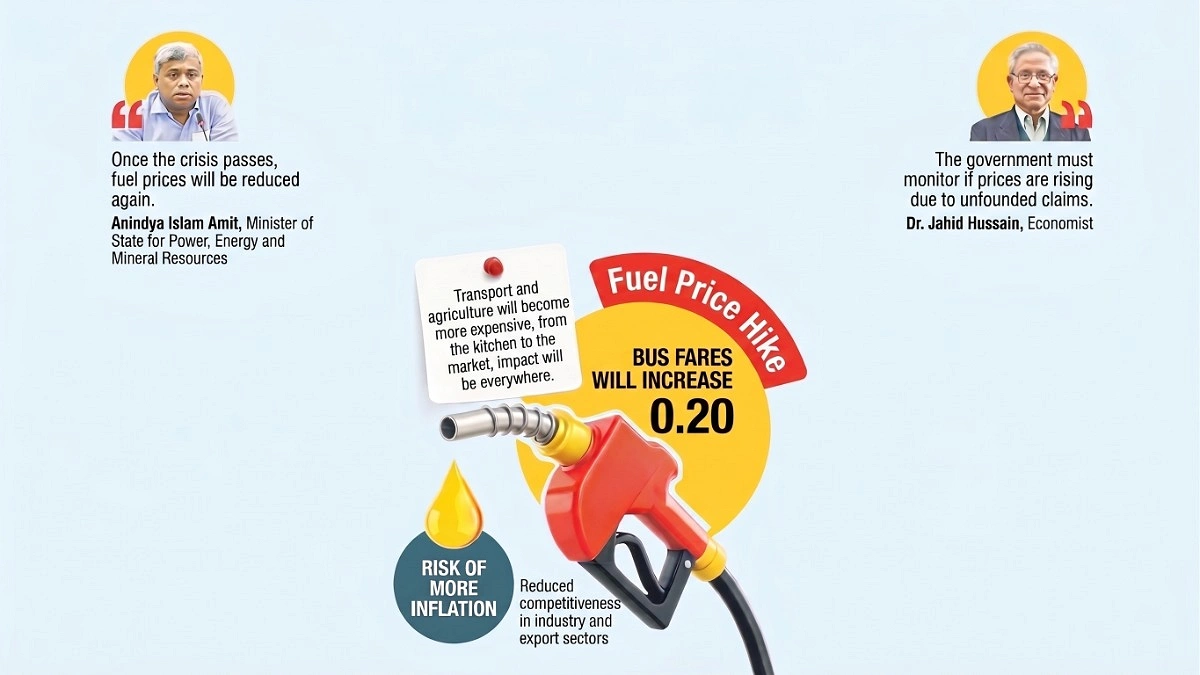
Graphics: Agamir Somoy
The government has said it was forced to raise the prices of four types of fuel due to an abnormal increase in fuel import costs caused by global factors. It also cited the need to reduce pressure on foreign exchange and lower the risk of fuel smuggling through the border.
Experts have also said the government had no alternative to raising prices due to extreme volatility in the global fuel sector. However, they said the increase could have been kept lower through some measures. Alternatively, prices could have been raised gradually instead of in a single step. They have advised the government to learn from the situation and work toward sustainable energy security in the future.
Professor Dr. M Shamsul Alam, energy adviser to the Consumers Association of Bangladesh (CAB), said the government and the energy division do not consider many available alternatives.
He told Agamir Somoy that when prices of other products rise in the global market, VAT and government revenue collection are sometimes reduced. But this is not done for essential products such as fuel.
Under the law, the Bangladesh Energy Regulatory Commission has the authority to determine fuel prices. Prices are supposed to be set fairly through public hearings. But instead of following that process, the government raises fuel prices at its discretion in the middle of the night. As a result, consumer rights are being undermined.
Referring to various allegations of bribery, irregularities and corruption against officials and employees of Bangladesh Petroleum Corporation (BPC), he said there is a lack of transparency in BPC’s financial accounts.
International organizations have repeatedly proposed conducting standard audits but this has not been done. On one hand, the corporation reports losses. On the other hand, its employees receive bonuses worth hundreds of thousands of taka. If these practices were stopped, the pressure of government subsidies would not have increased so much.
Economist and researcher Jahangir Alam Khan told Agamir Somoy that the fuel price increase will have negative impacts across all sectors.
Alongside rising fuel prices in the global market, the government has also faced pressure from salary increases of up to 140 percent for government employees. As a result, fuel prices have increased. He said the pressure could have been avoided if salaries had not been increased at this time.
Bangladesh Petroleum Corporation (BPC) said it has borrowed around Tk 19,500 crore from banks this year to meet fuel import costs. It currently has around Tk 12,368 crore in its bank accounts. However, nearly Tk 20,000 crore is required to cover two months of import costs.
At the current international market price, BPC is incurring a loss of around Tk 89 per liter on diesel. This amounts to a daily loss of around Tk 109 crore. Annual losses from diesel alone could reach Tk 40,000 crore. The energy division said that raising the price by Tk 20 per liter would reduce BPC’s annual losses by Tk 10,000 crore.
Energy expert Professor Dr. M Tamim told Agamir Somoy that all countries around the world are suffering from high energy costs. The government is also having to provide huge subsidies for LNG along with fuel. It is impossible for the government to provide such large subsidies. Therefore, there is no alternative to raising prices.
This will put severe pressure on the economy and increase people’s hardship. Fuel consumption will decrease. However, the expert believes that if the government reduced the VAT and taxes imposed on fuel imports, prices would not have needed to be raised by so much.
The total tax burden on diesel imports is currently around 34 percent. An alternative proposal was discussed as recently as April this year that could have limited the extent of the price increase.
In 2022, when international oil prices increased, India reduced the central excise duty on petrol and diesel. In March this year, amid severe volatility in the international market, India also reduced the excise duty on both petrol and diesel by 10 rupees per liter.
Instead of providing equal subsidies for all types of fuel, there was an opportunity to provide needs-based subsidies. As diesel and kerosene are used more widely, subsidies on these two types of fuel could have been increased to keep their prices at a more tolerable level.
There was also an opportunity to convert fuel subsidies into direct assistance for poor people. In 2022, Indonesia transferred part of its fuel assistance directly to poor and vulnerable families.
Experts believe that instead of increasing the price by Tk 20 at once, making small adjustments over several months would have reduced the shock to the market.
The government cited the risk of smuggling to neighboring countries as one of the main reasons for the current price increase. In this case, border-based price and supply management could have been strengthened.
Other measures could have included limiting fuel use in government offices, improving efficiency, reducing costs in BPC’s procurement and supply systems and preventing waste, irregularities, corruption and opportunities for middlemen in the supply chain.
Shafiqul Alam, Bangladesh’s lead energy analyst at the Institute for Energy Economics and Financial Analysis, believes that the country’s growing dependence on fuel imports for a long time has left the government with no alternative to raising prices.
He advised increasing the use of electric vehicles and renewable energy to reduce fuel consumption. He also called for domestic gas exploration to ensure sustainable energy security.
According to BPC’s financial reports, the corporation made a profit of Tk 4,212 crore in fiscal year 2014 15 after six consecutive years of losses. It made a profit of Tk 7,753 crore in fiscal year 2015 16 and Tk 4,551 crore in fiscal year 2016-17.
During this period, fuel prices in the domestic market were reduced on April 25, 2016. BPC made a profit of Tk 6,533 crore in fiscal year 2017-18.
Including VAT, taxes, dividends and surplus funds, BPC deposited a large amount of money into the government treasury.
In addition, officials and employees shared interest earnings as bonuses after keeping money deposited in various banks. Employees of three distribution companies, Padma, Meghna and Jamuna, have a record of receiving profit bonuses of up to Tk 16 lakh a year.
In addition, multistory buildings are being constructed in Dhaka and Chattogram at a cost of hundreds of crores of taka. Sector insiders believe that if these unnecessary expenses could be controlled, the corporation could have continued operating without raising prices during unstable periods or by increasing them to a tolerable level.
Experts have also raised objections to the automatic formula used to adjust fuel prices in line with global market prices. According to them, the formula has been set by including VAT, taxes and profit. As a result, regardless of the price set, BPC always makes a profit.
Meanwhile, at a briefing at the Secretariat yesterday, State Minister for Power, Energy and Mineral Resources Anindya Islam Amit said the government had no alternative to adjusting fuel prices amid the extreme increase in global fuel prices caused by instability in the Middle East.
He sincerely apologized for the hardship that the price increase would cause ordinary people. The state minister expressed hope that the current situation is temporary. He said fuel prices would be reduced again once the crisis subsides.
In response to questions about the justification for the current price increase compared with the past and questions about BPC’s funds, he said BPC had been able to absorb massive losses of nearly Tk 23,000 crore without raising prices for so long because the corporation had money saved in its fund during this unprecedented crisis in the Middle East.
