


5-Year Strategic Plan
Unemployment allowance under consideration

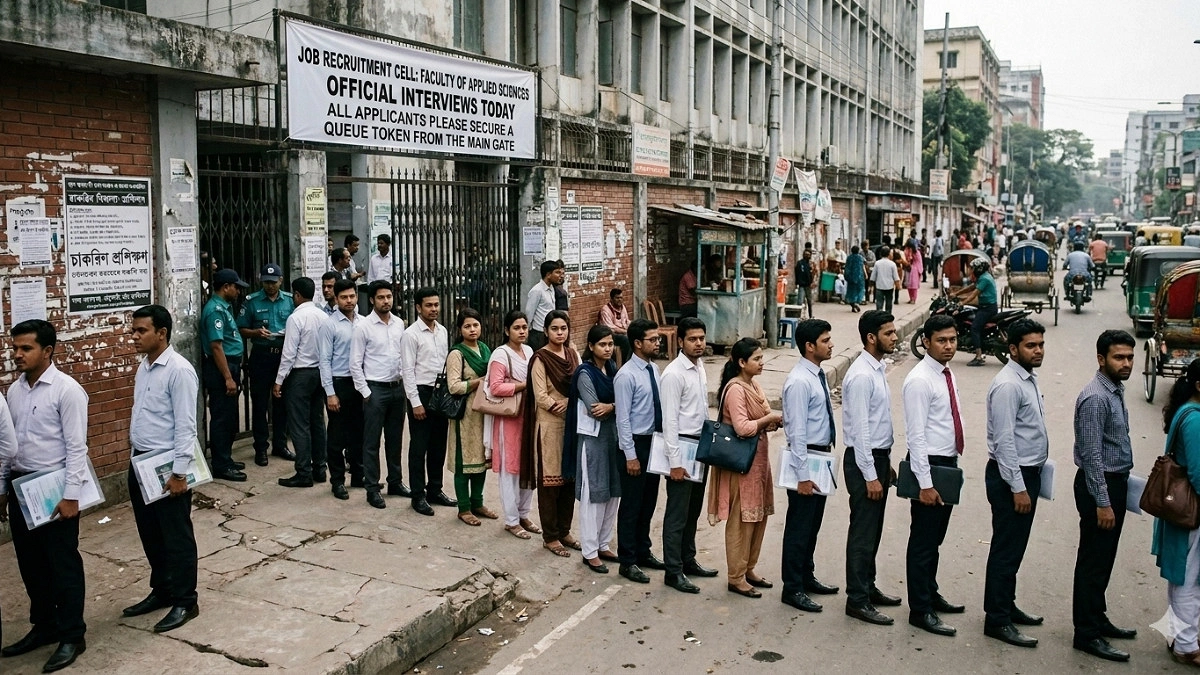
Representational Image drawn by AI.
The government is planning a major restructuring of its social safety net programmes to ensure they are more realistic and genuinely beneficial to people.
Under the initiative, the existing 123 programmes are expected to be reduced to around 15. The reform plan includes introducing unemployment allowances, creating a pension fund for private-sector employees, launching e-health cards, providing low-cost medicine for critical diseases, and establishing a special fund for orphans, among other measures. These initiatives will be incorporated into a “Five-Year Strategic Framework” being prepared to run up to 2030.
Some of the proposed initiatives have already begun implementation as part of election manifesto commitments. The framework is being developed by the General Economics Division (GED) of the Planning Commission.
Speaking on the matter, Dr. Mostafa K Mujeri, Executive Director of the Institute for Inclusive Finance and Development (InM), said it is currently difficult even to determine the exact number of social safety programmes in operation. Some estimates say 123, while others suggest around 140. He noted that managing such a large number of programmes is beyond the country’s capacity, leading to irregularities, corruption, and inefficiency in beneficiary selection and fund distribution. According to him, most of these programmes have therefore not been fully effective. Reducing them to 10–15 programmes would make implementation easier and ensure that truly deserving people receive support.
Under the proposed plan, unemployed educated youth would receive a financial allowance for up to six months while they search for jobs, extendable up to one year. This assistance is expected to provide temporary relief and help them sustain themselves during unemployment.
The strategy also proposes the creation of a pension fund for private-sector employees, alongside an increase in pension benefits. It includes raising allowances for the destitute, widows, divorced women, and vulnerable elderly citizens.
In the health sector, the framework proposes introducing an e-health card for every citizen, which would provide instant access to healthcare services. Free primary healthcare is also expected to continue.
GED member (Secretary) Dr. Manjur Hossain said that these new ideas have been taken from the government’s election manifesto and were presented at the first meeting of the advisory committee. He emphasized that the strategic plan will include implementation guidelines for these proposals and may also introduce additional programmes aimed at improving public welfare through practical and realistic planning.
Under the proposed plan, primary healthcare services will be significantly expanded across the country. One primary healthcare centre will be established in every union, while urban wards will have one or more such centres depending on need. In addition, the government plans to recruit 100,000 new healthcare workers, 80 percent of whom are expected to be women.
The strategic framework also outlines provisions for free medicine and vaccination services. It proposes nationwide free supply of essential medicines for primary healthcare, along with low-cost treatment for serious illnesses. Medicines for complex conditions such as cancer, stroke, and diabetes are expected to be included in this support system.
To improve services for persons with disabilities, the plan includes free transportation on buses, trains, and launches for people with special needs. It also proposes the establishment of specialised healthcare centres and schools at the district level. Alongside this, a dedicated fund for vulnerable and orphaned individuals will be created, called the National Maintenance Fund, which will help ensure access to free education, employment opportunities, and essential services.
According to official sources, around 123 social safety net programmes are currently being implemented through 24 ministries and divisions. Major programmes include old-age allowances, widow allowances, disability allowances, and freedom fighter stipends. In total, nearly 49.1 million people receive cash or food support under these schemes.
In the 2025–26 fiscal year, the budget allocation for the social security sector stands at approximately 116,731 crore taka.

