


Bangladesh’s organic boom built on deception, not safety

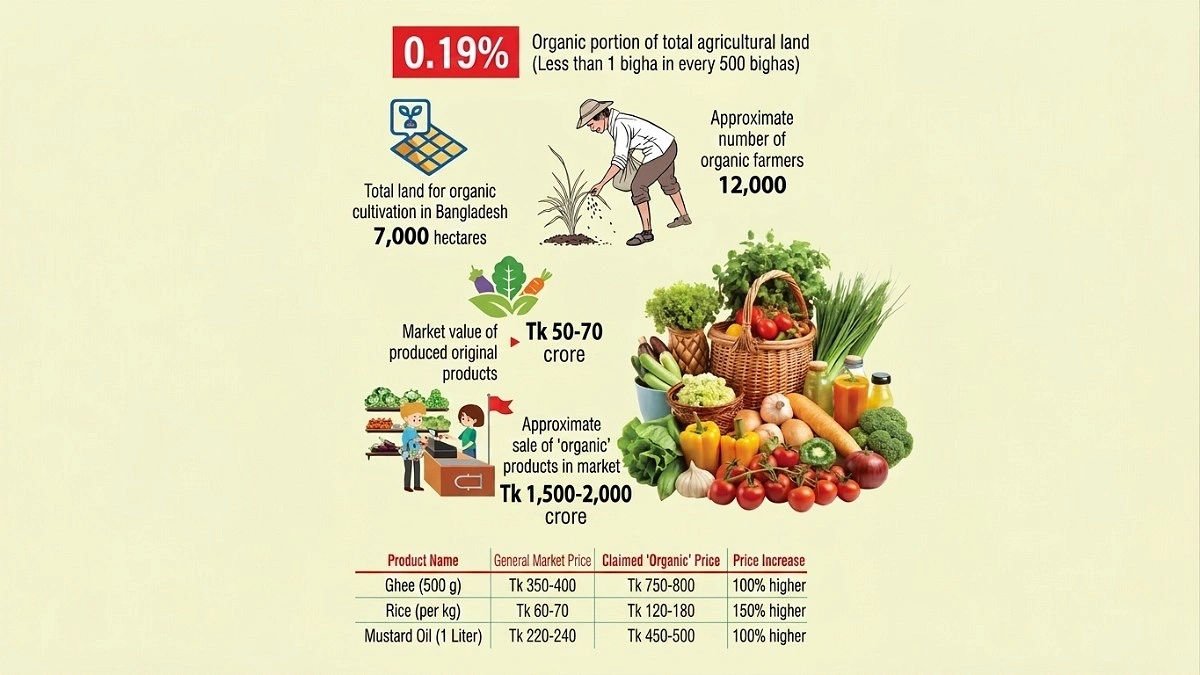
Graphics: Agamir Somoy
As the demand for safe options grows, the “organic” product market is expanding rapidly, with consumers paying several times the general market price for items such as organic rice, lentils, vegetables, and fish.
From the narrow alleys of Dhaka to super shops, online platforms, and social media, countless “organic” shops have emerged. Market analysts estimate the size of the domestic market to be several thousand crore taka, yet the most critical question remains: who will verify if these products are truly organic?
While various countries have strict laws, specific standards, independent certification bodies, laboratory verification, and product identification systems, Bangladesh lacks a specific legal definition for organic products.
As a result, there is no effective framework to hold anyone accountable if they purchase items from a general market, apply an attractive packet and an “organic” sticker, and sell them at an inflated price. Consumers, hoping for safety, risk falling into an adulteration trap.
Md Nazim Uddin, senior scientific officer at the Bangladesh Agricultural Research Institute (BARI), said, “Consumers want to buy toxic-free and safe food even at higher prices.”
He added that dishonest traders exploit this demand for extraordinary profits and suggested that Bangladesh needs an independent, multi-stakeholder board similar to the “National Organic Standards Board” in the United States, which was formed to tackle a crisis of unverified, fake organic labels.
The demand for these products is fueled by increasing public health risks and anxieties regarding excessive pesticides and formalin in conventional food. However, the state’s weakness in ensuring safe food has allowed a deception market to flourish.
Although the government formulated the “National Organic Agriculture Policy” in 2016, which called for a certification body, that institution has not become functional nearly a decade later. This lack of an institutional system means there is no reliable way to identify organic producers or products.
Bangladesh’s position in organic certification on the International Federation of Organic Agriculture Movements (IFOAM) global list is virtually zero.
A massive inconsistency exists between production and supply; organic farming occurs on only 0.19 percent of the country’s agricultural land, meaning less than one bigha out of every 500 is cultivated organically.
With only about 7,000 hectares of organic land and 12,000 farmers, it is unclear how the vast supply seen on Facebook pages and in shops is maintained. Stakeholders fear that general market products are simply being repackaged and relabeled as “organic”.
This cheats consumers twice: they remain exposed to chemical risks while paying a premium price. Even genuine organic farmers face challenges, as chemicals from neighboring fields can reach their land through air, irrigation, or groundwater.
BARI data shows many farmers use excessive chemicals due to adulterated pesticides and lack of training, making it scientifically difficult to claim any crop is “100% chemical-free”.
Public health expert and epidemiologist Mushtuq Husain said, “Claiming a product is ‘toxic-free’ or ‘organic’ without using toxic-free production methods should be punishable.”
Experts believe fraud cannot be stopped solely through raids on retail shops; monitoring must begin at the production level. This requires a coordinated effort from the Department of Agriculture, as well as the Fisheries, Livestock, and Water Resources authorities.
In contrast, the United States utilizes the “Organic Foods Production Act, 1990” and the USDA’s “National Organic Program” to determine standards, with punishments and fines for violations. European Union uses the “Euro-Leaf” logo, while India employs the “Jaivik Bharat” logo and the “PGS-India” certification system to ensure identity. China also maintains a traceability system for consumers to track the origin of their food.
The absence of such a framework in Bangladesh is a major weakness that leaves genuine organic farmers without assurance while allowing dishonest traders to use “organic” as a high-priced marketing tool.
This is not just a financial issue but a public health concern. While the actual organic production in the country is valued at Tk 50-70 crore annually, the total sales of products labeled “organic” are estimated at Tk 1,500-2,000 crore.
The price markups are significant: ghee that costs Tk 350-400 is sold for Tk 750-800 as “organic,” rice jumps from Tk 60-70 to Tk 120-180, and mustard oil increases from Tk 220-240 to Tk 450-500.
These price hikes raise the question of whether a large trade is being built behind a mask. Establishing a genuine organic market requires four essentials: law, independent certification, laboratory verification, and a reliable identification system. Without these, the word “organic” remains a tool for inflated pricing.

