
10,000 Mongooses Gone: How Japan Won a 30 Year Battle on Amami Oshima


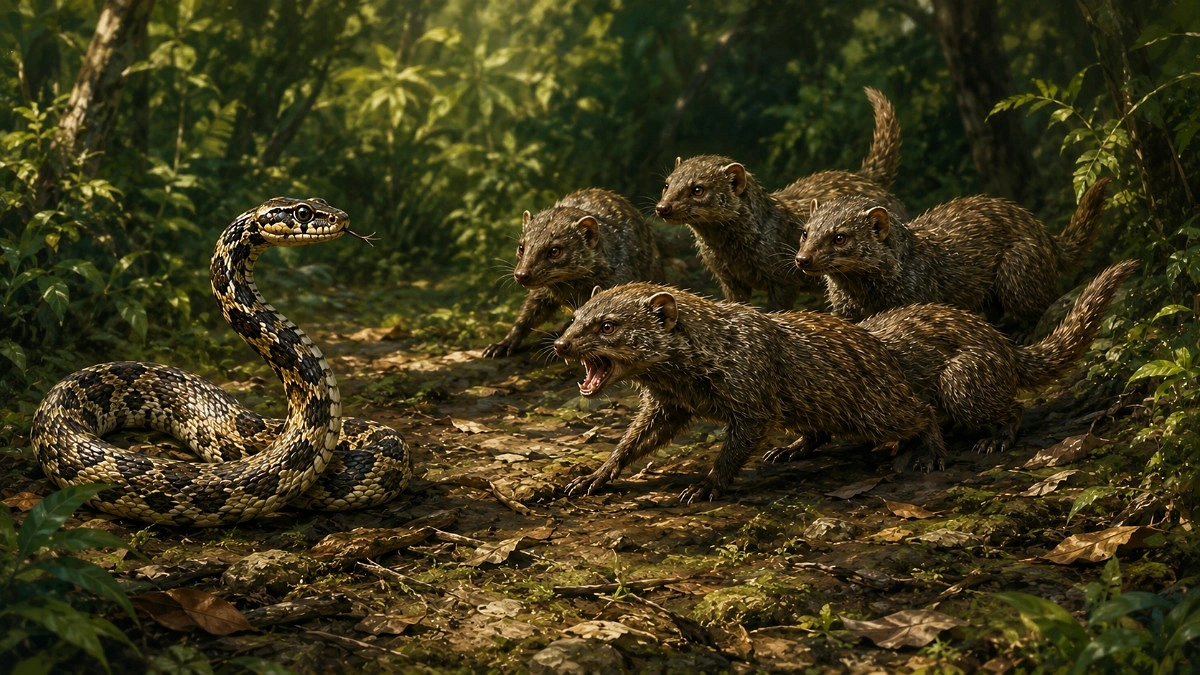
Picture: Generated by AI
For nearly half a century, a small, sharp toothed predator ruled the forests of a subtropical Japanese island where it never belonged. On September 3, 2024, that reign officially ended. Japan’s Ministry of the Environment declared that the small Indian mongoose had been completely eradicated from Amami Oshima, a UNESCO World Heritage Island in Kagoshima Prefecture. Officials called it a miracle. Scientists called it a world first. And for the island’s endangered rabbits, it meant survival.
This is the story of how one of the most ambitious invasive species removal campaigns in history unfolded, why it was needed in the first place, and what it actually cost to undo a mistake that began in 1979.
A Cure That Became the Disease
Amami Oshima sits in the Ryukyu Islands chain, a lush, biodiverse landmass covering about 712 square kilometers. It is home to species found nowhere else on Earth, most famously the Amami rabbit, a dark furred, short eared animal often described as a living fossil because of its primitive features. The island also harbors the habu, a venomous pit viper whose bite can be fatal to humans and which has long been feared by local residents.
In the late 1970s, Japanese authorities came up with what seemed like a practical solution to the habu problem. About 30 small Indian mongooses were released on the island in 1979, brought in specifically to hunt and control the snake population. The idea was not entirely new. Japan had already introduced mongooses to Okinawa’s main island decades earlier, in 1910, for the same purpose.
The plan rested on a basic assumption that turned out to be wrong. Mongooses are diurnal animals, active during daylight hours. Habu snakes are nocturnal hunters. The two species rarely crossed paths. Instead of taking on the vipers, the mongooses found an easier and far more vulnerable target: the Amami rabbit, along with other native birds, amphibians, and reptiles that had evolved for millions of years without any mammalian predators like this one.
Freed from natural checks and with abundant prey, the mongoose population exploded. By around the year 2000, estimates placed the number of mongooses on the island at roughly 10,000. The Amami rabbit, already rare, saw its numbers drop sharply, and it was eventually listed as endangered on the International Union for Conservation of Nature red list.
Building an Army Against a Predator
Japan’s response began in 1993 with an experimental control project, and it was fully scaled up by 2000 into a sustained, island wide eradication campaign. This was not a small undertaking. Authorities eventually deployed around 30,000 traps across the island and installed sensor cameras to track mongoose movement in even the most remote forest areas.
Perhaps the most distinctive part of the effort was human. A dedicated field team known locally as the Amami Mongoose Busters was formed, made up largely of local residents who walked the island’s terrain checking traps, tracking signs of mongoose activity, and later working alongside specially trained detection dogs that could sniff out the last remaining animals when their numbers dwindled to a handful.
The campaign moved in stages. Early years focused on reducing the bulk of the population across the island’s forests and farmland. As numbers fell, the work became harder rather than easier, since finding the last few animals in dense subtropical terrain required far more effort per capture than clearing out the bulk of a large population. Over nearly two decades, the team captured a total of about 32,600 mongooses.
The final capture came in 2018. From that point on, despite continuous monitoring with traps and cameras across the island, not a single mongoose was detected for six straight years.
Declaring Victory, Carefully
Proving that a species has been completely wiped out from a large, complex landscape is scientifically difficult. You cannot simply point to zero captures and call it done, because absence of evidence is not automatically evidence of absence, especially across an island of this size. So before making any declaration, Japan’s Ministry of the Environment convened an expert examination panel to assess the probability of true eradication using data collected through the end of fiscal year 2023.
The panel applied two separate statistical models to estimate how likely it was that the mongoose population had truly been eliminated rather than simply reduced to an undetectable few. One model, based on the area searched, produced a probability of 99.7 percent. A second model, based on capture numbers, produced 98.9 percent. Both figures were considered high enough for the panel to conclude that eradication had, from a scientific standpoint, been achieved.
Based on that conclusion, combined with input from relevant authorities, the Ministry of the Environment made its formal declaration on September 3, 2024. Kagoshima Governor Koichi Shiota welcomed the announcement as genuinely good news for the prefecture and for the conservation of Amami’s ecosystem, while also noting the lessons the island had learned about the damage invasive species can cause and the effort required to reverse it.
Conservationists outside Japan took note too. Piero Genovesi, who chairs the IUCN Species Survival Commission’s Invasive Species Specialist Group, described the achievement as a groundbreaking demonstration of what sustained commitment can accomplish in the fight against invasive species. The scale of the achievement is part of what makes it notable. Amami Oshima is far larger than most islands where mammal eradication programs have previously succeeded, and it remains inhabited by tens of thousands of people, which makes the logistics of a total wildlife removal campaign considerably more complicated than clearing an uninhabited island.
Even after the declaration, the work was not entirely finished. Monitoring continued for several more months as a precaution, and the removal of all remaining mongoose traps across the island was completed on February 7, 2025, formally closing out the physical infrastructure of a program that had run for roughly three decades.
What It Cost, and What It Was Worth
The financial side of the campaign has since been studied in detail. According to an analysis published in the conservation journal Oryx, the total cost of the mongoose control and eradication program from 2000 to 2024 came to approximately 23.82 million US dollars, or about 3.57 billion Japanese yen.
That is a significant sum for a wildlife management program, but researchers who evaluated the project’s broader impact found that its benefits far outweighed its price tag. The same analysis estimated the social benefit generated by the program, factoring in ecological recovery and value to the public in Japan, at more than 1.69 billion US dollars, equivalent to roughly 253.9 billion yen. Broken down per person among the beneficiary population in Japan, that works out to about 16.93 US dollars, or 2,539 yen, per individual.
In other words, researchers concluded that for every dollar spent removing mongooses from Amami Oshima, the return in ecological and social value was dramatically larger, making the case that early, sustained investment in invasive species control can pay for itself many times over even when the initial price looks steep.
A Rare Win, With a Cautionary Neighbor
The success on Amami Oshima stands in sharp contrast to the situation on Okinawa’s main island, where mongooses were introduced even earlier, in 1910, and where no realistic prospect currently exists for full eradication. Control measures in the northern part of Okinawa are showing gradual progress, but the mongoose population there is considered too widespread and too deeply established for a clean removal along the lines achieved on Amami Oshima.
That contrast is part of why the Amami Oshima case is being studied closely by conservationists internationally. Amami Oshima, along with Tokunoshima Island and parts of Okinawa and Iriomote Island, was inscribed as a UNESCO World Natural Heritage Site in 2021, largely because of its unique biodiversity, the very biodiversity that the mongoose invasion had threatened to unravel. With the predator gone, researchers and local officials are now watching closely to see how the island’s native species, including the Amami rabbit and other threatened amphibians and reptiles found only in the region, respond and recover over the coming years.
For now, Amami Oshima stands as proof that even a mistake nearly fifty years in the making can be undone, given enough patience, enough traps, and enough people willing to walk the forest floor searching for an animal that was never supposed to be there.
Sources: Ministry of the Environment, Government of Japan; Oryx (Cambridge University Press); The Japan Times; AFP/Gulf News; explore.amami; Indianapolis Zoo Conservation Blog.
