
Primary teachers' transfers postponed indefinitely

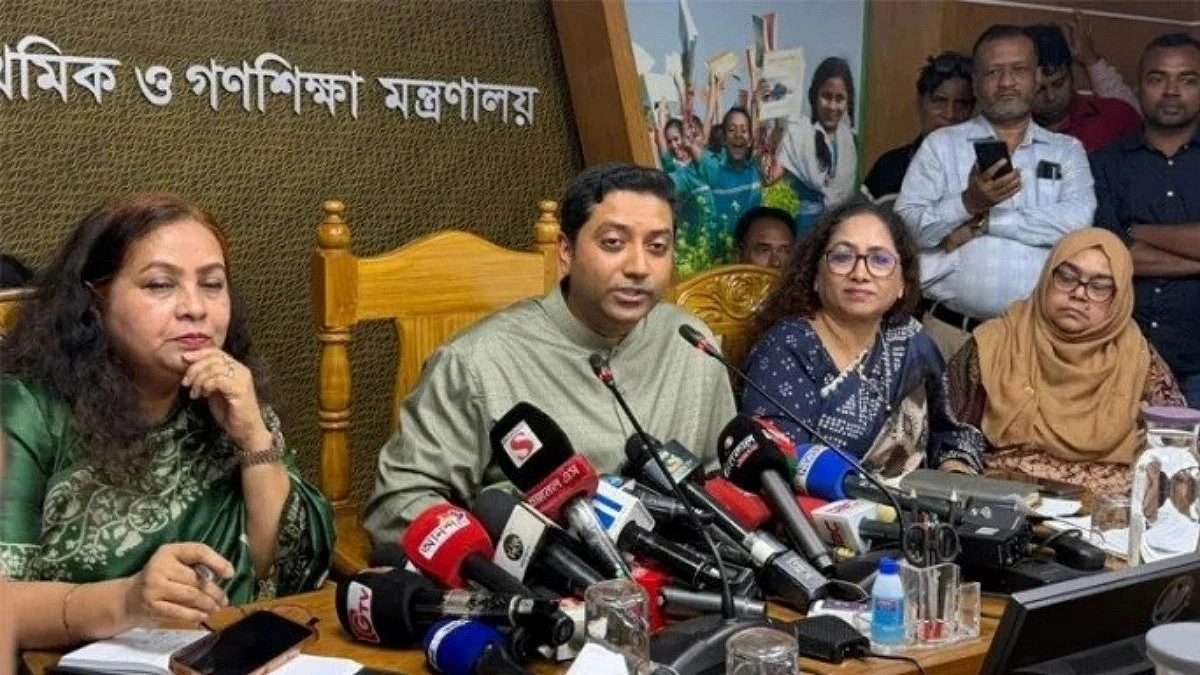
State Minister for Primary and Mass Education Bobby Hajjaj speaks at a press briefing held at the Secretariat on Monday — Photo: BSS
The transfer process for primary school teachers has been suspended from Monday (September 7). The transfer will resume after the placement of over 14,500 newly appointed teachers is completed.
However, a decision will be made at that time on whether transfers will continue under the existing policy or whether a new procedure will be introduced.
This information was announced today (Monday) at a press conference held at the Secretariat on the occasion of International Literacy Day by State Minister for Primary and Mass Education, Bobby Hajjaj. He said, "During the period of holding transfers suspended, the placement of new teachers will be completed. After that, considering the situation, a subsequent decision will be taken regarding the transfer process."
Regarding the appointment of head teachers, the State Minister said, "The court's verdict on this matter has been received. Discussions are ongoing with the Bangladesh Public Service Commission (PSC) regarding subsequent actions, including grade determination. It may be possible to announce the results within the next one to one and a half months. There is a need to appoint over 34,500 head teachers across the country."
Meanwhile, the government has set a target to raise the country's literacy rate to 86–90 percent by 2031. According to the Labour Force Survey 2024, the literacy rate among the population aged 7 years and above is 78.98 percent.
The State Minister informed that literacy is no longer being viewed merely as the ability to read, write, and calculate; it is being linked with skills and employment. In the district headquarters of all 64 districts, 5,120 drop-out youth aged 15–24 years are being provided with 460 hours of effective literacy and skills training. Among the registered 4,312 individuals, 4,198 have passed as competent. Of them, 92.47 percent have found some form of employment connection.
Additionally, plans are in place to provide education up to the fifth grade to 19,200 out-of-school children in 64 upazilas, and livelihood skills to another 19,200 youth. In the second phase, another 4,000 adolescents will be trained across 50 districts.


